
AI job losses and video games: Amodei’s idea leaves the rent unpaid
An old video game idea from Dario Amodei’s OpenAI years has sparked debate. Readers asked who would pay the rent; his own essay also says livelihoods are the harder problem. Leisure after AI needs economic security and choice.
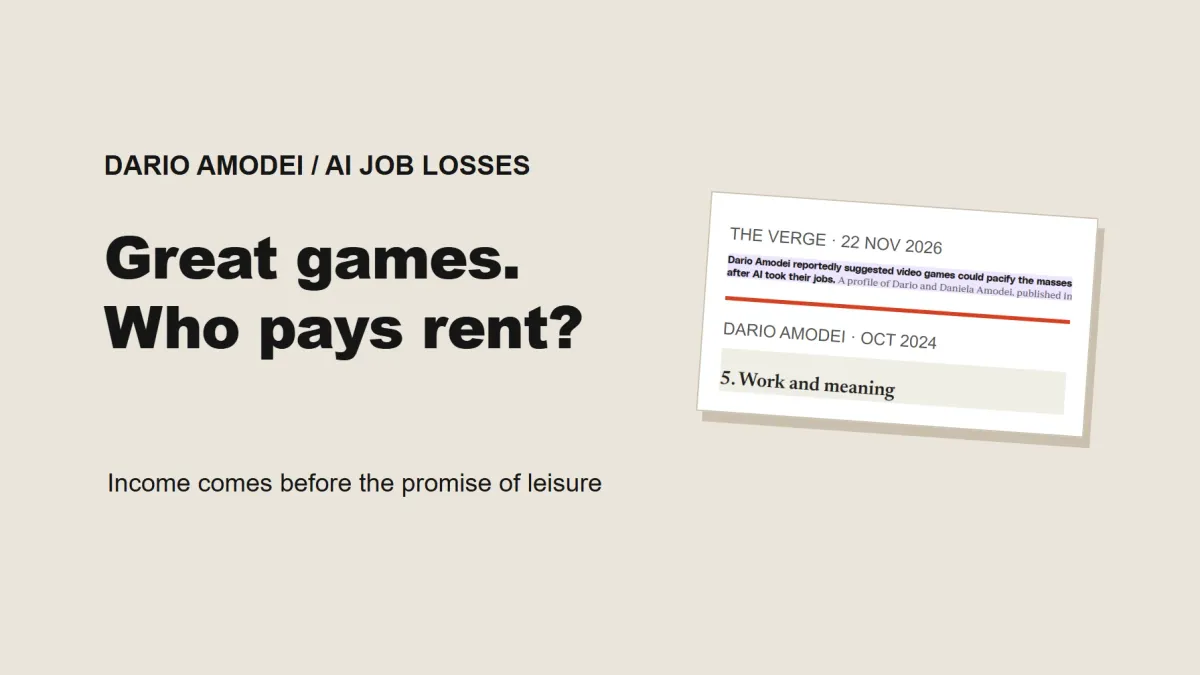
Amodei once considered using immersive video games to ease political conflict arising from AI-driven job losses. On November 22, The Verge editor Terrence O’Brien recounted this old discussion from Amodei’s OpenAI years, citing a Wall Street Journal profile. The report drew on Slack messages that circulated widely inside the company at the time.
After AI takes away their jobs, can people find fulfillment in immersive games? An old idea from Anthropic CEO Dario Amodei has recently put that question before readers. The central objection is straightforward: games can be great fun, but people who lose their wages first need money to live on.
That old discussion touched on workers’ most immediate concern about AI. Companies talk about efficiency, technology leaders talk about future lifestyles, and people think about their next paycheck. Put those questions together and disagreement is almost inevitable: between finding fulfillment without a job and surviving without an income lies an entire system of economic support.
AI job losses: the comments ask who pays the rent
In Reddit’s Futurology community, user Gari_305 shared the report. The replies quickly moved beyond whether games have value to the question of everyday bills.
MyUsernameIsAwful’s point was blunt: unless playing games pays, boredom is not the most urgent problem after losing a job. Shawn_NYC asked about rent, groceries, healthcare and childcare, while fudgepuppy took the question a step further: games and hardware cost money too, so how would people buy them?
Before people can enjoy leisure, they need money to live on. For someone with a steady income, a few extra hours can mean time for games, exercise or friends. For someone who has lost their income, those same hours may be filled with job searches, bills and anxiety. Both calendars may say “time off,” but the circumstances are entirely different.
PaxNova, meanwhile, said they liked working because it let them help others, and losing that would make them sad. Others were willing to embrace more entertainment if a basic income were in place. Some cared about living costs, others about the sense of usefulness work provides, and some really did want to work less and play more games.
The disagreement is also about choice. Games can offer challenges, cooperation and real fulfillment. The question is whether an activity people freely choose can answer a predicament imposed by the need to make a living.
A player choosing to spend an evening finishing a game and someone being advised to fill their days with games after losing a job may appear to be doing the same thing. The freedom behind those choices is very different.
Amodei has also distinguished livelihoods from meaning
Amodei himself has addressed the income problem.
In Machines of Loving Grace, published in October 2024, he specifically discussed work and meaning in the AI era. Section five first explains that games, sports and spending time with friends can already give people meaning; nobody needs to prove they can outperform AI to deserve enjoyment from those activities.
More significantly, he then explicitly acknowledged that economic livelihoods are harder to address than meaning. He envisaged that, as AI becomes sufficiently cheap and powerful over the long term, society would need to reconsider how the economy is organized. He also mentioned universal basic income—the idea of providing everyone with a basic income—but saw it as only a small part of the solution, with the details still requiring experimentation.
After losing a job, some people suffer most because they cannot pay their bills; others also lose familiar colleagues, daily routines and a sense of achievement. People with secure incomes may still need new goals; people who find new hobbies still need to eat.
If livelihoods are the harder problem, technology companies’ visions of the future cannot be concrete only when discussing entertainment and freedom, while leaving income distribution to be answered later.
Workers need to ask who bears the transition costs
For workers, the most useful part of this debate is not deciding whether they would want to play games every day. It is understanding who gets what behind each promise of greater efficiency.
When companies say AI can make the same work take less time, employees will naturally ask: will the hours saved become their leisure time, or a heavier workload? How will the gains from higher efficiency be shared? If jobs change, who bears the cost of interrupted income and the time needed to find new work?
These questions deserve discussion before a world without work arrives. Whenever someone uses future abundance to explain present-day job changes, they should spell out the path from here to that future. Nobody can use services that might become cheaper tomorrow to pay rent due today.
The reported idea of easing political conflict leaves another question: have unemployed people’s grievances been addressed, or have they simply been assigned a more tolerable existence? To judge this idea, we need to ask whether their lives improve and whether they have the right to choose another way of living.
What determines whether this is a good future is not how realistic the games become. It is whether people can pay their bills, then decide for themselves whether to put on a headset.
Further reading
- Terrence O’Brien: report on Amodei’s video game idea (The Verge)
- Dario Amodei: Machines of Loving Grace, section five
- Original Futurology post and comments
- Phoenix Technology’s account of the Amodei siblings’ story (republished by cnBeta)
- Berber Jin, Maxwell Zeff and Keach Hagey: profile of the siblings (WSJ)