
How to correct Claude agent memory: A wrong turn and missing contract terms
Claude fell from the same ledge three times, then found its way out of the cave after correcting a note. In another test, agents left contract terms out of a shared table. Both experiments offer lessons for anyone using Claude to pick up a project.
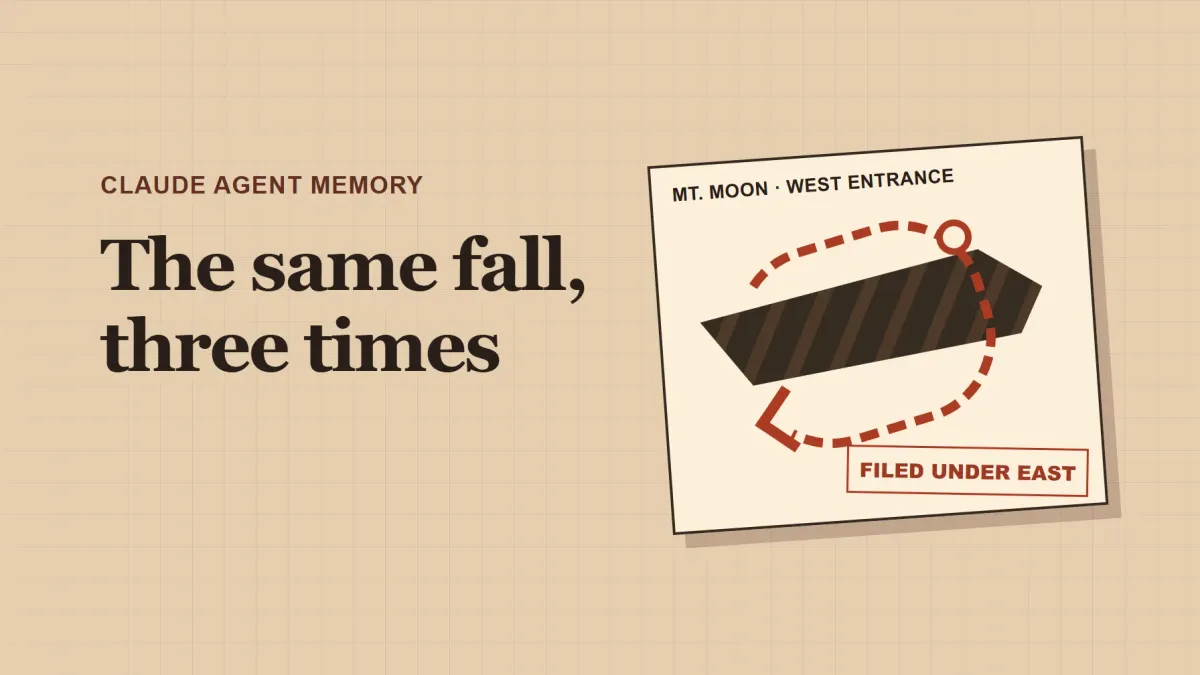
While playing Pokémon, Claude misremembered the Pokémon Center near the west entrance as being near the east exit. When it left the center, it thought it had already made it through Mt. Moon and turned away from the cave mouth. A ledge near the cave mouth can only be jumped down. Going down takes you back to the route you traveled before entering the mountain. In an experiment Anthropic published on November 6, Claude followed that note, fell at the same spot three times, and never reached Cerulean City.
The researchers ran the task again with the same erroneous note. Claude reviewed the session, corrected the Pokémon Center's location, and went back into the cave. This time it reached Cerulean City. The tech publication The Decoder revisited the research on November 16. Around the same time, Anthropic's guide to always-on agents explained how to save progress so the next session can pick up where the last one left off. At work, an unchecked note can send the next session off course just as easily.
How Claude agent memory got the route backward
Claude agent memory is material the model leaves for its next session. It can be a few lines of notes or a set of files organized by topic. When Claude went down the ledge at Mt. Moon, its navigation tool didn't show the fall. Claude saw that it was back on the west side and assumed it had simply gone too far west. As long as the note said it had already made it through the cave, Claude would leave the center the next time with the same assumption.
Anthropic calls the process of reviewing sessions and organizing and correcting notes between tasks Dreaming. First, check the messages and tool records from the original session. Then use the corrected notes in the next run. In the game, you can trace the actions to work out where Claude was. At work, if the session contains only a line saying “The client agreed,” you'll still need to go back to the client's reply to verify it. Copying the assistant's claim into memory carries the risk of treating it as confirmed into the next session.
A shared table left out 16 contract facts
The same Anthropic engineering article describes a simulated corporate acquisition. Several agents filled in contract terms in one shared table at the same time, overwriting one another's entries. Claude then drew on the table to write a briefing. Of the 57 facts the briefing was supposed to cover, only 41 made it in.
The researchers changed how the agents recorded the terms. Each contract got its own page, each page went to a single agent, and the agents kept the original wording of the clauses. A briefing written from this set of materials met all 57 grading criteria. A shared table works well for tracking progress. If a later step needs to pull a specific clause from the table, include a reference back to the source document. If a column is missing an entry, the person reading the briefing still has somewhere to look it up.
Where to leave the handoff when Claude needs to pick up the work
On November 16, a Teams user on r/ClaudeAI said Duet, Claude's assistant app, could draw on their desktop and mobile chats, but the desktop and mobile apps could not refer back to tasks the user had done in Duet. The user disabled Duet for their organization after less than three days. Anthropic's help documentation explains which tools share memory. With memory enabled, chats and cloud Cowork can share it. Projects have their own memory, and Cowork tasks that run locally don't use this cross-chat memory. To have Claude read a particular project file next time, the most direct option is to start a new session in the same project and ask Claude to open the file by name.
Suppose a client emails on Thursday to push delivery back from next Tuesday to next Friday. If you want Claude to continue writing the weekly report on Monday, leave one line in a project file it can read: “Delivery moved to Friday. The client confirmed by email on Thursday. The original Tuesday date no longer applies.” Add the email link at the end of the line. If your organization has a dedicated project tracker, make the update there once and have both tasks read it. As for whether the weekly report should have three paragraphs or four, you can ask Claude to remember your preference.