
DeepSeek chat usage costs appear: What the three figures mean
DeepSeek is showing usage costs to some web and app users, while chats remain free. The estimated amount per turn, context usage and daily allowance remaining each tell you something different.
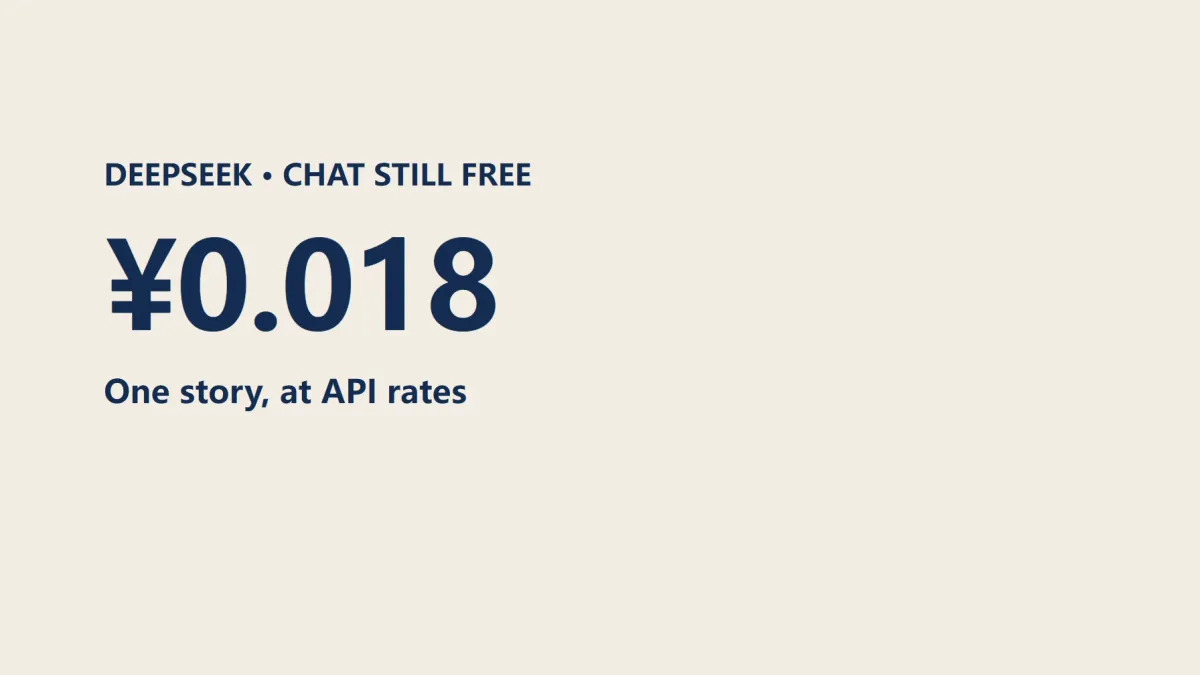
DeepSeek has started showing monetary amounts for free chats. Since November 26, some web and app users have found a new usage-details button below replies. It shows the tokens used in that turn and an estimated amount calculated at API prices. IT Home and other outlets reported on the limited rollout on November 27, prompting speculation about paid plans.
Personal chats were still free. At 2 p.m. on November 27, Hongxing Capital Bureau reporter Yang Peiwen asked, “How many hairs does a normal adult woman have?” The interface showed an estimated amount of about 0.00155 yuan, still marked free. STAR Market Daily reporter Huang Xinyi also found the new button in Android version 2.10.0. Availability remains limited: some Reddit users reported seeing it on the web but not yet on their phones.
DeepSeek's usage display lets users see how much each task consumes. For people working on writing, study or projects over multiple sessions, the more useful information is what their remaining allowance can support and how it replenishes once exhausted.
Why DeepSeek chat usage costs vary so much
A short question and a longer creative task can produce very different figures, even though each counts as one request. Yang's question used 67 input tokens and 177 output tokens. At the API's peak-time prices then in effect, the estimated amount was less than 0.002 yuan. In an article published the same day, AI Xinxi Gap described asking DeepSeek to write a short story: 249 input tokens and 4,536 output tokens, valued at about 0.018 yuan, close to two hundredths of a yuan.
A token is a small unit the model uses to process text; it does not map directly to a Chinese character. What you send counts as input, and what the model generates counts as output. A long answer can therefore increase output usage substantially even when the request itself is brief. To understand your figures, look at how much the model read and wrote in that turn, rather than simply counting your questions.
Long conversations can produce another puzzle: why are there more than 100,000 input tokens when you just added one sentence? To continue answering, the model needs the earlier conversation too. That history is included in the input, but some of it can reuse earlier computation and is recorded as a cache hit.
A screenshot of a long conversation shared by IT Home's Wenzhou showed about 185,000 cached input tokens, another 12,000 uncached input tokens and 1,470 output tokens. Together, the three amounts came to roughly 0.02 yuan. Despite the large input count, the estimated amount remained small, largely because cached input was cheaper.
DeepSeek's official off-peak Flash API prices are 0.02 yuan per million cached input tokens and 1 yuan per million uncached input tokens: cached input costs one-fiftieth as much. Its cache documentation explains that the system matches previously processed content from the start of the conversation. It can reuse a cached segment only when that entire opening segment matches. Editing earlier content can also prevent later portions from matching. The length of the history and edits to it can therefore affect the input breakdown for a turn.
The card uses the API price list to express usage as a monetary amount. That is a reference selling price, rather than DeepSeek's actual hardware, electricity and operating costs for producing the answer.
Context usage and today's allowance answer different questions
The bottom of the new details panel also shows how much context has been used through the current turn. Context is the content supplied to the model within this conversation, including earlier messages and materials. The percentage shows how much of the current conversation's capacity has been used.
The app has also displayed daily allowance reminders. AI Xinxi Gap's report showed a message saying that 22% of the day's allowance remained. This concerns how much more the user can use that day, rather than the context usage of a particular conversation: someone can start a short new chat after already consuming a large share of their daily allowance.
| Display | What it tells you |
|---|---|
| Estimated amount for this turn | What the task would cost at API prices |
| Context usage | How much content capacity this conversation has used |
| Daily allowance remaining | What proportion of the day's allowance is left |
Publicly available material has not yet set out the full daily allowance and measurement rules. An estimated 0.02 yuan per turn therefore cannot tell you how many more questions you can ask today. Input, output and cache usage vary by task; sustained writing and an occasional factual query are difficult to summarize with the same question count.
After Reddit user _idkwhattowritehere_ posted the new figures on November 27, commenter Extension_Dingo_8696 asked which number corresponded to the daily chat limit. Another user, Complex_Opening_9127, urged DeepSeek to introduce an app subscription.
Users willing to pay want to keep working
In arguments over free-tier limits, some users are willing to pay for more reliable access, while others have difficulty making international payments at all. Advising all of them to switch to the API overlooks the workflow they already rely on: open the app, find an existing conversation and carry on with the task.
The API is a separate interface for software to call the model. It requires prepaid credit and a suitable client. Connecting to it does not buy a membership in the existing app, nor does it automatically transfer old conversations. For ordinary users accustomed to the app, switching also means choosing tools again, organizing materials and recovering their work in progress.
Reddit user Electrical-Hour-368 took a more direct approach: keeping key details from long conversations locally in case a chat was interrupted. People working on writing, study or projects over time can likewise save source materials, established conclusions and next steps separately. If they need to start another conversation, they have something to continue from without searching through the chat history again.
As for payment, the limited-rollout cards described in current reports are still marked free, and no personal subscription plan has been announced. To persuade users whose work has been interrupted by limits to pay, a plan should spell out the allowance, how it replenishes and the rules for long conversations alongside its price. Users need to judge whether the service can get their work done.
Further reading
- IT Home, Wenzhou: Usage display rollout and a long-conversation screenshot
- STAR Market Daily, Huang Xinyi: New pricing button in Android 2.10.0
- Hongxing Capital Bureau, Yang Peiwen: November 27 question test (republished by Sohu)
- AI Xinxi Gap: Story-writing usage and the daily allowance reminder (republished by Sina)
- DeepSeek: Models and pricing
- DeepSeek: Context caching rules
- Reddit: New usage figures and questions about the daily allowance
- Reddit: Differences in web and mobile availability
- Reddit: Users' experiences with free-tier limits
- Reddit: Discussion among paid and free users