
GPT-6.2’s sketchbook mystery: a name in 22 minutes, and a diary to check
GPT-6.2 Astra linked an anonymous 1808 sketchbook to a French aristocrat and located a travel diary. Historian Mark Humphries then obtained copies and checked the handwriting, itinerary and drawing record.
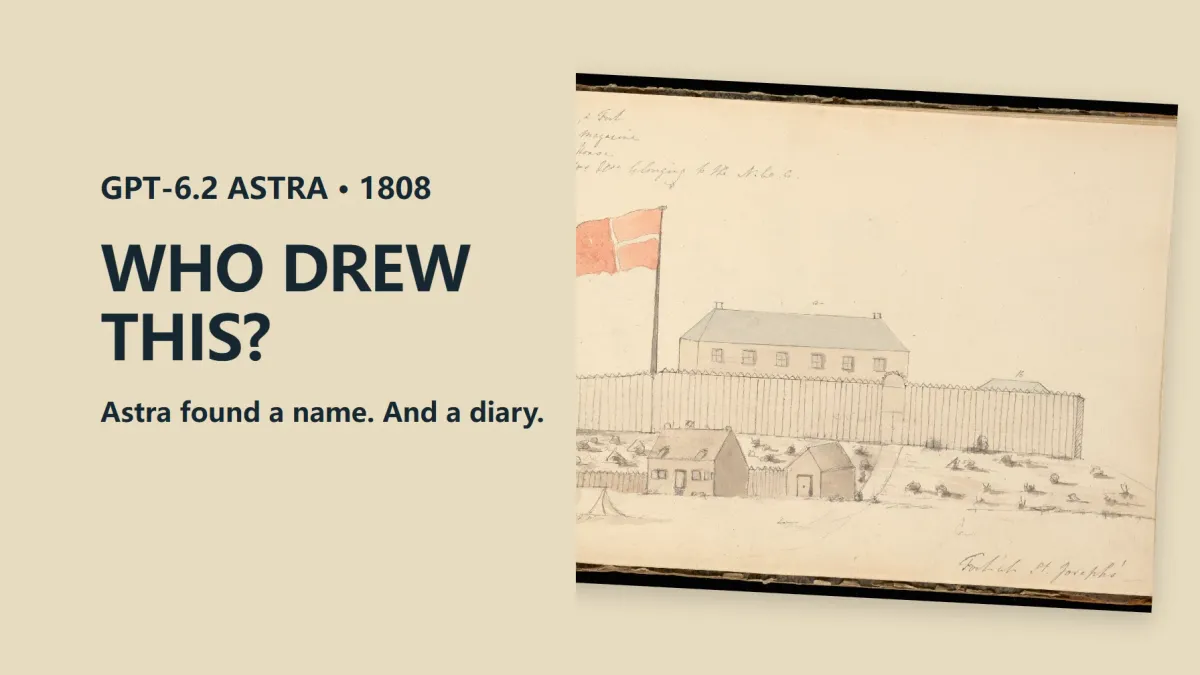
An anonymous sketchbook from 1808 had puzzled Canadian history professor Mark Humphries for years. On November 24, he published an account of a GPT-6.2 Astra test: in 22 minutes and 1 second, the model identified the French aristocrat the vicomte de Chabot as the likely artist. It also located a travel diary that could be used to check the attribution.
Humphries carried out the next stage. He requested copies from archives and found that the diary’s handwriting, itinerary and an entry about making a sketch matched the book held at Yale. We see promise in this investigation because the model also found the next archival document to examine. Once the researcher had a name, he could start testing it.
In the diary, the artist recorded the day he drew
Chabot’s travel diary gave Humphries several corroborating clues. Its handwriting resembled the sketchbook’s captions, and the itinerary lined up: when the sketchbook depicted a place on a given day, the diarist was there on the corresponding date.
The most direct match came on June 18, 1808. After Chabot’s canoe reached Fort St. Joseph, he recorded making a sketch and described the view of the fort. Humphries compared the entry with the drawing in the sketchbook and found that the views matched.
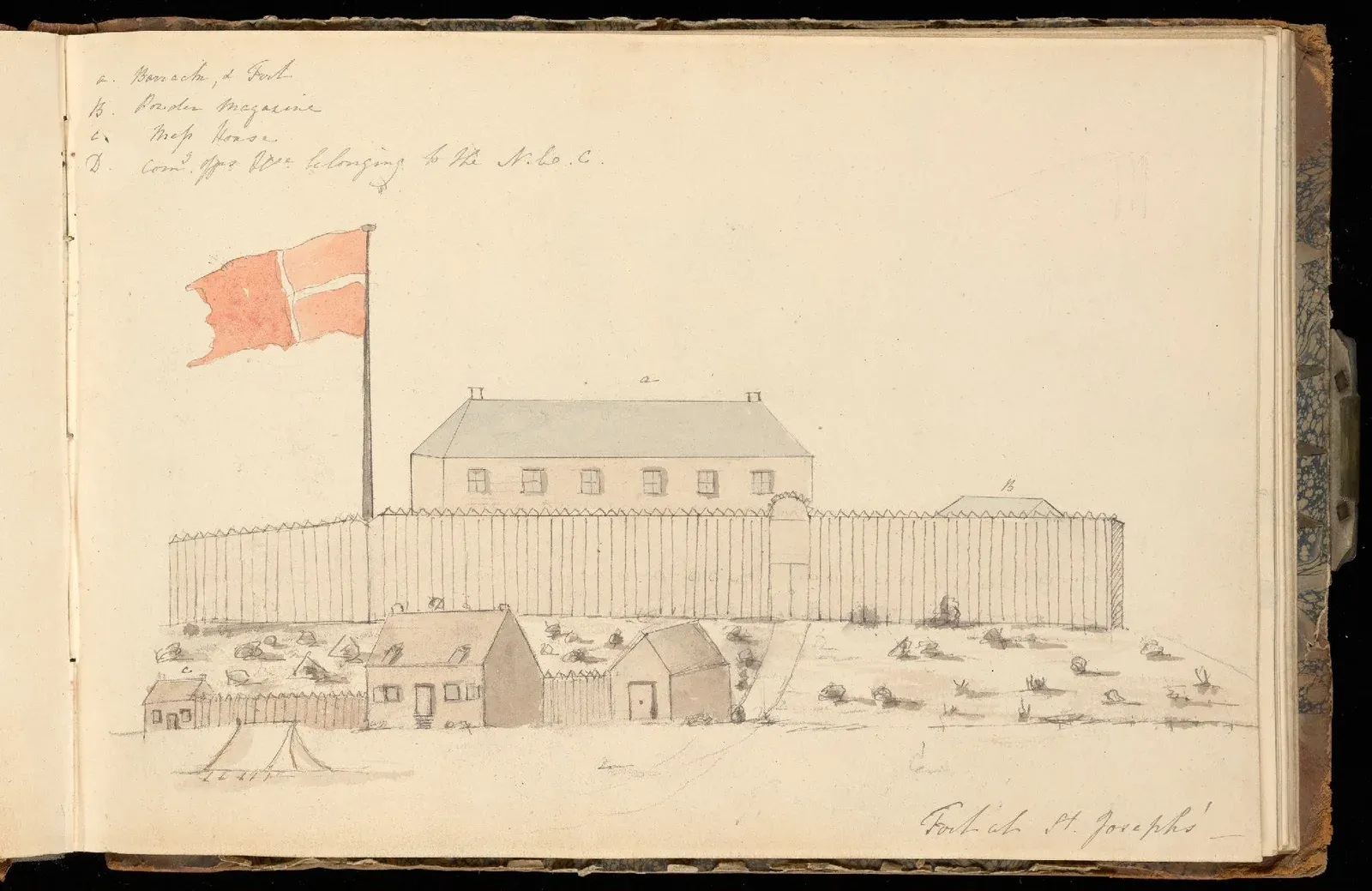
Fort St. Joseph in the sketchbook, fol. 17r. Source:Yale’s Beinecke Library collection, reproduced in Humphries’ original post.
In a subsequent Business Insider interview, he said a Yale librarian had welcomed the finding but had not yet acted on it.
The trail also yielded something extra. The diary runs to about 162 pages, and accompanying material includes excerpts from old North West Company papers. Humphries believes these can provide new material for the history of Canada’s fur trade. An investigation that began with a missing name ended with a diary worth studying in its own right.
GPT-6.2’s sketchbook investigation first had to get past the professor’s guesses
To understand how the model found Chabot, start with the problem it faced. The sketchbook depicts a Canadian fur-trade route, with recognizable landmarks and dates on a few pages. But many people traveled that route each year. Knowing where the artist had been still left a large field of candidates.
Humphries had previously suspected two men, Kendall and Berczy, so he included their names in his prompt. The model ruled both out using the dates: they had been elsewhere at the times recorded in the sketchbook.
The new name came from material that seemed to have little to do with drawing. Joseph Frobisher, a fur trader living in Montreal, kept a diary of his social engagements. The model found an entry recording Chabot’s departure on June 6, 1808; five days later, a dated river drawing in the sketchbook placed the journey on the Ottawa River along the same route. The timing and direction aligned, making Chabot worth investigating.
The model then followed John Askin Jr.’s letters to place Chabot at Fort St. Joseph later that month. A candidate who appeared first at the departure point and then at a place depicted along the route gave the investigation a reason to focus on him temporarily.
Humphries later reconstructed this search by reviewing the model’s tool calls and reasoning summaries.
A Canadian sketchbook led to a thesis on French aristocrats in exile
The Chabot the model found was a French aristocrat born in 1780 who died in 1875. He had served in the British Army and was in Canada in 1808. For someone tracing the sketchbook, that placed him in the right time and setting. Establishing that he had drawn the pictures required a record of his own.
A reference to his travel diary appeared in a doctoral thesis completed by Juliette Reboul in 2014. The thesis studied French aristocrats in exile, and its diary reference led the investigation into another field of historical writing. A search starting with an anonymous Canadian fur-trade sketchbook ended up in research on French émigrés—the sort of turn a person could easily miss.
The part of the diary recording this journey into the Canadian interior is preserved on microfilm at Cleveland State University. Microfilm stores reduced photographic images of paper documents, which researchers can request to consult or have copied. The model found this archival lead, enabling Humphries to ask the library for the material.
The university’s Lafayette Microfilm Collection contains more than 25,000 documents; the university acquired its copy in 1997. Its description explains that the online finding aid does not list every document filmed, and some more detailed folder notes are on the microfilm itself. Preserving an archive still leaves several steps between a researcher’s question and the document they need.
Chabot’s name, departure date and stops along the route connected these previously scattered materials. Humphries had never heard of him. With the diary reference, he had a specific document to request.
The professor used AI to find a person, but did not have it write history
Humphries said in the interview that a human could carry out the same investigation, but it would take considerable time. Finding suitable people in a mass of social records and checking each itinerary against the sketchbook first requires a researcher to decide whether the question merits that much effort.
Many anonymous documents attract curiosity; what is missing is someone willing to bear the long search. When AI supplies both candidates and material for checking them, an investigation that has sat idle can resume. Researchers can give it a specific task: first find who fits the known dates, then find a document that can test that candidate.
Yet Humphries’ own attitude toward the technology is more complicated than the exuberant headlines. He said explicitly in the interview that he does not use AI for writing. In the comments on his original post, Timothy Burke took the question a step further: establishing who produced a document is a precondition for historical interpretation; people still have to decide what the material means.
Another commenter, Hollis Robbins, valued the model’s ability to make new connections. AI connected the sketchbook, a social diary, letters and a doctoral thesis. Once the travel diary arrived, the historian had more material to read and interpret.
To use AI as a research assistant, start with a task like this: investigate candidates against existing clues, list supporting and conflicting records, and locate the next primary source that can test the answer. If the answer stops at a name, the investigation is still at its starting point. A diary that can be obtained tells the researcher where to go next.
Further reading
- Mark Humphries: the test and subsequent archival research
- Henry Chandonnet / Business Insider: telephone interview with the professor, republished by Yahoo
- David Nield / TechRadar: reporting on the sketchbook discovery
- Simon Willison: notes on the historical research case
- Cleveland State University: Lafayette Microfilm Collection
- McGill: Joseph Frobisher Collection catalogue
- Juliette Reboul: catalogue entry for the 2014 doctoral thesis
- Hacker News: discussion read during this run