
KPMG audit agents probe deeper. How will junior accountants learn?
KPMG ran more than 100 agents in a parallel audit of a UK-listed company. As AI takes on the work, how will junior accountants gain the experience to review it?
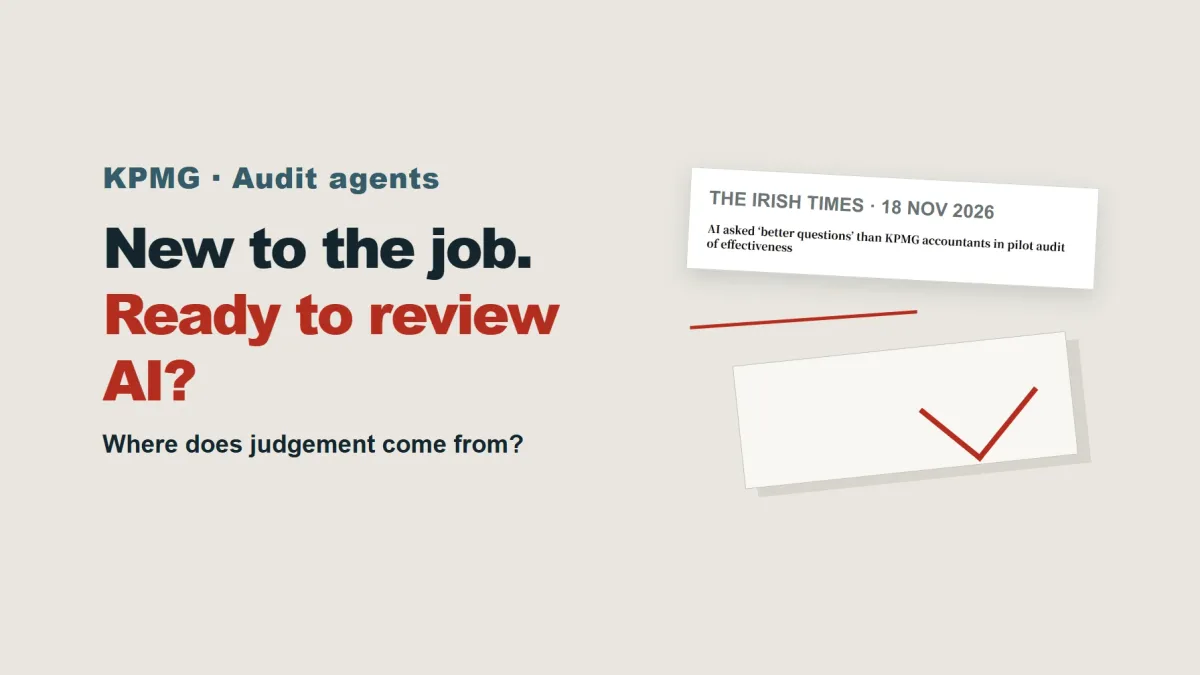
KPMG has put more than 100 AI agents to work checking a UK-listed company's accounts alongside a human team. On November 18, the Financial Times reported on the experiment: KPMG UK selected an unnamed constituent of the UK's FTSE 250 index this year and had AI work through every stage of an audit to see how much it could do.
Cath Burnet, KPMG's UK head of audit, said the agents explored some issues more deeply than the regular team and asked better questions. But they also needed people to take over at times. An agent failed at matching regulatory requirements to company documents, and an auditor had to intervene.
For professionals thinking about their careers, the striking detail is that AI is now involved in a continuous sequence of information gathering, analysis, documentation and drafting conclusions. Junior staff used to build experience through those tasks before becoming capable of reviewing other people's work. Teams now need to redistribute who does the work and who checks it. They must also answer a question: if juniors have never done the work themselves, how will they know where the AI went wrong?
Where KPMG's audit agents are already doing the work
An agent is an AI system that can carry out steps and use tools to pursue an assigned goal. In KPMG's experiment, agents gathered, analysed and documented information, then drafted conclusions and observations. They could also collaborate and suggest what to do next.
Auditors still had to give the system a clear brief. People first set objectives and explained the client's business and the background to previous audits. They then checked outputs and challenged conclusions as the work progressed. What a transaction record means, or whether an anomaly merits investigation, has to be understood in the context of the business.
KPMG spent four months building the system. The team that built and ran it included two partners, a director, senior managers and junior staff. KPMG did not disclose its total headcount.
The experiment's findings were not used for the audited company's formal audit opinion. KPMG plans to expand these parallel experiments to test whether the system can take on more real work.
More questions still need someone to decide what comes next
The agents' willingness to keep investigating is one reason the experiment has drawn discussion. Auditing involves many details that can wear people down; AI can repeatedly search, compare and ask further questions. In the Hacker News discussion, one user said the model helped them remember many tedious details.
But further investigation creates work of its own. A user called priyadarshy had used AI to check SOC 2 compliance material—documents in which a business demonstrates how it protects its systems and data. They said the model was demanding about evidence, but sometimes made unrealistic requirements that could not be completed. Once AI lists concerns, a team still has to decide which ones deserve its time.
The regulation-matching failure in KPMG's experiment makes that human role concrete. When the agent failed to connect documents with regulatory requirements properly, an auditor had to recognise the problem and take over. A reviewer needs to understand the original material and the task's requirements to judge whether an apparently complete output holds up.
How do juniors review work they have never learned to do?
That is precisely the difficulty facing junior staff. In the Big4 community, one poster described their work shifting from carrying out tasks themselves to reviewing AI outputs and turning them into finished work for clients. Juniors appear to be reaching judgement-based work earlier, but the question of what they will base those judgements on remains unresolved.
Senior staff can spot problems today partly because they have handled the underlying material and been corrected repeatedly themselves. They have seen why a record is easily misread and know where a conclusion typically goes wrong. Removing the task does not automatically put that experience into a junior colleague's head.
Similar concerns arise in other industries. A respondent working in software implementation said that when senior staff use AI for documentation, meeting notes and repetitive configuration, juniors lose opportunities to practise. Some argue that new recruits should learn to critique AI outputs directly. Others ask how they can know what to critique without reading the original material or going through several rounds of review.
We suggest preserving opportunities for juniors to form their own judgements first. For example, have them read a set of original documents and write down their conclusions and reasoning before opening the agent's analysis and comparing the two. A senior colleague can then discuss the differences: did the junior miss a piece of evidence, or did the agent exaggerate an unimportant issue?
Arranged this way, the time AI saves can become an opportunity to learn. If a team simply requires juniors to review more outputs each day, they may quickly learn the format of a finished deliverable without ever understanding how its conclusions were reached. When the agent makes a mistake, they will still be looking at a document that resembles the right answer.
Who ends up with the hours saved?
Another practical question will shape the division of work: how much money can an audit save? KPMG acknowledged clear opportunities for AI to save time but did not say whether clients' audit fees would fall. The same Financial Times report noted that KPMG International had itself sought lower fees from its own auditor, arguing that AI could reduce costs.
Clients will question the price, while firms must decide where to spend the time saved. Taking on more engagements, investigating important issues more thoroughly and giving juniors time to train all require those hours. If juniors are to form their own judgement before comparing it with an agent's, that time needs a place in the engagement schedule.
KPMG plans to extend the experiment to as many as 20 larger audits. The technology cannot yet handle thousands of engagements, and some clients' data is not clean enough, so expansion still faces practical obstacles.