
Qwen4-Max API pricing is out. How much can you save per task?
Qwen4-Max is now available on a pay-as-you-go basis. Alibaba Cloud Model Studio's Singapore input and output rates are both 25% lower than for its predecessor. Cache hits, reasoning and retries shape the cost of getting a task done.
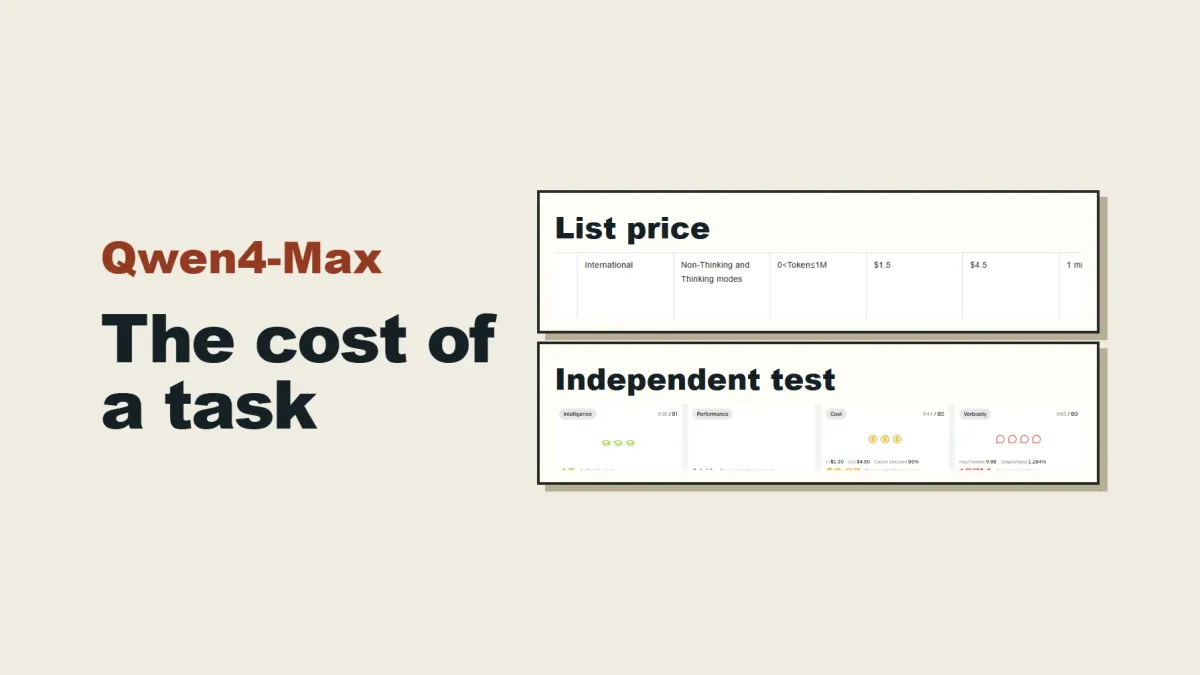
On November 16, Alibaba released the production version of Qwen4-Max with pay-as-you-go API access. The preview released five days earlier was available only on subscription plans. The production model ID is qwen4-max, and usage is now billed as you go.
In the Singapore region of Alibaba Cloud Model Studio, standard input and output rates are both 25% lower than for Qwen3.8-Max. Alibaba also reported that the average cost per task fell by about 60% in an office-work benchmark. Those figures can differ because the two models may use different numbers of tokens to do the same job.
What you save at the same token count
Alibaba Cloud Model Studio lists the following standard rates for Singapore in US dollars per million tokens.
| Model | Input | Output |
|---|---|---|
| Qwen3.8-Max | 2.00 | 6.00 |
| Qwen4-Max | 1.50 | 4.50 |
Suppose each model uses 100,000 input tokens and 20,000 output tokens, with no cache hits. The older model costs $0.32 and the new one costs $0.24. The entire 8-cent saving comes from the lower rates.
The bill changes if the workflow repeatedly reads the same project materials. When that earlier input produces a cache hit, Qwen4-Max charges $0.075 per million tokens for the cached portion in Singapore. The rest of the input is billed at the standard rate. If the first delivery falls short, a second request is billed separately.
Where the roughly 60% saving comes from
In its Work360 office-work benchmark, Alibaba reported that Qwen4-Max used 35% fewer tokens than its predecessor with reasoning set to high. The average cost per question fell by about 60%. If every category of token usage fell by 35% and you applied Singapore's 25% cut in standard rates, the savings would come to about 51%. Alibaba's announcement gives the change in total token usage. It leaves out the breakdown across input, output and cached tokens that you'd need to reproduce the benchmark's costs.
Independent evaluator Artificial Analysis put the average cost per question for Qwen4 Max at $3.27 across its own benchmark suite. When reading results like these, look for questions that resemble your work, such as organizing documents or running a multistep workflow. Use those to decide what to test.
Test the switch on work you've already approved
Pick a few recent tasks you've completed and approved. Give both models the same materials and hold them to the same standard. Keep tracking costs after the first answer comes back. Include requests to retry failed attempts and handle follow-up requirements in the actual API bill, then record separately how much time people spend making corrections.
Take the earlier example. The old model costs $0.32 to prepare a report that passes review on the first try. The new model costs $0.24 on the first pass but leaves out two critical pieces of data. If the follow-up costs more than $0.08, the new model's API bill ends up higher. Run that comparison on one type of task before deciding whether to switch.