
AI vulnerability patching still takes time after faster discovery
PHP2Shell's 71-day path from report to release shows why AI vulnerability patching involves more than fast discovery: compatibility, review and release decisions still take work.
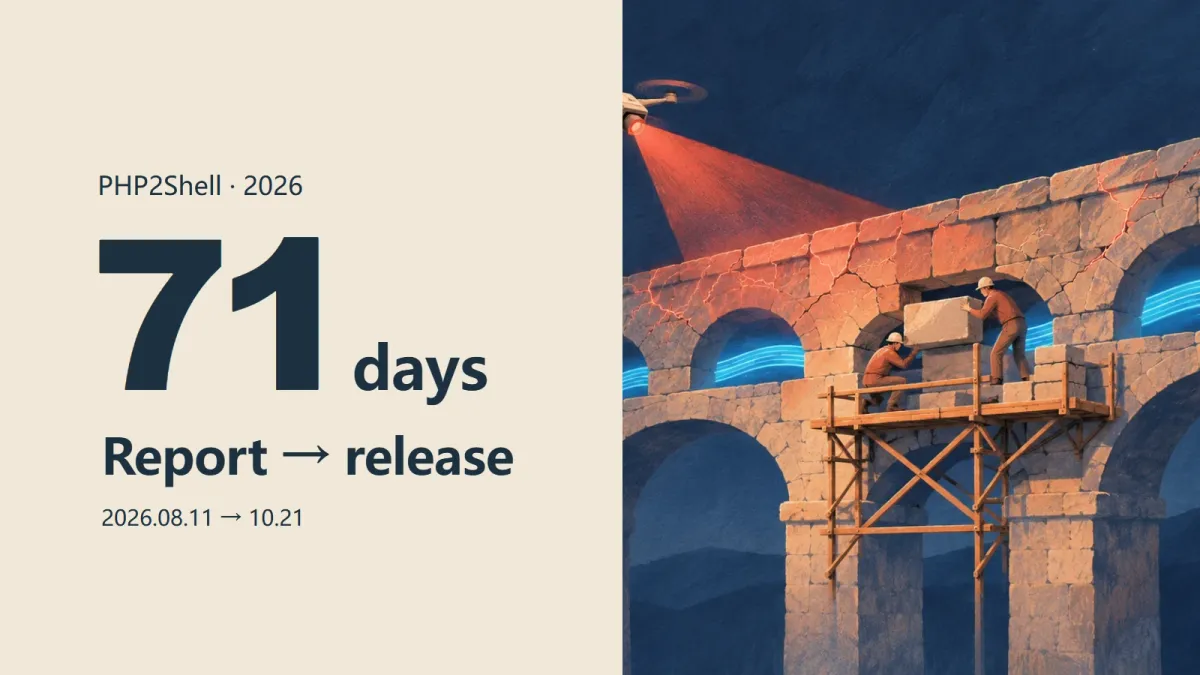
AI vulnerability patching: 71 days from report to release
On August 11, a report led the PHP team to confirm that a memory issue, signs of which had surfaced before, could let attackers run code on a server. On October 21, patches shipped across multiple PHP branches. The dates are 71 days apart: the calendar interval between the report and the release.
The problem lay deep in the PHP engine's handling of memory and errors. Fixing it could break older programs or require changes to third-party extensions. Once a machine helps identify the danger, someone still has to choose the least disruptive fix and make sure the many systems already in production can adopt it.
AI is speeding up vulnerability discovery. Patching still has to leave a path forward for older systems. Maintainers must decide how to fix an issue, which ones to address first, and when the systems that depend on their software should move to a new version.
The warning signs appeared in 2024. Why was there no immediate fix?
PHP2Shell is the collective name for two critical PHP vulnerabilities. One concerns state handling after memory allocation fails: a program is forced to exit part of its work early, but subsequent cleanup may continue using incomplete state. What initially looked to users like a crash was later shown to have more serious consequences.
The PHP Foundation's October 21 account is candid about what happened. In 2024, core developers found early signs of the flaw while addressing an issue from an external audit. Exploitation was considered possible, but no concrete path had been found, and the team had other issues with clearer consequences to address.
Choosing a fix was difficult, too. One approach could break backward compatibility; another would introduce a new denial-of-service risk; others required changes across many third-party extensions. The security team made decisions by consensus, and few developers knew the engine's deepest internals. Work repeatedly stopped and restarted amid disagreements and other tasks.
In August 2026, Calif reported a remote code execution issue with the same root cause, making the urgency clear. The foundation then prioritized the work for its security staff and ultimately delivered fixes across several supported branches. Its disclosure described the earlier delay as a structural failure caused by decision-making processes and resources, and said the team was adjusting its approach to consensus to encourage decisions between competing options.
Coordination continued right up to release. The patches were originally scheduled for October 22. On October 20, the related vulnerability identifiers began circulating, and the team moved the release to October 21. Distributors were still preparing packages at the time. An immediate disclosure on October 20 would have left many users without an easily installed update. Moving the release forward by one day became the compromise between acting quickly and making updates available.
Calif's research account shows where AI can help: tracing state changes in source code and turning one discovery into a pattern to search for elsewhere. Reusable discovery methods can produce more leads. Compatibility decisions still depend on the particular project, its extension ecosystem, and its release schedule.
Reports are faster to write, but still costly to assess
More vulnerability reports do not directly tell maintainers which issue to fix first.
In an October 14 explanation of the process, PHP security team member Alexandre Daubois wrote that since July 1, the team had published 15 CVEs and closed 106 reports that were not vulnerabilities, were duplicates, or could not be reproduced. Someone had to review each report before closing it. The two figures describe different outcomes; they cannot be used to calculate the accuracy of AI-generated reports.
Some crashes occur only in particular builds. Some reports point repeatedly to the same root cause. Others fail to explain what an attacker can control or ultimately achieve. Time saved by the reporter on writing may be shifted to maintainers reproducing the issue and asking follow-up questions.
The PHP team is also using AI to help: checking claimed impacts, grouping reports with the same root cause, and identifying entries that deserve attention first. People still make the final severity assessment and write or review the patches. Tools now operate at both ends of the queue, but the people making decisions still need to understand the relevant engine behavior.
HN user bunderbunder raised another tradeoff: removing the source of an error may require refactoring, while adding a defensive check is a smaller change. The choice depends on what a team can accept. Others argued the reverse: agents could lower the maintenance cost of duplicate implementations, while isolating code could reduce interactions between components. Both approaches need to be assessed in the context of a specific project.
948 vulnerabilities: first establish which stage they have reached
OpenAI's Linux kernel research illustrates this screening work at a larger scale. The study ran in mid-October and was published on November 4. It reported results at several stages:
| Stage | Reported count |
|---|---|
| Deduplicated candidate findings | 2,308 |
| Dynamically reproduced vulnerabilities | 1,724 |
| Deduplicated local privilege escalation issues | 948 |
A candidate finding is simply a lead worth investigating. Dynamic reproduction shows that an issue can be triggered in the target environment; further assessment of exploitability helps determine its priority. Local privilege escalation means a user with an existing low-privilege foothold gains greater privileges. It does not mean remotely taking over 948 websites.
The 1,724 reproduced results covered different impacts. Subsequent evaluation produced multiple working privilege escalation exploits. The researchers then performed variant analysis, using 948 distinct patches to group the findings into independent privilege escalation issues.
The patches generated for these issues are still candidates, to be reviewed by researchers before being reported to kernel maintainers. Generating a patch does not mean it has been merged upstream.
Maintainers were also moving quickly. OpenAI said that in the 10 days between scanning and the completion of human analysis, 61 of the issues had already been fixed upstream, 43 had staged patches, and 299 were being publicly reported and discussed. The researchers therefore stressed the need to revalidate findings against the latest code before submitting them. A report that looks important today may already have been addressed by someone else.
Repeated scanning also needs a corresponding process for handling reports. As scanning capacity grows, deduplication, patch-status tracking, and evidence others can check become more valuable. Submitting an outdated report again consumes the review time that is already in shortest supply.
AI can write proofs, but first define what needs proving
Patching can become faster, too. In research published on October 22, Anthropic and Theorem had Claude fix discovered issues and generate formal proofs for 239 test entry points across 123 open-source libraries, then used the external Rocq proof checker to verify them.
Formal verification means expressing the rules a program must satisfy as a precise specification, then proving that the program meets those rules. For example, compression followed by decompression should restore the input, or a test entry point should not crash because of certain memory errors. AI can do much of the proof-writing, while the checker verifies that the reasoning satisfies the specification.
What the specification covers still determines the value of a proof. One set of results in this study applies to single-threaded, statically linked RISC-V binaries under conditions including a fixed memory budget, the modeled Linux environment, and inputs smaller than 64 MB. It cannot be extended to mean that an entire library is safe on every computer and for every possible input.
Generating proofs can also consume hundreds of millions of tokens. One cost-reduction approach identified by the researchers is to reuse completed proofs for shared underlying components, reducing the work needed to derive proofs for subsequent programs from scratch.
When a model generates patches or proofs, open-source maintainers can deliver them alongside evidence that reproduces the issue, the properties covered, and the conditions still outside that coverage. A model's claim that something is fixed carries far less weight than evidence others can check.
Returning to PHP's 71 days, the hardest part is already clear in the foundation's explanation: every option had a cost, and systems still had to keep serving users. AI can help investigate those costs more thoroughly and test patches faster. The decisions maintainers must make remain specific: which compatibility changes to accept, when to release, and which users will still be unable to make the transition in time.
Information is current as of November 5, 2026, and is based on the original disclosures, research results, and reporting listed below. Orbis News has not independently reproduced the vulnerabilities.
Related reading
- Handing off AI prototypes at Goldman Sachs: who is responsible for deployment?
- The Postman integration controversy: limits on configuration changes
References
- PHP Foundation: The fixes and changes to security organization
- Alexandre Daubois: How the PHP security team handles reports
- Calif: PHP2Shell research
- Dina Genkina / IEEE Spectrum: PHP2Shell and AI security research
- OpenAI: A thousand fewer paths to root
- Anthropic and Theorem: Formal verification research and its limits
- Hacker News: Discussion of technical debt