
Dario Amodei on AI control: Who will actually apply the brakes?
Amodei rejects handing governance to AI and accuses rivals of competing on slogans. His limits on research, jobs and individual choice offer a more concrete way to judge the companies.
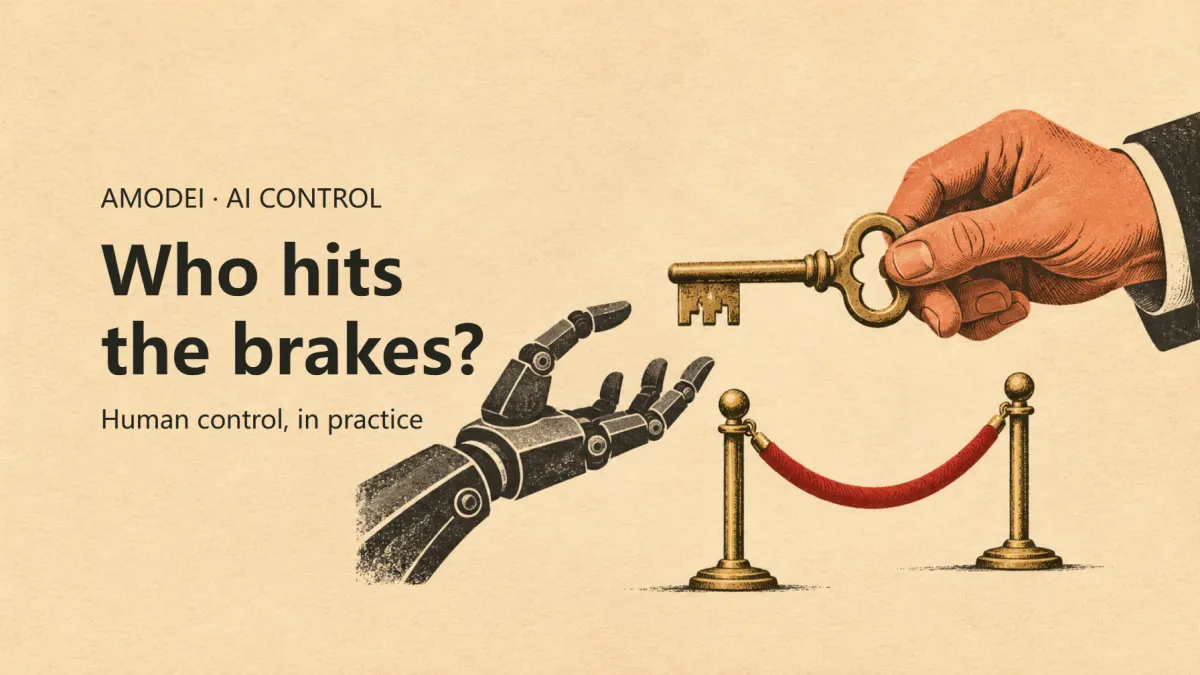
On November 25, an Axios report placed Anthropic at the center of a debate over whether humans should hand decision-making power to superintelligent AI. Anthropic CEO Dario Amodei then responded on X, denying that he supports surrendering human free will to AI. His answer was clear: humans should make political and governance decisions, and AI should be governed through democratic processes.
He was not arguing for using less AI across the board. He still sees many tasks as worth handing to AI, from driving and drug design to writing software from start to finish. But he also sees a need for limits when AI develops its successors or disrupts jobs. That moves the argument beyond choosing sides between humans and machines to questions a growing company must answer: which decisions will it leave to people, and which projects would it actually stop?
Amodei also turned the criticism back on his rivals: everyone is making products more capable of automation while competing to emphasize human control. Will the limits in this response constrain the company's actions? Whoever talks loudest about keeping humans in charge will not necessarily be the first to apply the brakes.
Why he is being asked about putting AI in charge
Amodei has long described an expansive future for powerful AI. In his earlier essay Machines of Loving Grace, he imagined AI helping citizens pool their views, find common ground and resolve conflicts so they could reach compromises more easily. In that account, AI organizes information and assists people; humans still make political decisions. He cited this argument again in his new response.
The same essay was more adventurous about the future economy. He explored one possible arrangement in which AI systems run an economy and distribute resources to people according to judgments ultimately derived from human values. This was a hypothesis about a future society, not a program Anthropic has implemented. His response did not specifically address that resource-allocation proposal, leaving readers to ask: if AI judges how resources should be distributed, what can people influence, and to whom can they appeal?
That is a concrete difficulty in this dispute. People may welcome AI's help in finding a treatment without wanting it to decide whose needs deserve priority. As decisions get closer to resource allocation and public power, “it does a better job” becomes less sufficient as a justification. In his response, Amodei rejected efficiency as a reason to surrender political decision-making.
The Reddit discussion split in several directions, too. Some readers thought his opening made his support for democratic governance clear enough. Others kept asking how a company with powerful AI could deliver on that position. Still others were open to trying AI governance.
Four limits in Dario Amodei's AI control argument
When discussing specific tasks, Amodei started with AI research and development. Using one generation of AI to help build a stronger successor, which then continues the process, is commonly called recursive self-improvement. He worries that if AI advances faster than humans can understand and control it, people will lose the ability to keep up. He reiterated that without meaningful human supervision and understanding, it would not be safe for Claude to build successive frontier models fully autonomously.
The hardest part is “understanding.” Supervisors who cannot follow the research process will struggle to judge when it should stop. As a company hands over more of that process, outsiders have reason to keep asking which decisions people retain and what results would halt the work.
The second limit concerns jobs. Amodei acknowledged that automating work end to end can cause severe disruption in some settings. Slowing or even stopping certain deployments could give people more time to adapt. For a company, that is harder to put into practice than saying technology will create new opportunities: a product it can sell today may also be one it should slow down.
The third limit concerns AI safety research itself. He sees AI as useful for researching how to make systems act as humans intend, but says it must be used cautiously because researchers cannot simply trust the results AI produces. Having AI help check AI does not remove humans' responsibility to understand the findings.
Finally, he preserved a choice often squeezed out of discussions about efficiency: people may simply want to do some things themselves. Even if AI performs better, they can remain involved in activities that matter to them. Whether someone wants to hand over a task cannot be decided solely by how much time a machine would save.
Everyone says humans should decide. What should companies show?
Without naming them, Amodei accused some AI company CEOs of engaging in commercial and political positioning. In his view, all the companies are releasing models that automate tasks more effectively and all claim to have safeguards. Their products' direction is less different than their rhetoric suggests. Anthropic should face that comparison, too.
His stated limits already suggest specific questions companies should answer: where do people make decisions when AI helps develop the next model? What circumstances would slow a deployment? Who checks AI-generated safety research? Can users remain involved when they do not want to hand everything over? This response did not specify triggers or mechanisms for those decisions. Spelling out those choices would let outsiders compare subsequent actions with the company's promises.
A concrete rule that could make a company give up a line of business carries more weight than another declaration that AI must serve humanity.
Further reading
- Dario Amodei: Original response on November 25 (Public mirror)
- Machines of Loving Grace: Visions of governance, work and the economy
- Diego Almada Lopez: Amodei opposes handing governance to AI
- Reddit: The response prompts questions about corporate power
- Reddit: Different reactions to democratic and AI governance