
Anthropic’s IPO filing shows when its $900.9 billion compute bill comes due
Anthropic ended its Nasdaq debut up about 17%, but the company’s share sale is still priced at $83. Compare its roughly $79.4 billion in gross proceeds with near-term compute payments and data center deliveries.
Anthropic began trading on Nasdaq under the ticker ANT on November 19 U.S. time. CBS News reported that the shares opened at $111.50, about 34% above the $83 IPO price, and closed at $97.17, up about 17% on their first day.
The IPO price has already fixed the value of this share sale. According to Anthropic’s November 18 announcement, the shares sold by the company are worth about $79.4 billion before offering costs. After the listing, investors buy and sell shares among themselves at new market prices, and the sellers receive that money. Assessing how much Anthropic has to pay its compute bills still means looking at its financing, cash and contractual payment schedule.
The November 10 preliminary prospectus schedules contractual payments through 2045: about $900.9 billion in total commitments, almost entirely for compute and infrastructure.
Proceeds from the share sale come in at closing. Data centers are delivered in stages. If they arrive late, Anthropic has to keep renting more expensive short-term compute for Claude. If they arrive early and usage lags, the company still has to pay for some machines that sit idle. The IPO can give Anthropic more room to maneuver. How much growth that money can buy depends on when the data centers come online and how much customers use them.
What comes due first in Anthropic’s IPO filing?
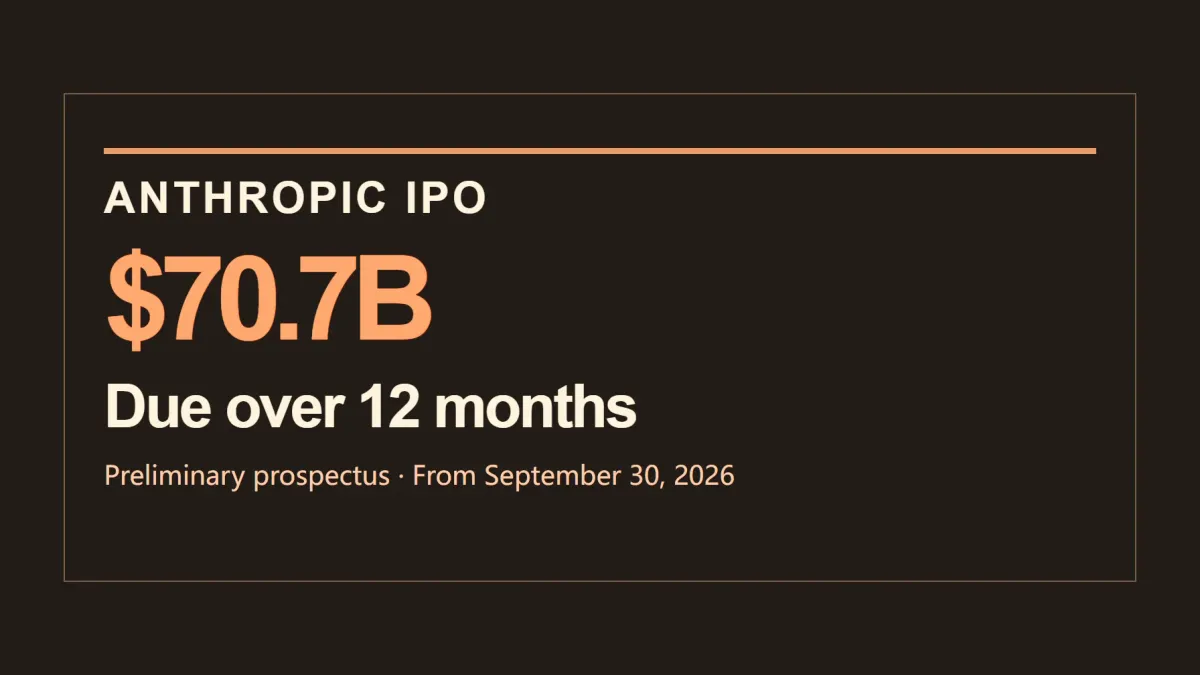
Anthropic expects to pay about $70.7 billion in the 12 months after September 30, 2026. About $4.2 billion of that relates to arrangements that are conditional or can be terminated before they begin. The $70.7 billion falls within the roughly $451.6 billion in expected payments through the end of 2030. Including later commitments, the total comes to around $900.9 billion. Almost all of the commitments beyond 2030 fall between 2031 and 2045. The total includes leases that have yet to commence.
The offering comprises 980 million shares with a total offering value of about $81.3 billion. Anthropic is selling about 956 million shares, while existing shareholders are selling about 23.65 million. At $83 per share, Anthropic’s gross proceeds from its share sale are about $79.4 billion, before underwriting fees and offering expenses. The selling shareholders will receive about $2 billion from their sales. The shares trade under the ticker ANT, and the offering is expected to close on November 20. Anthropic has also granted the underwriters a 30-day option to buy up to 147 million additional shares.
Comparing only Anthropic’s gross proceeds from this share sale with the $70.7 billion in near-term payments leaves out the funds it already has on hand and its operating expenses beyond compute. The prospectus puts liquidity as of September 30 at about $146.6 billion. Most of that is cash and cash equivalents and short-term investments. The figure also includes about $14.8 billion in available credit.
SpaceXAI costs about $3.1 billion a month at full delivery
SpaceXAI (SpaceX.AI LLC, formerly X.AI LLC) is a wholly owned subsidiary of SpaceX and supplies Anthropic with NVIDIA GPU compute. The prospectus says the compute arrangements run through 2029 and are worth up to about $120.5 billion. The combined monthly cost comes to roughly $3.1 billion once all contracted capacity has been delivered. Costs vary as supply ramps up, so the full monthly bill kicks in after delivery.
That’s why Anthropic is still buying short-term compute while signing long-term contracts. Until its dedicated data centers are fully delivered, temporary capacity can cover demand at what the prospectus describes as significantly higher prices. Anthropic plans to replace that expensive short-term capacity as dedicated capacity comes online. If the new capacity runs late, it has to rent for longer. If it comes online and customer usage falls short, some contracts still require Anthropic to buy a minimum amount. Long-term deals secure supply and leave Anthropic bearing the cost if it overestimates demand.
Can new capacity keep up as Claude sales accelerate?
The transition already shows up in the income statement. Anthropic’s revenue for the third quarter of 2026 reached about $17 billion, up from about $1.4 billion a year earlier. Its operating loss narrowed from about $3.1 billion a year earlier to $567 million. The preceding quarter, however, it recorded $974 million in operating income. Anthropic attributes the return to an operating loss primarily to about $5 billion in third-quarter short-term compute costs and about $2 billion in expenses recognized for matching employees’ charitable donations with shares. Claude sales are growing, but expensive short-term compute still weighed on operating profit that quarter.
The next time Anthropic updates its financials, I’ll look first at compute deliveries and operating cash flow. Did long-term capacity come online on schedule? Did short-term rental costs fall? How much cash did operations generate as Claude sales grew? If rental spending keeps rising and contract payments come due sooner, the two bills will absorb some of the room the financing gives Anthropic. The first day of trading has already shown investors’ enthusiasm. Once the data centers are delivered, Anthropic has to show how much paid Claude usage the new machines can handle.
Further reading
- CBS News on Anthropic’s first day of trading (updated November 19)
- Anthropic’s November 18 IPO pricing announcement
- Anthropic’s preliminary prospectus filed with the SEC (November 10 amendment)
- Reuters coverage of demand for Anthropic’s IPO and investors’ questions
- The Decoder on Amodei and Dimon’s discussion of compute purchases
- Cailian Press coverage of demand for Anthropic’s IPO
- r/Anthropic discussion of contractual commitments and quarterly revenue