DeepSeek V4.1 Flash hands-on: a new architecture takes over from V4 Pro
DeepSeek V4.1 Flash moves to a new 552B architecture with native vision, and DeepSeek is routing all V4 Pro traffic to it. Side-by-side tests show it beating V4 Pro on some coding and 3D tasks, though it is still less stable than flagship models on complex work.
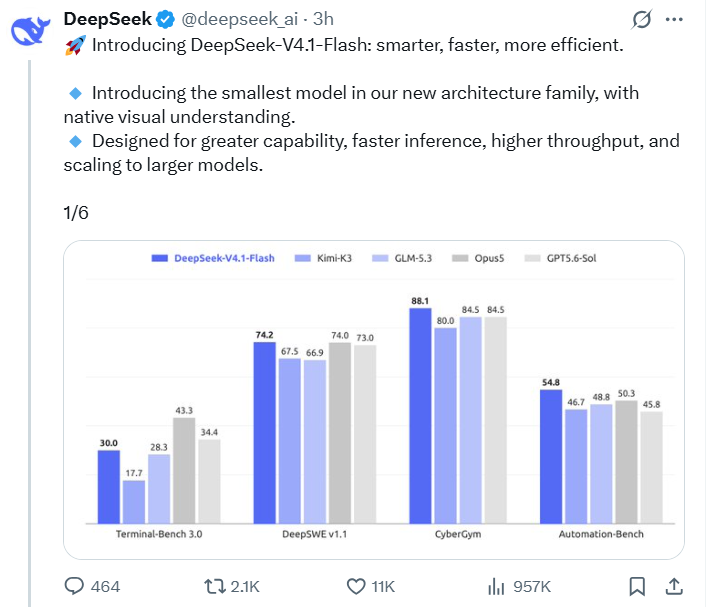
DeepSeek officially released DeepSeek V4.1 Flash on September 10. According to the company, the new version beats V4 Pro on performance, speed, cost and total task time, and after September 14 all V4 Pro API requests will be routed to V4.1 Flash.
This is not a routine point release. V4.1 Flash moves to a new Causal-Encoder-Decoder architecture with 552B total parameters, activating only 8B on the input side and 16B on the output side. It also adds native visual understanding, shrinks the KV Cache substantially once again and cuts API prices further. DeepSeek's intent is clear: have a Flash model take on more and more of the work that used to belong to Pro, while pushing inference costs down even further.
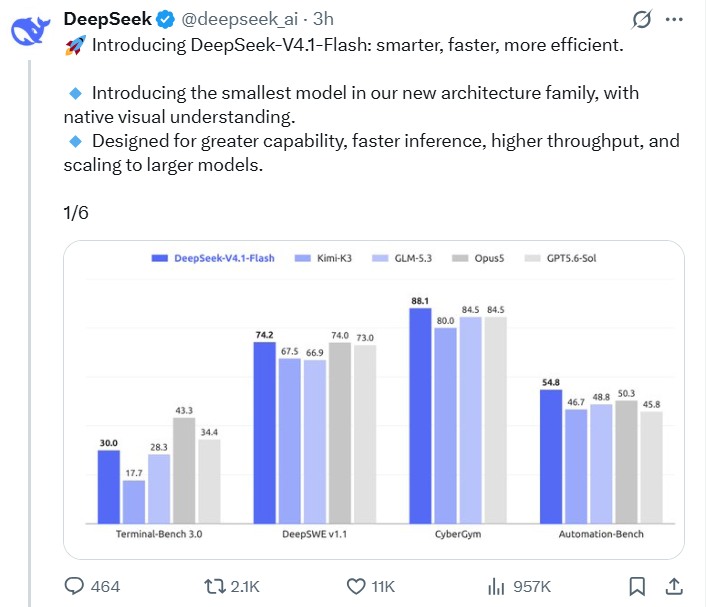
A new architecture: separate compute for input and output
V4.1 Flash is the smallest model in DeepSeek's new architecture family. It has 552B total parameters in a mixture-of-experts (MoE) design, which makes it well suited to agent workloads. A coding agent typically reads code repositories, tool documentation and conversation history over and over, then outputs only a small amount of code or a few tool commands. Using different compute scales for input and output cuts the cost of the reading stage.
The official benchmarks show V4.1 Flash performing strongly on GPQA Diamond, Codeforces, MathArena Apex, Terminal-Bench and CyberGym, beating V4 Pro on some of them. On Terminal-Bench 3.0/4.0 and ProgramBench, however, it still trails the top closed models. Overall, the upgrade is still about balancing capability, speed and cost.
Native multimodality
DeepSeek previously offered vision mainly through experimental releases such as V4-Flash-Vision-Exp. This time V4.1 Flash folds visual understanding directly into the main model, so images, screenshots, charts and PDFs can all go through the same model pipeline.
That matters especially for agents. Real-world tasks are rarely text-only: web pages contain screenshots, product docs contain flowcharts, coding tasks involve error screens, and office files come with spreadsheets and PDFs. A model that can handle all of this within a single task context is far easier to work with.
An even smaller KV Cache
The new generation shrinks the KV Cache dramatically: compared with the previous generation, HBM requirements drop to 1/4 and SSD requirements to 1/8; compared with the original model, the KV Cache is now 437 times smaller. If cache footprint and cache-hit prices keep falling, the cost of an agent running dozens or hundreds of consecutive rounds falls with them. V4.1 Flash optimizes caching, architecture and pricing together, with the goal of making the model better suited to sustained work.
Lower prices as V4 Pro is retired
The V4.1 Flash API keeps peak and off-peak pricing, with off-peak prices at half the peak rate; the new prices took effect at 12:00 on September 10. DeepSeek also announced that V4 Pro would be phased out after 12:00 on September 14, with requests that used to go to V4 Pro routed directly to V4.1 Flash. The move makes the new model's role plain: Flash is stepping into the main-model slot.
Leaderboard ranking
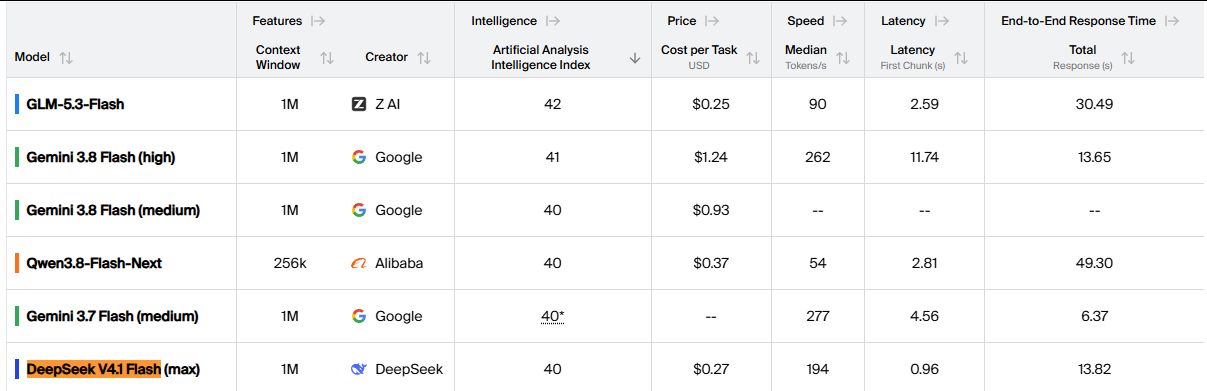
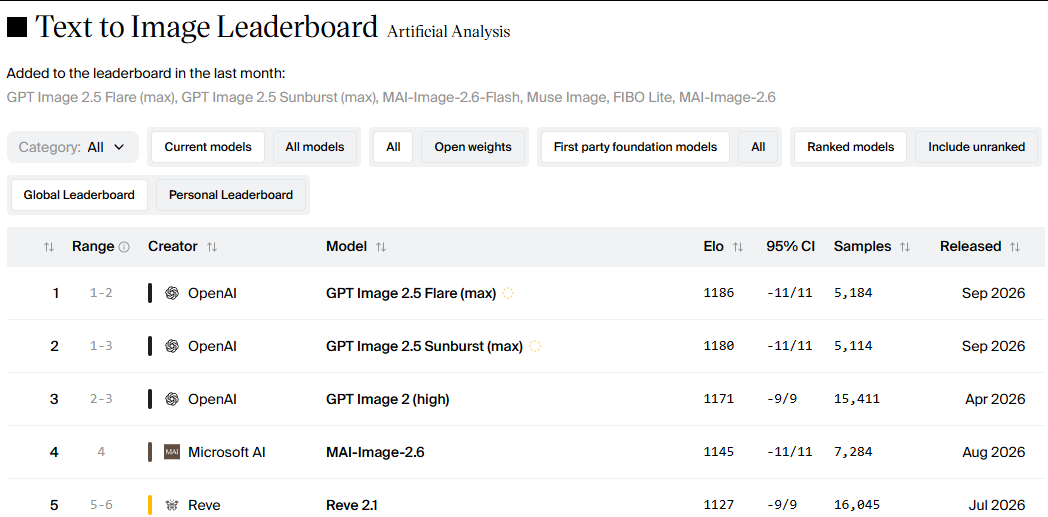
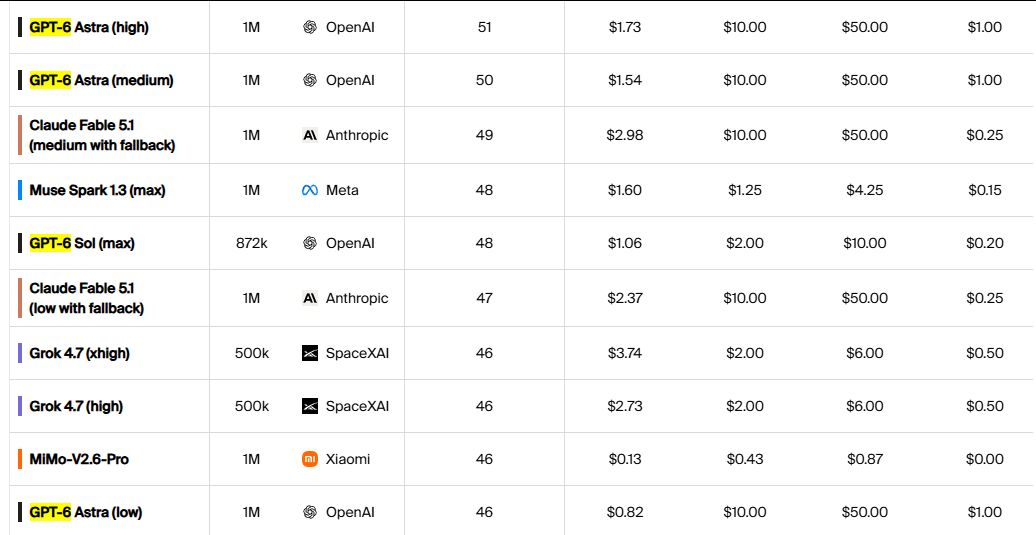
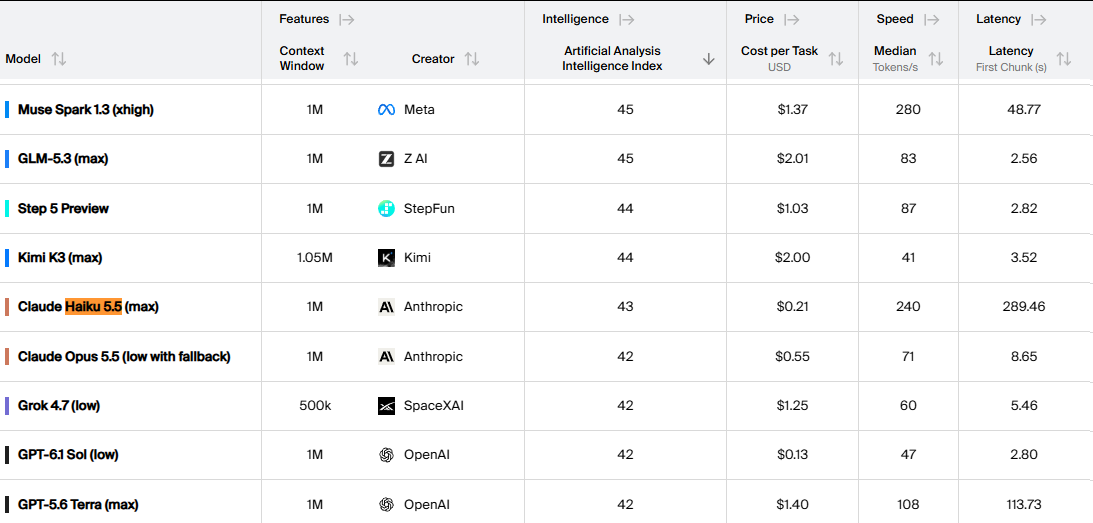
On the current Artificial Analysis leaderboard, V4.1 Flash ranks 37th overall and 6th among Flash models.
Hands-on tests: Pro-level capability at a Flash-level price?
Beyond specs, benchmarks and pricing, differences in coding, agent, multimodal and long-context work only show up when the model is actually put to work. The following side-by-side tests check whether V4.1 Flash lives up to the promise of "Pro-level capability at a Flash-level price" on real tasks.
Model tested
deepseek-v4.1-flash, with a 1M-token context window (1,000,000 tokens).
Methodology
The evaluation focuses on logic, math, coding, multimodal and human-intuition questions. It is not an authoritative test of cutting-edge specialist domains; the goal is to track how models are evolving and offer a reference for choosing between them.
- Question bank: 10 logic and math questions, 7 human-intuition questions and 12 coding simulation questions, with final results taken under the corresponding scoring rules; representative cases are shown below (question bank).
- Scoring: each question is worth 10 points, with deductions under set criteria; the final score is the average across rounds.
- All models received identical prompts and the first output was used; coding tasks ran in a Claude Code sandbox.
Coding cases are rated on the following scale:
- ⭐⭐⭐⭐⭐ S tier: industry benchmark that redefines the standard.
- ⭐⭐⭐⭐ A tier: production-ready, with no obvious weaknesses.
- ⭐⭐⭐ B tier: middle-of-the-road, with some weaknesses.
- ⭐⭐ or below, C tier: unusable, with obvious problems.
Results overview
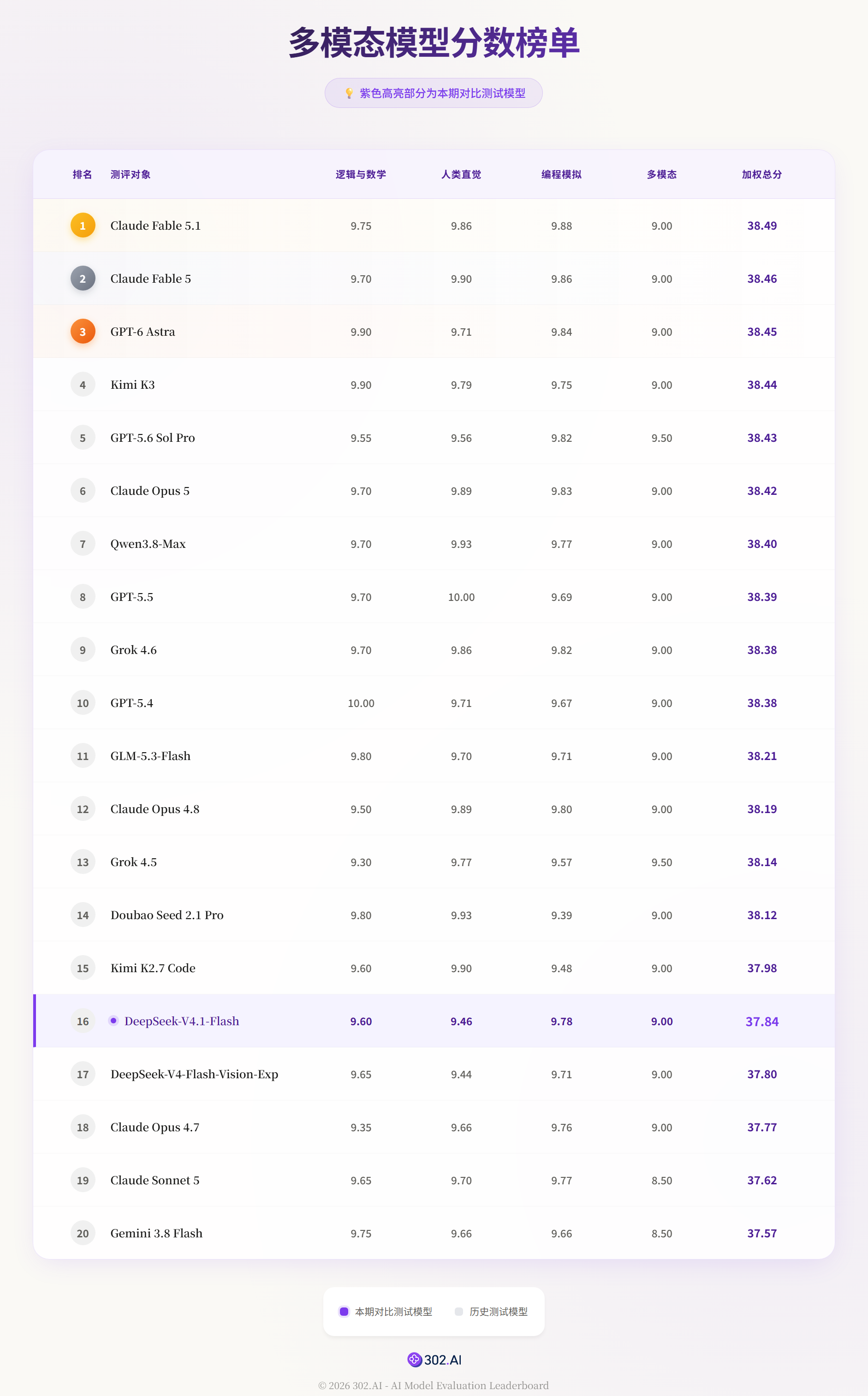
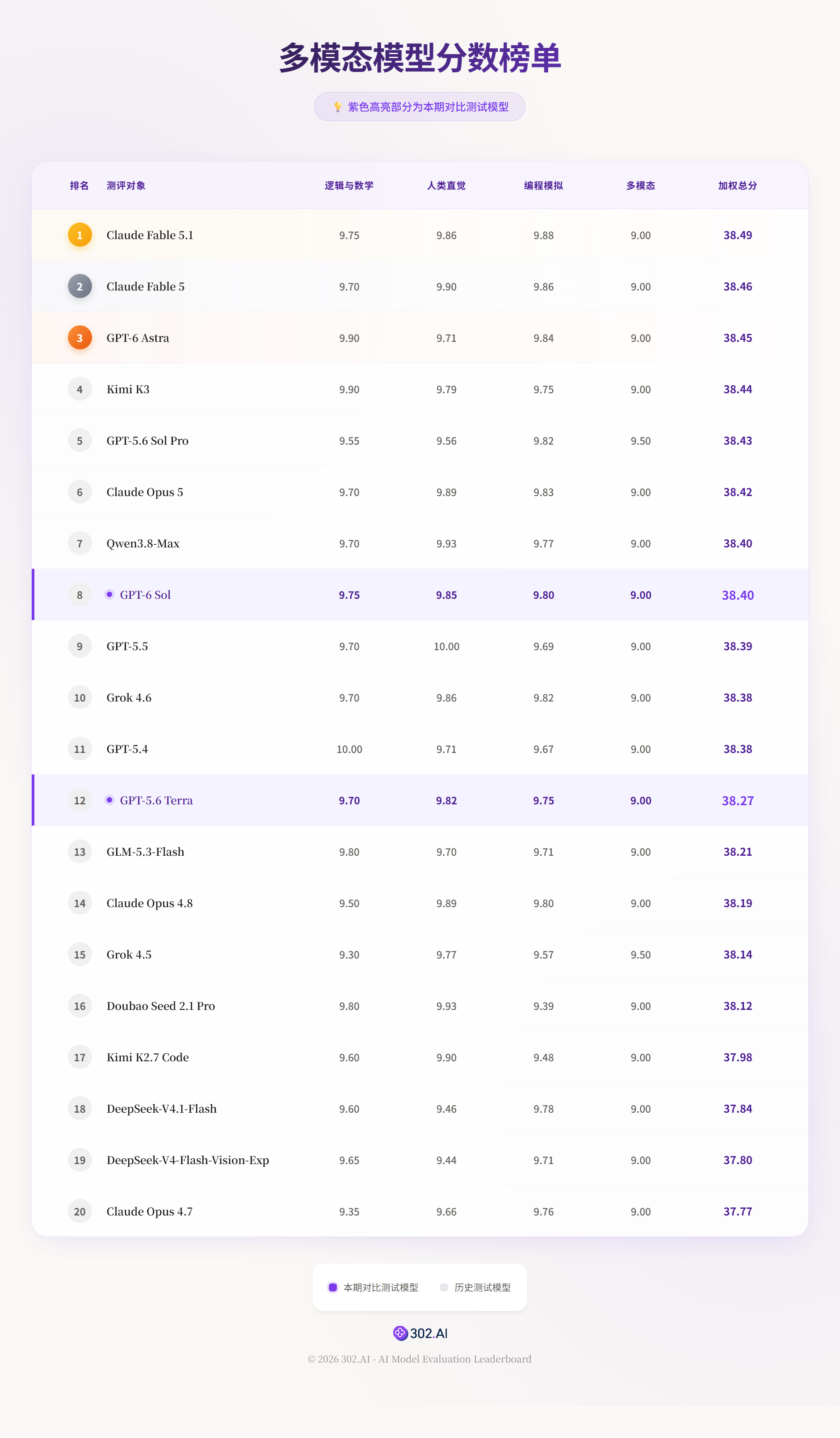
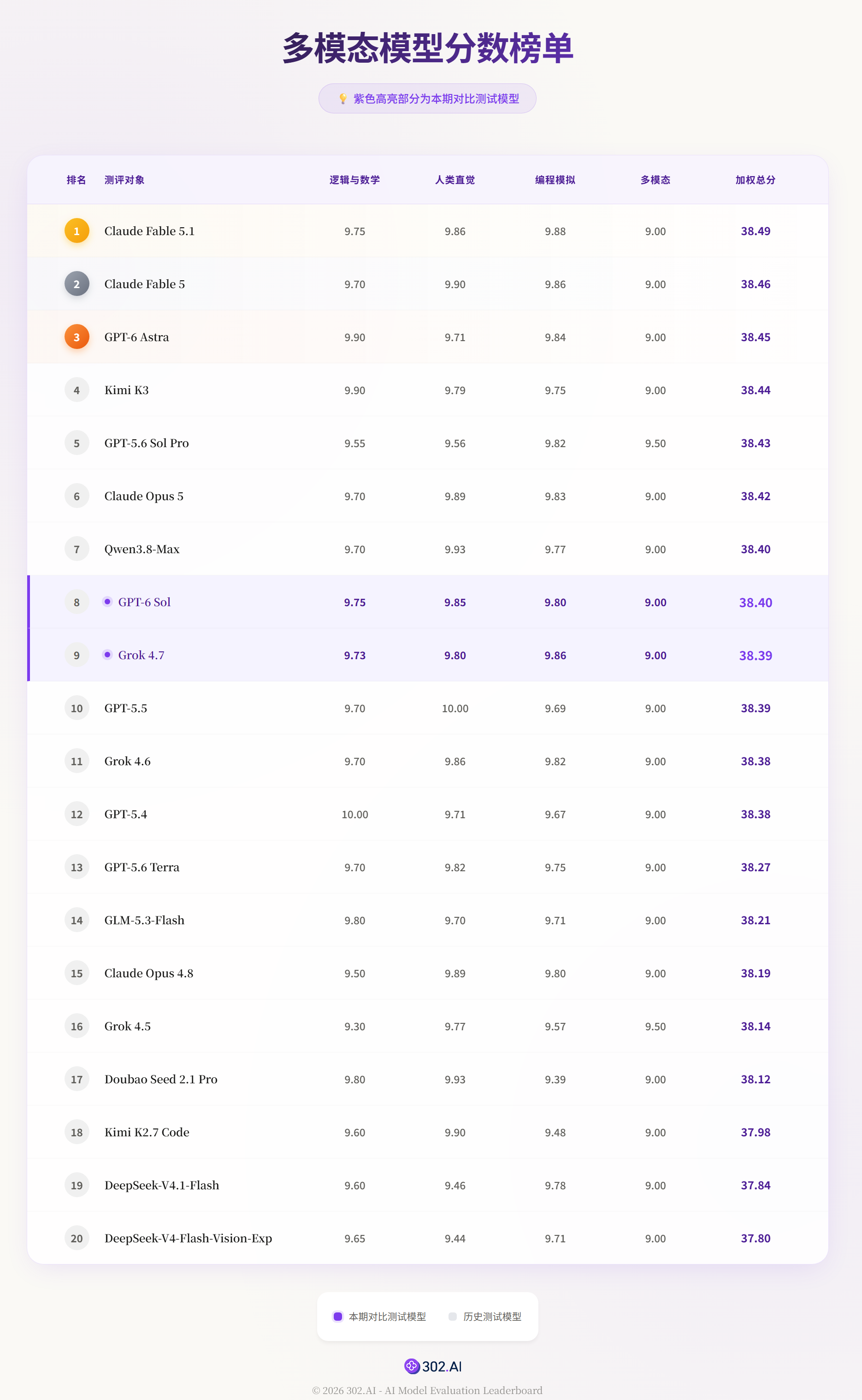
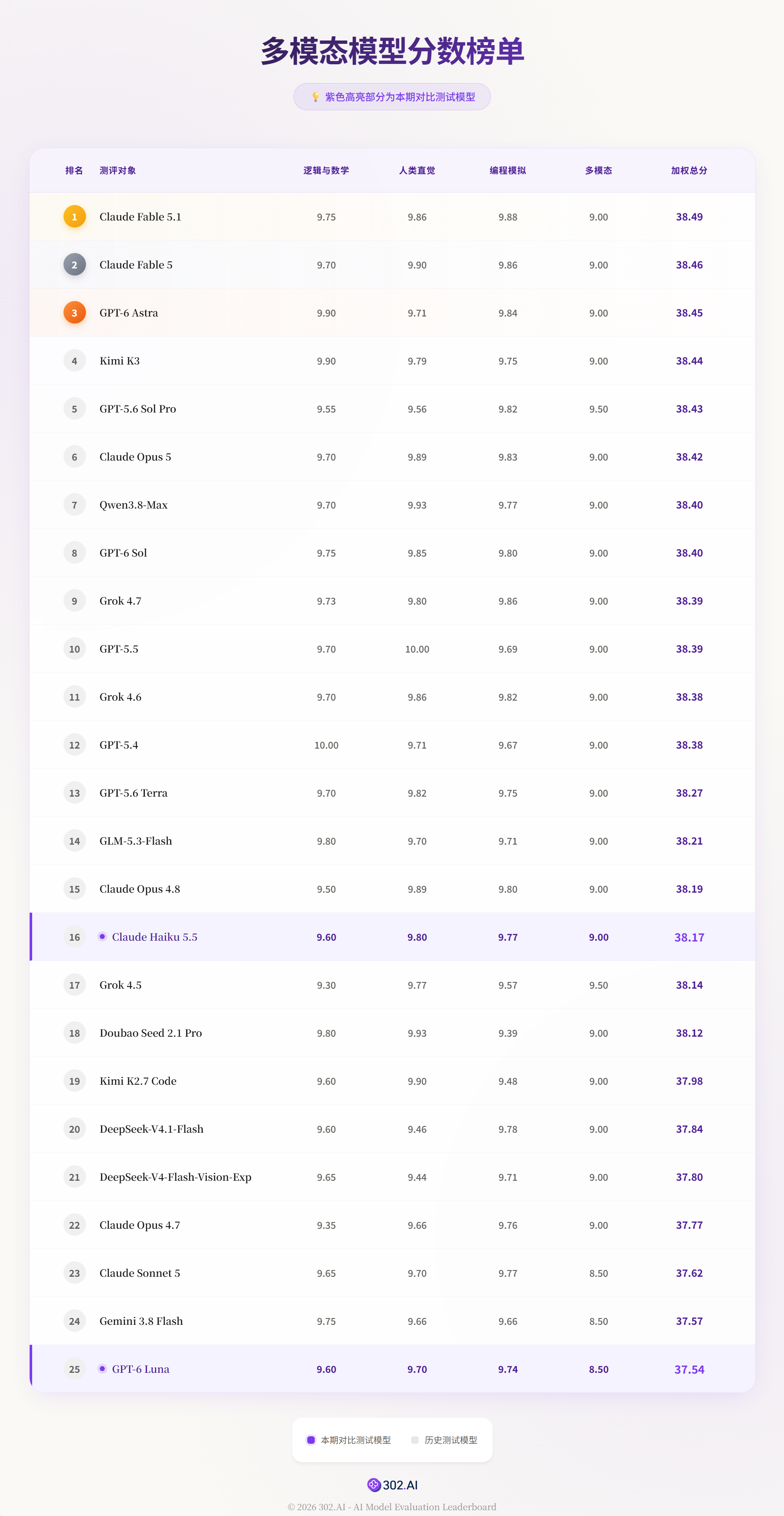
DeepSeek-V4.1-Flash posted a weighted total of 37.84, ranking 16th on the scoreboard. Its category scores were 9.60 for logic and math, 9.46 for human intuition, 9.78 for coding simulation and 9.00 for multimodal.
Case 1: procedural SVG generation
Prompt 1: Draw an animated SVG of a carousel in motion.

Prompt 2: Draw an animated SVG of a young skateboarder popping an Ollie in midair.

Verdict: V4.1 Flash gets the compositional complexity and the atmosphere of the scenes about right, with noticeable flaws only in the animation. The skateboarder's leg joints change through the takeoff, the airborne phase and the landing, for example, but the hand movements are implausible.
Case 2: website recreation
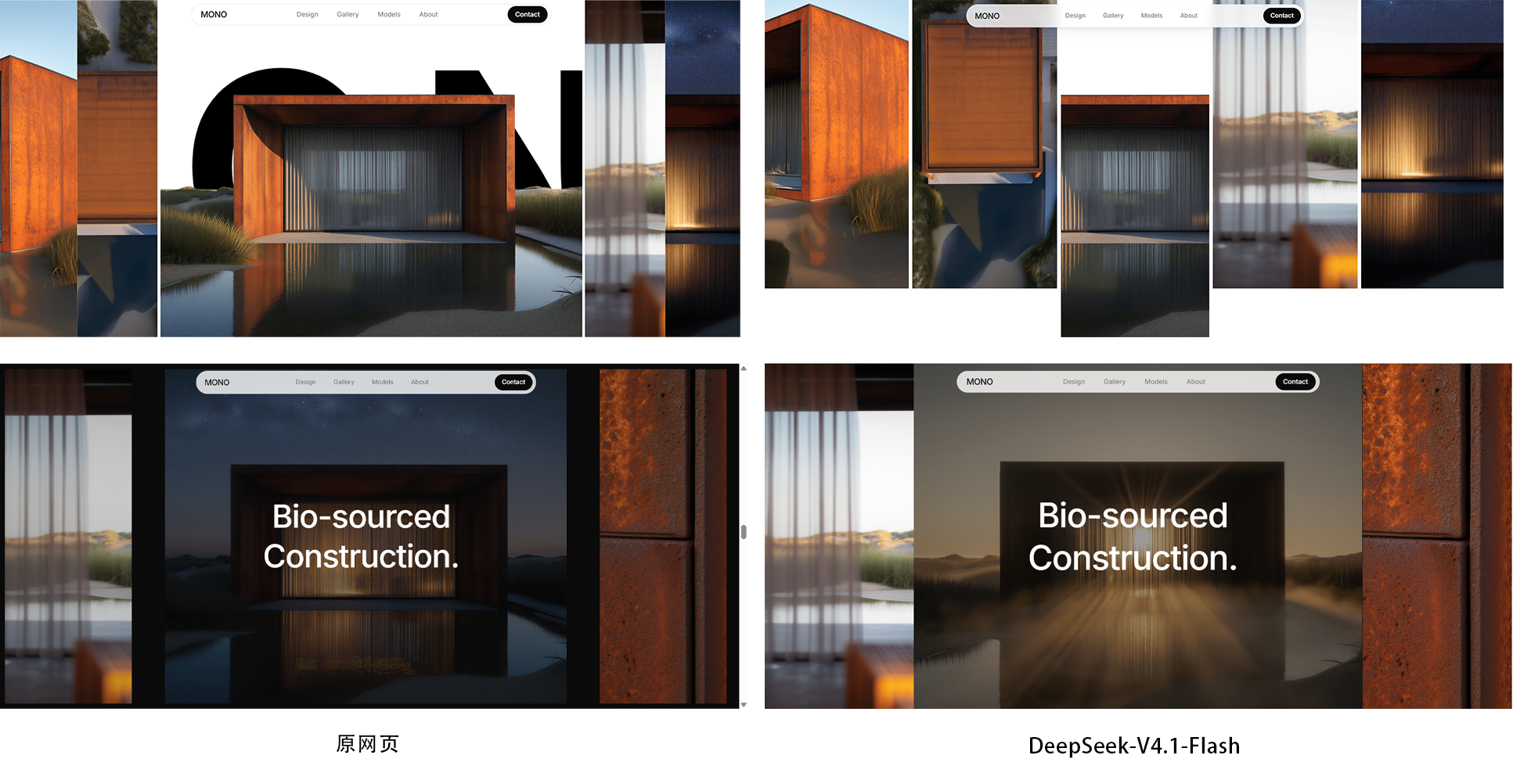
Given the URL of the Mono e-commerce template on v0.app, the model was asked to recreate the page pixel for pixel.
Verdict: fidelity is high overall. The page's basic structure is reproduced in full and the animated effects largely match the original; differences remain only in the details below.
Font differences:

Layout differences:
Case 3: 3D ball-pouring simulation
Prompt:
Create a single-page HTML 3D animation using Three.js.

Build a clean product-style scene with a transparent rectangular box containing about 30 colorful balls.

Animation:
1. The box slowly tilts to one side, causing the balls to fall out naturally.
2. The balls roll, bounce, and collide with each other and the ground.
3. After a short pause, the balls gradually roll back toward the box.
4. The balls enter the box and settle back inside.
5. The animation then loops.

Requirements:
- Use Three.js and JavaScript.
- Simulate basic gravity, velocity, collision, bouncing, and friction.
- Avoid balls passing through each other, the box, or the ground.
- The balls should have natural physical movement rather than simply following predefined paths.
- Add soft lighting, shadows, and a clean light-colored background.
- Add Play / Replay controls.
- Allow mouse drag to rotate the camera and scroll to zoom.
- Make the layout responsive.

Focus on realistic physics and smooth transitions. Avoid clipping, floating, teleportation, or obviously scripted-looking movement.
DeepSeek-V4-Pro's output for the same prompt served as the comparison.
Verdict: the ball-pouring simulator from DeepSeek-V4.1-Flash is clearly more complete than V4 Pro's in modeling quality, proportions and the control panel. It also handles the most important part, the motion, very well: the balls show no obvious violations of physical logic.
Case 4: interactive Three.js world
Prompt:
Create a polished, cinematic 3D railway simulator entirely in Three.js. Build a continuous countryside railway where a passenger train travels from a small station through a village, dense forest, mountain valley, dramatic bridge, and dark tunnel before emerging beside a beautiful lake.
Procedurally generate the train, tracks, terrain, trees, buildings, bridges, tunnels, signals, and other environmental details without Blender or external 3D assets. Give the train realistic motion with rotating wheels, subtle suspension, headlights, and smoke, while adding moving cars, birds, animated water, and swaying vegetation to make the world feel alive.
Use cinematic camera movements that follow the train, reveal wide landscapes, and showcase key moments along the journey. Make the environment gradually shift from warm countryside to mysterious forest, dramatic mountains, and a bright lakeside finale. Prioritize visual richness, smooth animation, atmospheric lighting, and a strong sense of scale while keeping everything performant in the browser.
Strengths:
- Massive scene construction: InstancedMesh is used to place 2,000 pines, 950 broadleaf trees, 2,400 shrubs, 520 boulders, 9,000 grass clumps, 2,600 flowers and 1,800 reeds, a substantial amount of code.
- Meticulous detail: the steam locomotive includes a smokebox, firebox, chimney, cab, connecting rods, crossheads, whistle, bell, headlight and many other parts; the suspension bob scales with speed, matching physical intuition.
- Strong atmosphere: nine ATMOS keyframes cover color, sun elevation, fog density, cloud cover and more, giving the sky a complete color-transition curve.
- Clean architecture: the scene is built layer by layer in parts 1–8, with per-frame logic highly decoupled.
Weaknesses:
- Oversized file: nearly 4,000 lines in a single file, which makes the first parse expensive.
- Flawed physics animation: in some scenes the carriages leave the tracks.
- Some scene placement errors: plants float above the ground.
Conclusion
Although V4.1 carries the Flash suffix, it shows capabilities close to, and in places beyond, V4 Pro. Across the coding, 3D scene-building, physics simulation and multimodal tasks in this round, it delivered a high level of completeness and stability, and in some cases it actually outshone V4 Pro.
Strength: clearly better coding
The most visible gains are in coding. The animated SVGs, the website recreation, the Three.js railway simulator and the ball physics simulation all show that V4.1 Flash has become better at breaking down and implementing complex requirements. The 3D ball-pouring case is the clearest example: the model had to handle scene modeling, gravity, collisions, bouncing, friction, box tilting and interactive controls all at once, and the result is fairly complete in modeling quality, proportions, control panel and motion, with no obvious violations of physical logic. Compared with V4 Pro, the improvement on this kind of composite coding task is especially apparent. In the complex Three.js case, the model was likewise able to build a large-scale scene, handle lighting, animation and environmental detail, and keep outputting, reasoning and repeatedly verifying its deliverable over a long-horizon task of 4,000 lines of code in a single file.
Strength: multimodality rounds out the experience
Native multimodality further improves the practical experience. Images, screenshots, charts and PDFs can go straight into the same workflow, which is more convenient for agents that need visual information to complete a task, and the output keeps its visual taste and overall style fairly well. Combined with lower API prices and a smaller KV Cache, V4.1 Flash also has an edge in long-context, multi-turn and sustained-execution scenarios.
Weakness: unstable on complex tasks
V4.1 Flash beats V4 Pro on some specific tasks, but its ceiling is still some distance from that of true mainstream flagship models. It has been heavily optimized for complex coding, 3D scenes and agent tasks, yet stability still wavers once the difficulty goes up further, as with the derailed carriages, floating plants and widespread clipping in the railway simulator. The ball simulation is fairly complete overall, but that mostly shows it can now handle complex tasks; it still has a way to go before matching the sustained high quality, distinctive taste and low error rate of flagship models.
Weakness: the value advantage is not absolute
In terms of real-world cost, V4.1 Flash does not have an overwhelming price-performance edge either. API prices are certainly low, and cached input is especially attractive, but when capability, stability and price are weighed together, peers such as GLM 5.3 Flash are more competitive. Cost control across different types of tasks also cannot be judged on API unit prices alone.
Source: 302.AI