GPT-6 Sol tested: half the price, steady gains in capability
OpenAI launched GPT-6 Sol on the same day as Opus 5.5, cutting prices by 50%. Tested against GPT-5.6 Terra on the same prompts, Sol shows clear gains on complex coding tasks but only middling multimodal reasoning. Its biggest advantage is still price.
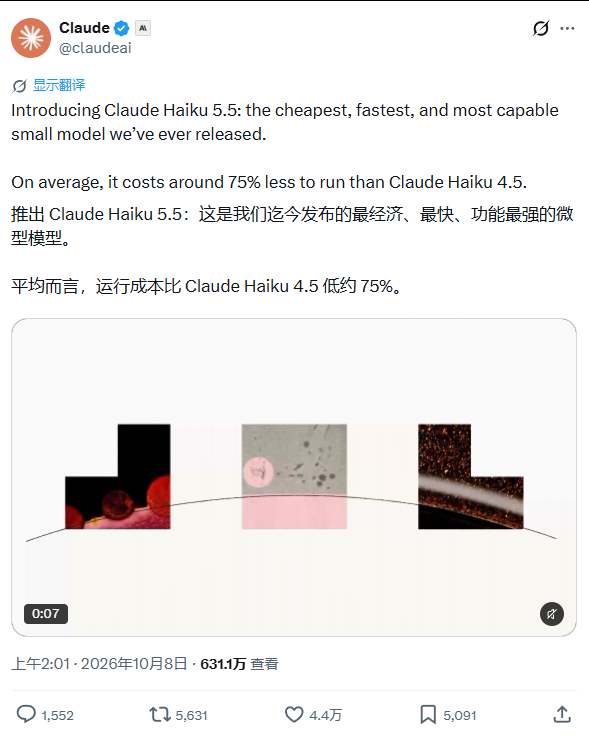
On September 22, Anthropic released Claude Opus 5.5, pitching intelligence on par with its own flagship Fable 5.1 at 40% less cost than Opus 5. At $4/$20, it is priced attractively among today's flagship models.
OpenAI had no intention of letting its rival own the headlines. The same day, it launched GPT-6 Sol and GPT-6 Luna and went straight at price:
- GPT-6 Sol: $2 input and $10 output, exactly half of Opus 5.5's pricing.
- GPT-6 Luna: $0.10 input and $0.50 output, one-twentieth of the flagship price and aimed squarely at Chinese models.
Anthropic had just touted being "40% cheaper than before," and OpenAI answered the same day with an even lower price tag. Two launches on one day, head to head.
Naming: an astronomical lineup
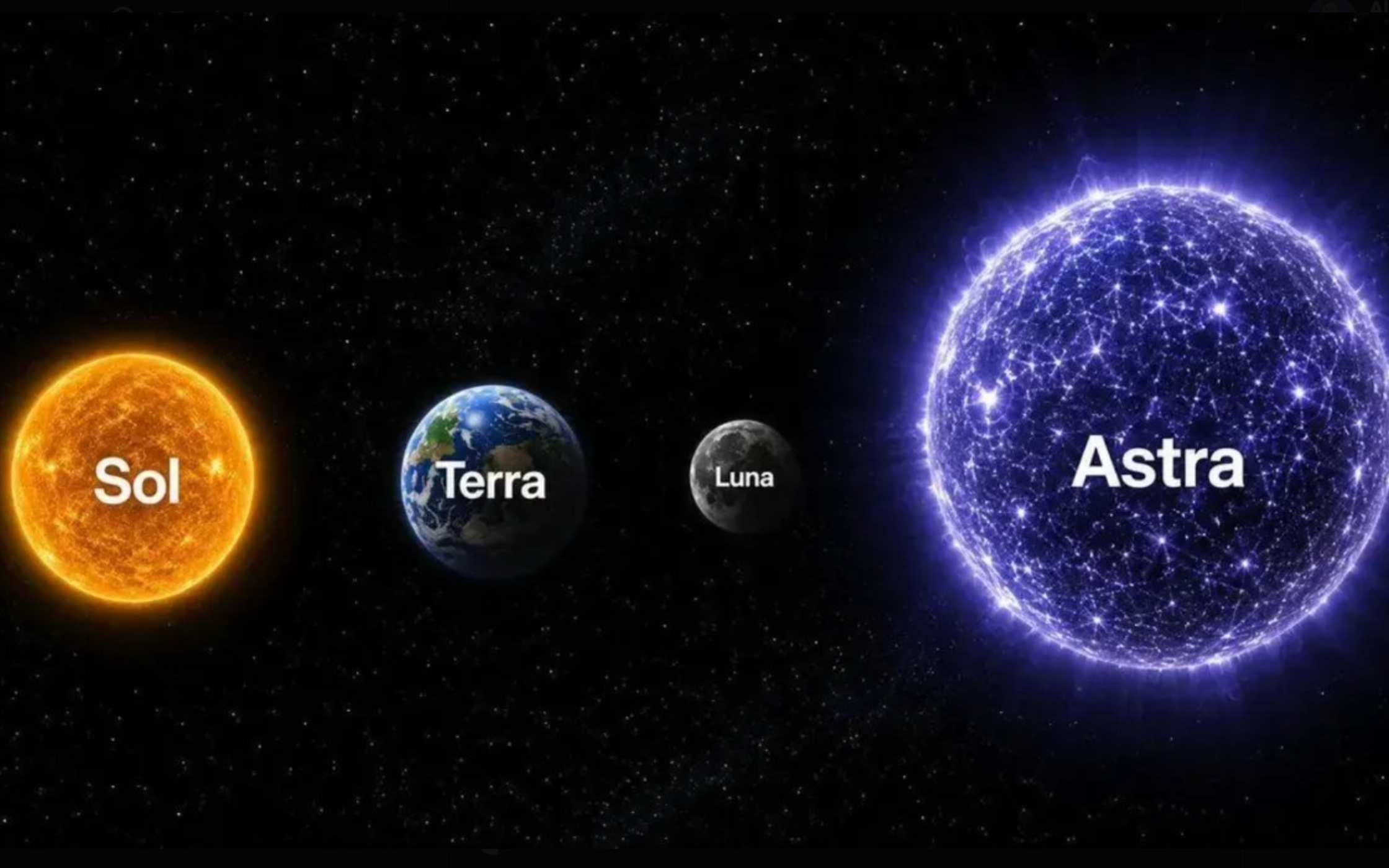
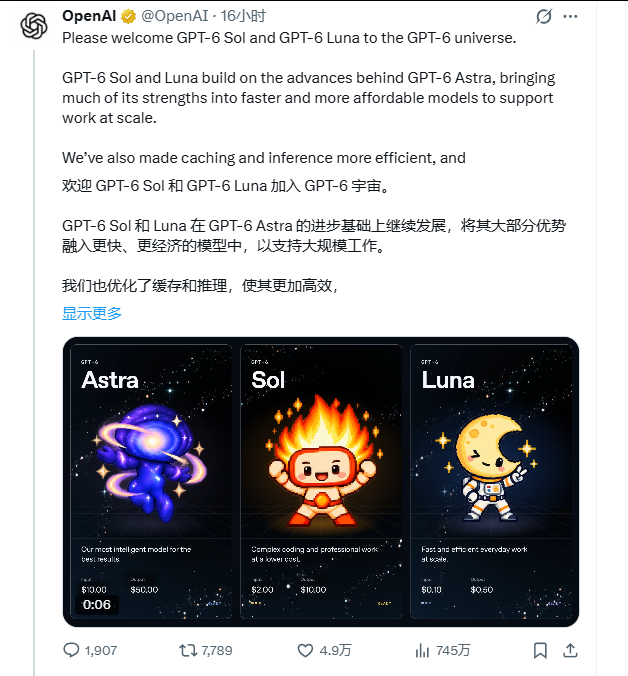
With GPT-6, OpenAI has stopped stacking suffixes onto version numbers and switched to astronomical names:
| Model | Positioning | API price (per million tokens, input/output) |
|---|---|---|
| GPT-6 Astra | Flagship, released September 3 | $10 / $50 |
| GPT-6 Sol | Workhorse, this release | $2 / $10 (previous gen $4/$20, down 50%) |
| GPT-5.6 Terra | Mid-tier (no GPT-6 version yet) | $2 / $12 |
| GPT-6 Luna | Lightweight, high-volume, this release | $0.10 / $0.50 (previous gen $0.20/$1.20, down 50%) |
Two details are worth noting:
- This is a straight 50% price cut, not a limited-time promotion.
- The real contest is over caching. Cached reads across GPT-6 get a 90% discount, which puts Luna's cached input at just $0.01 per million tokens. As an early tester, GitHub reported that the caching improvements cut the new tokens Copilot has to process by more than 50%. For agent workloads, this is where most of the savings come from.
Performance and price
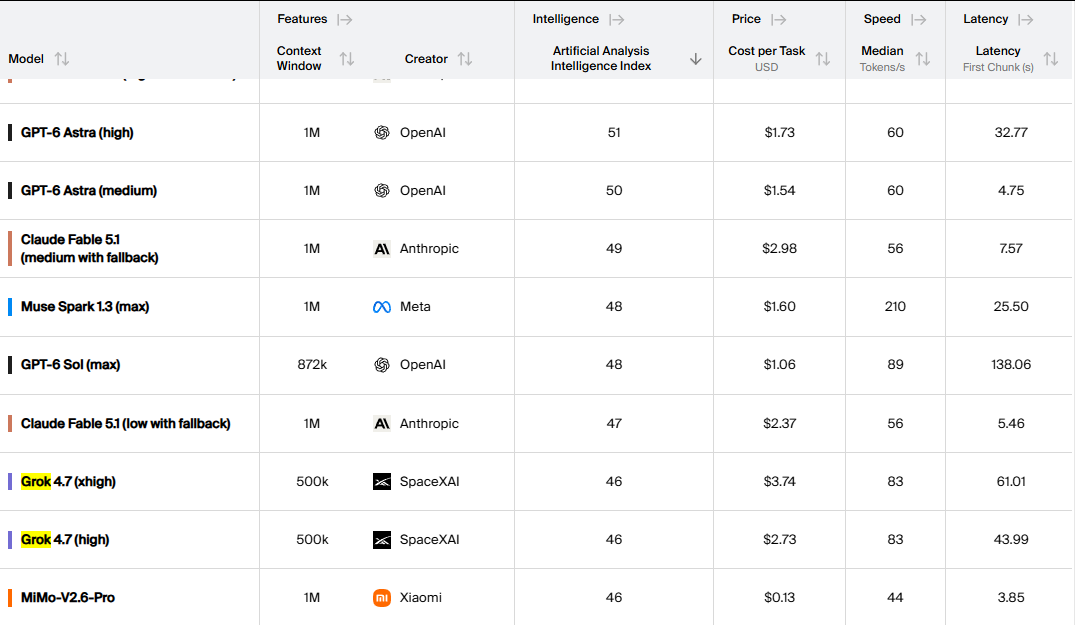
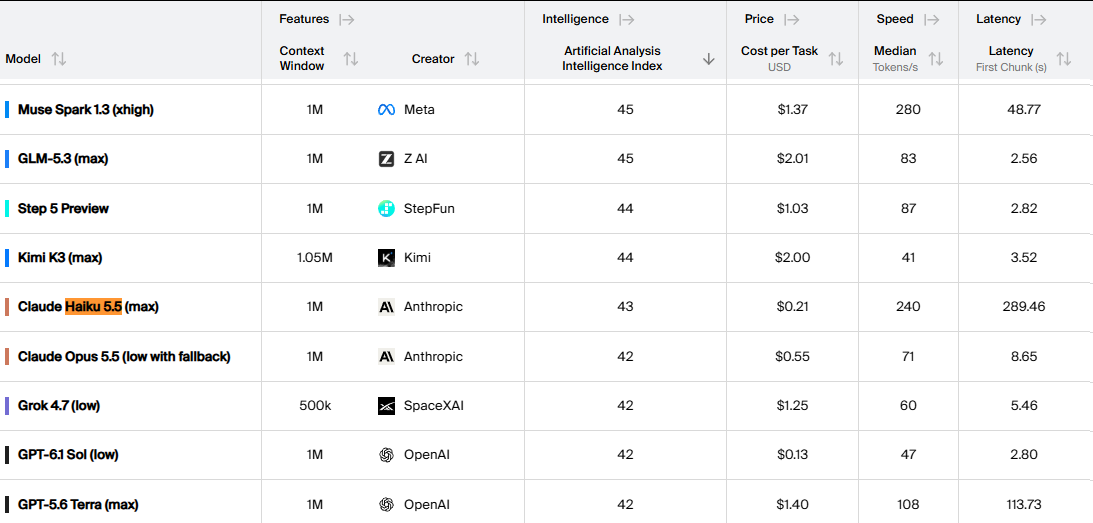
OpenAI's messaging this time was notably restrained: no talk of AGI, no talk of revolution. Third-party evaluator Artificial Analysis went further, saying in its headline that the models halve prices but "barely move the needle" on performance.
On raw intelligence scores, Sol and Luna indeed set no new records. But measured by intelligence per dollar, they stand out.
Luna: flagship-level intelligence at one-hundredth the price
According to OpenAI, GPT-6 Luna at high settings matches GPT-5.6 Sol at one-hundredth of the cost.
Sol: beating a rival's top configuration at 1/11 the cost
On Zapier's AutomationBench, which covers real business workflows across sales, marketing, finance and HR:
- GPT-6 Sol (xhigh): 33.2%, at $0.27 per task.
- GPT-6 Astra (low): 30.3%, at 3.9 times Sol's cost. In other words, Sol is both cheaper and more accurate than OpenAI's own flagship.
- Claude Fable 5.1 (max): 31.4%, at more than 8.9 times Sol's cost.
Note: percentages are end-to-end task completion rates; 33.2% means roughly 33 out of 100 tasks were completed correctly from start to finish.
Factuality: an easily overlooked gain
In internal evaluations based on real user correction data, Sol's error rate was cut in half, bringing its reliability close to Astra's. A workhorse model catching up with the flagship on hallucination rates matters more for everyday use than any coding benchmark.
Leaderboard rankings
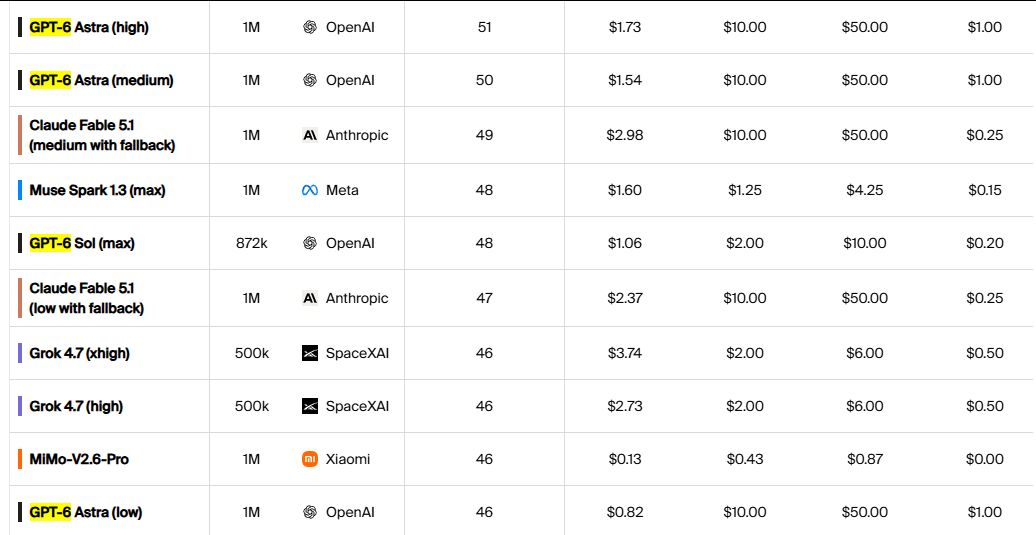
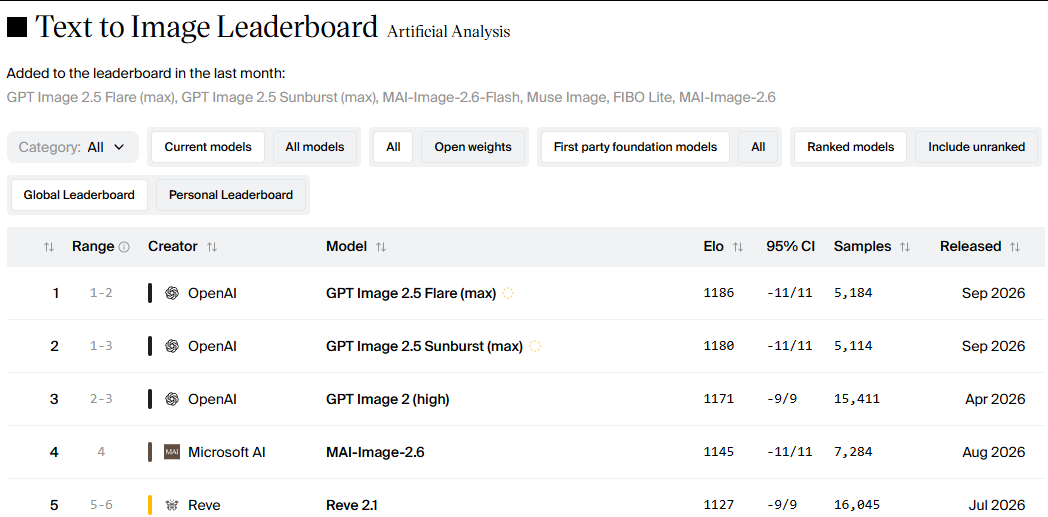
On the Artificial Analysis leaderboard, GPT-6 Sol and GPT-6 Luna rank 14th and 41st respectively.
Hands-on: GPT-6 Sol vs GPT-5.6 Terra
The following side-by-side tests pit GPT-6 Sol against GPT-5.6 Terra, the mid-tier workhorse of the 5.6 generation, on the same prompts to see whether the new generation is a meaningful step up.
Models tested
| Model | Context window | Official price (per million tokens, input/output) |
|---|---|---|
| gpt-6-sol | 1M | $2 / $10 |
| gpt-5.6-terra | 1M | $2 / $12 |
Methodology
This evaluation focuses on logic, math, coding, multimodal and human-intuition questions. It is not an authoritative test of specialized frontier domains; the aim is to track how models are evolving and to inform model selection.
- Question bank: 10 logic and math questions, 7 human-intuition questions, 20 multimodal questions and 12 coding simulation questions, with final results determined by the scoring rules; representative cases are shown below (question bank).
- Scoring: each question is worth 10 points and is graded against a deduction rubric; the final score is the average across rounds.
- All models received the same prompts, and only the first generated output was used; coding tasks were completed in a Claude Code sandbox.
Coding cases are rated on the following scale:
- ⭐⭐⭐⭐⭐ S tier: an industry benchmark that redefines the standard.
- ⭐⭐⭐⭐ A tier: production-ready, with no obvious weaknesses.
- ⭐⭐⭐ B tier: middling, with some weaknesses.
- ⭐⭐ or below, C tier: unusable, with obvious problems.
Results overview
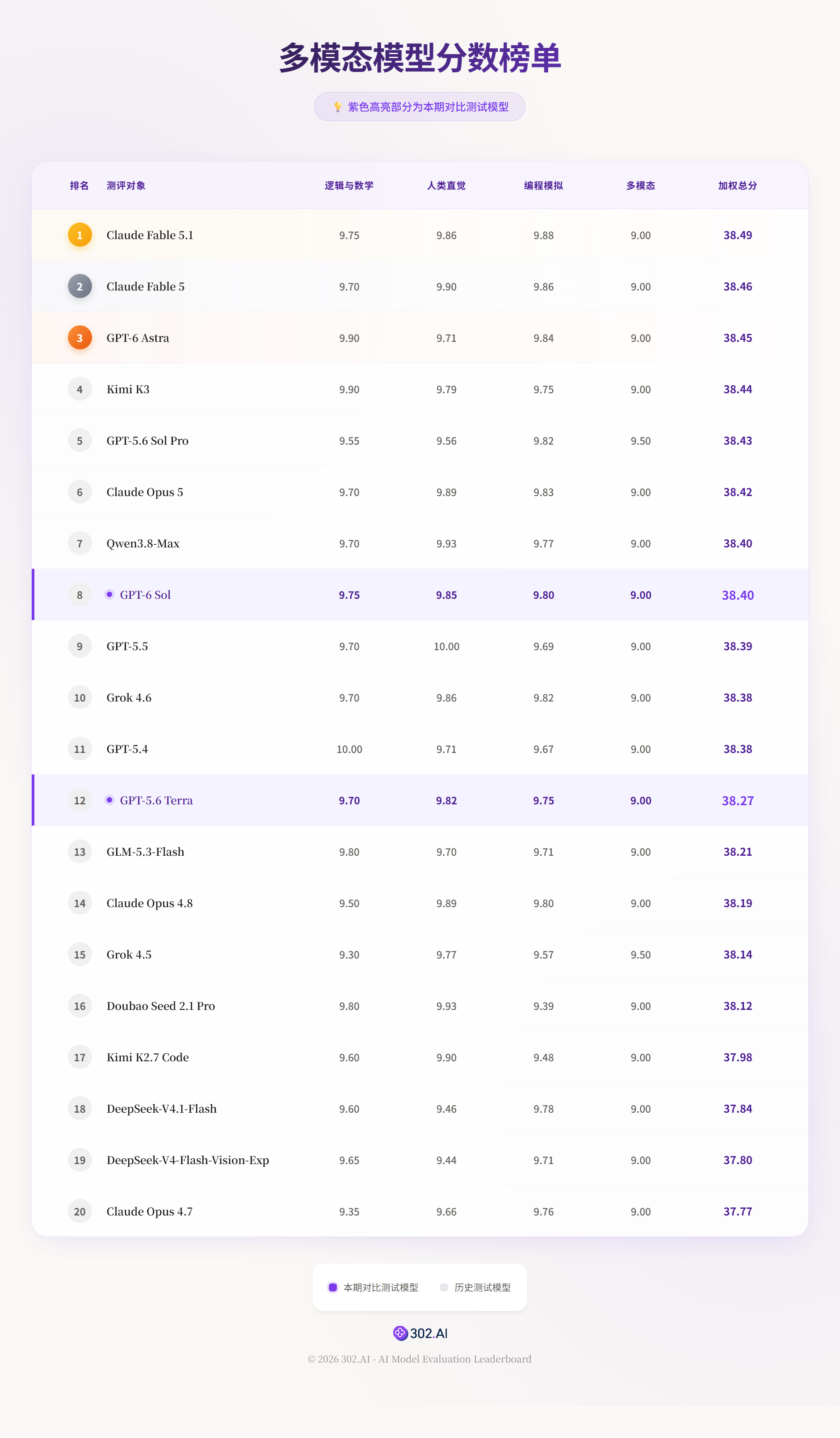
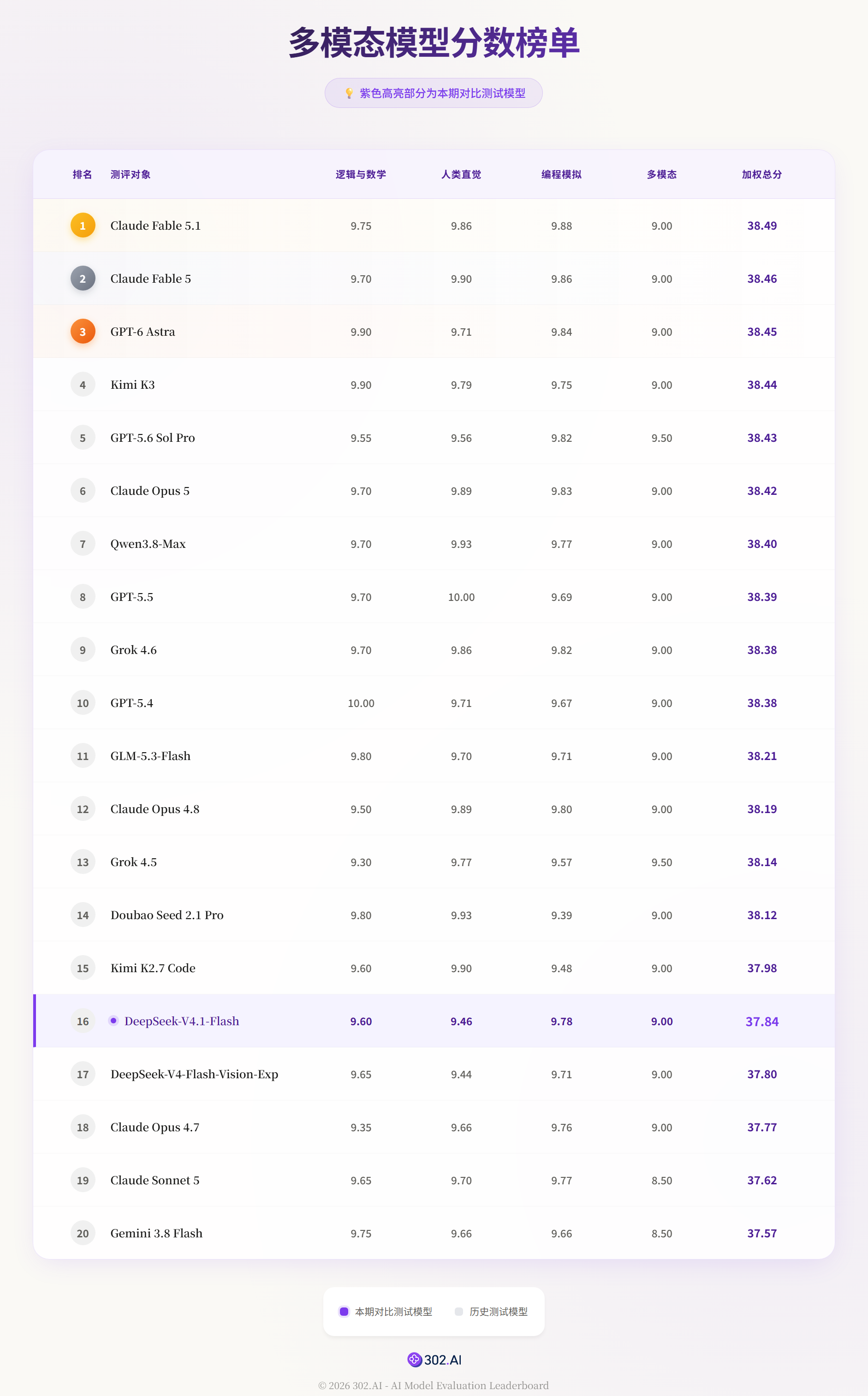
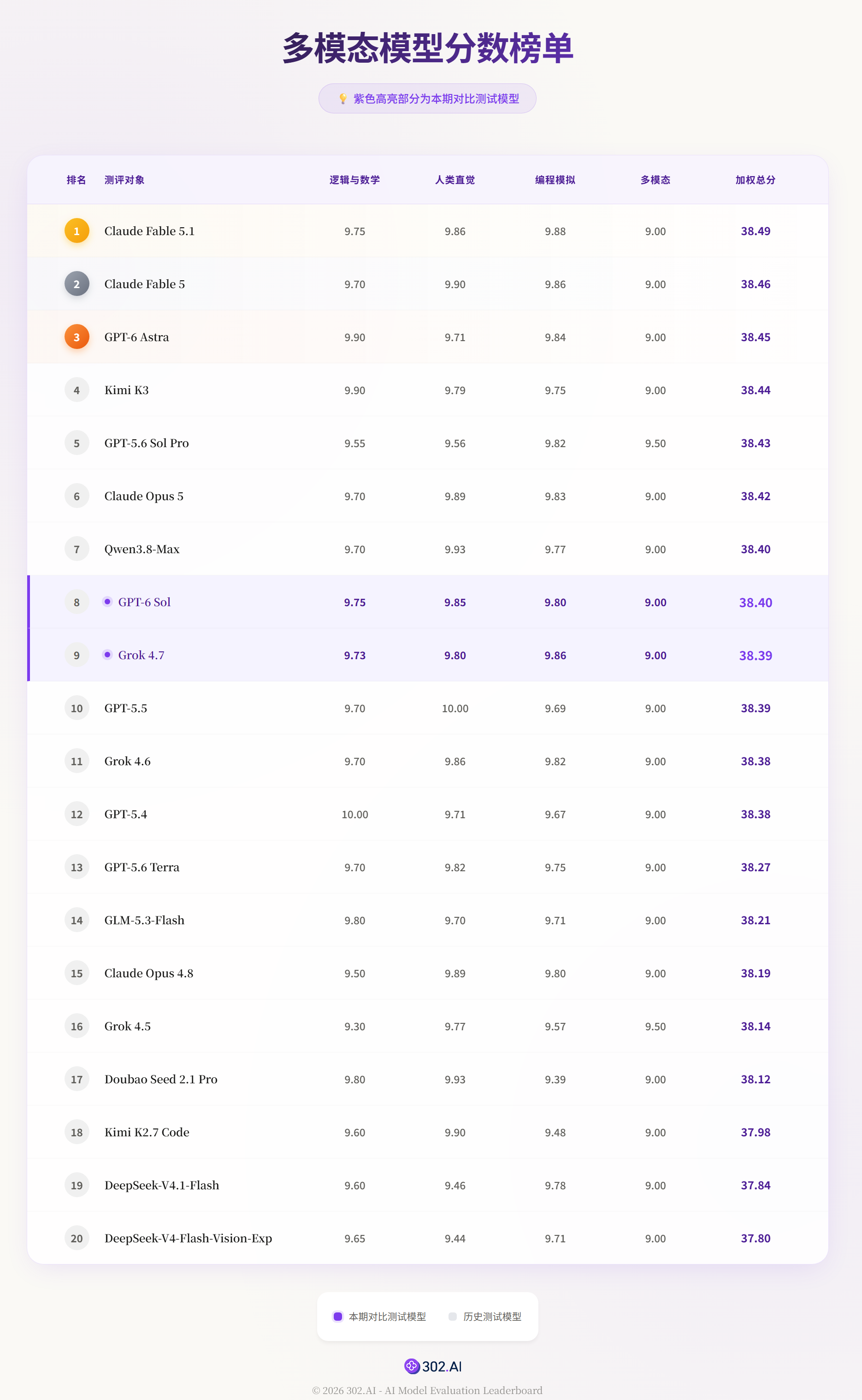
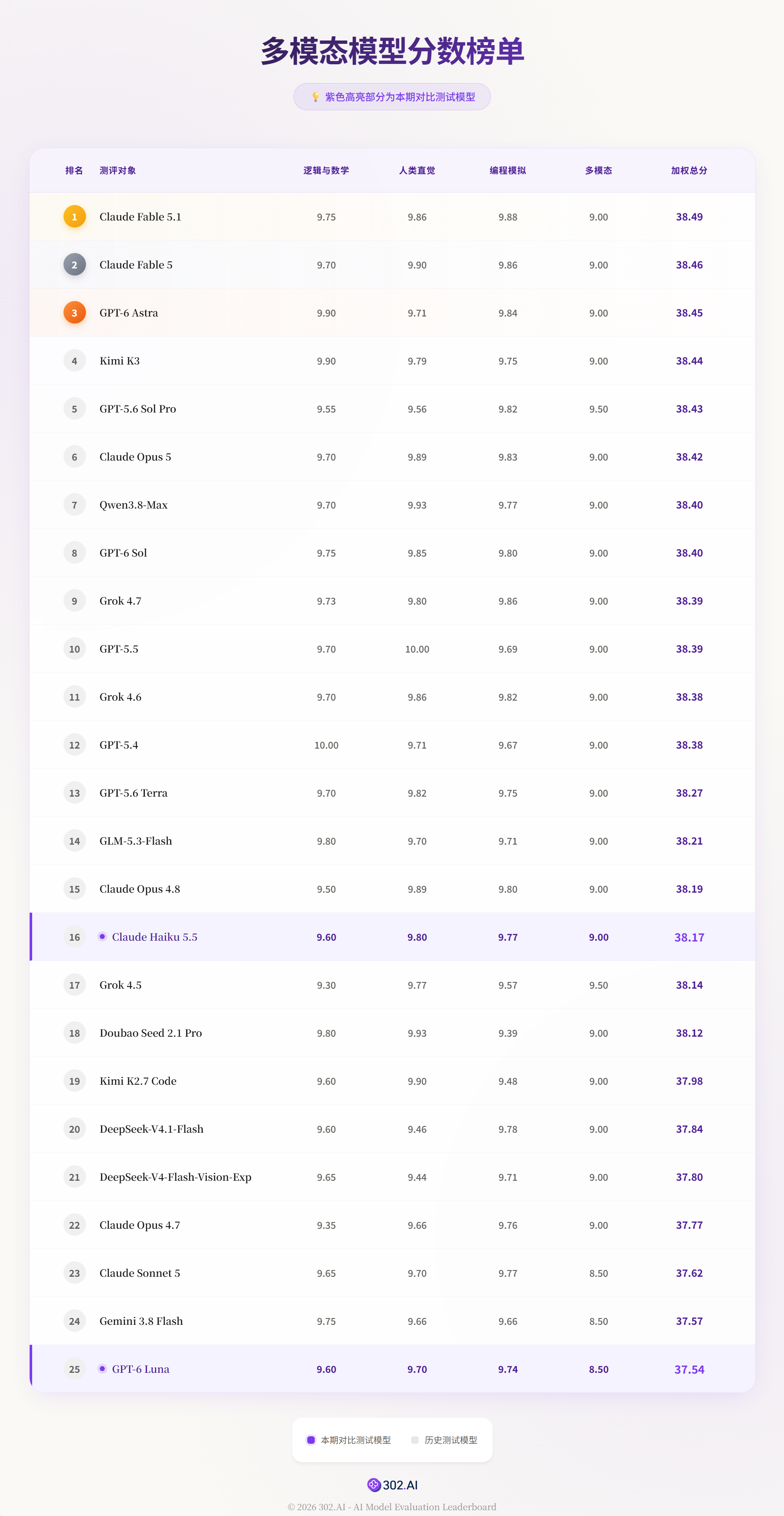
GPT-6 Sol posted a weighted total of 38.40, ranking 8th on the leaderboard; GPT-5.6 Terra scored 38.27, ranking 12th. Sol held narrow leads in logic and math (9.75 vs 9.70), human intuition (9.85 vs 9.82) and coding simulation (9.80 vs 9.75), while both scored 9.00 in multimodal.
Case 1: multimodal reasoning
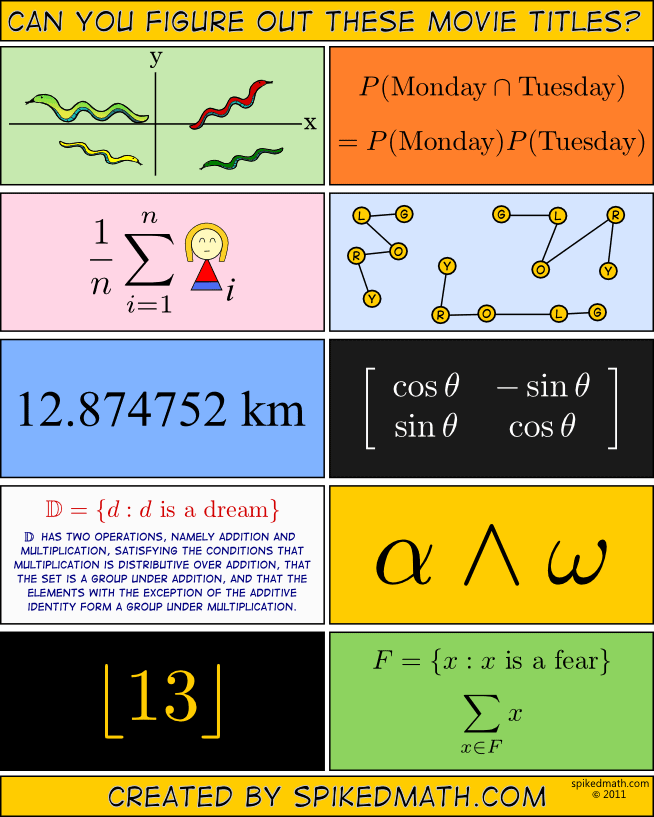
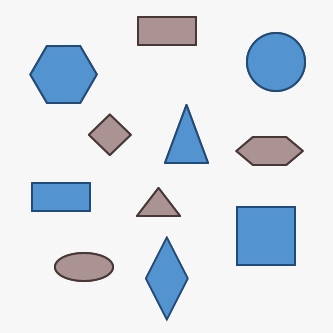
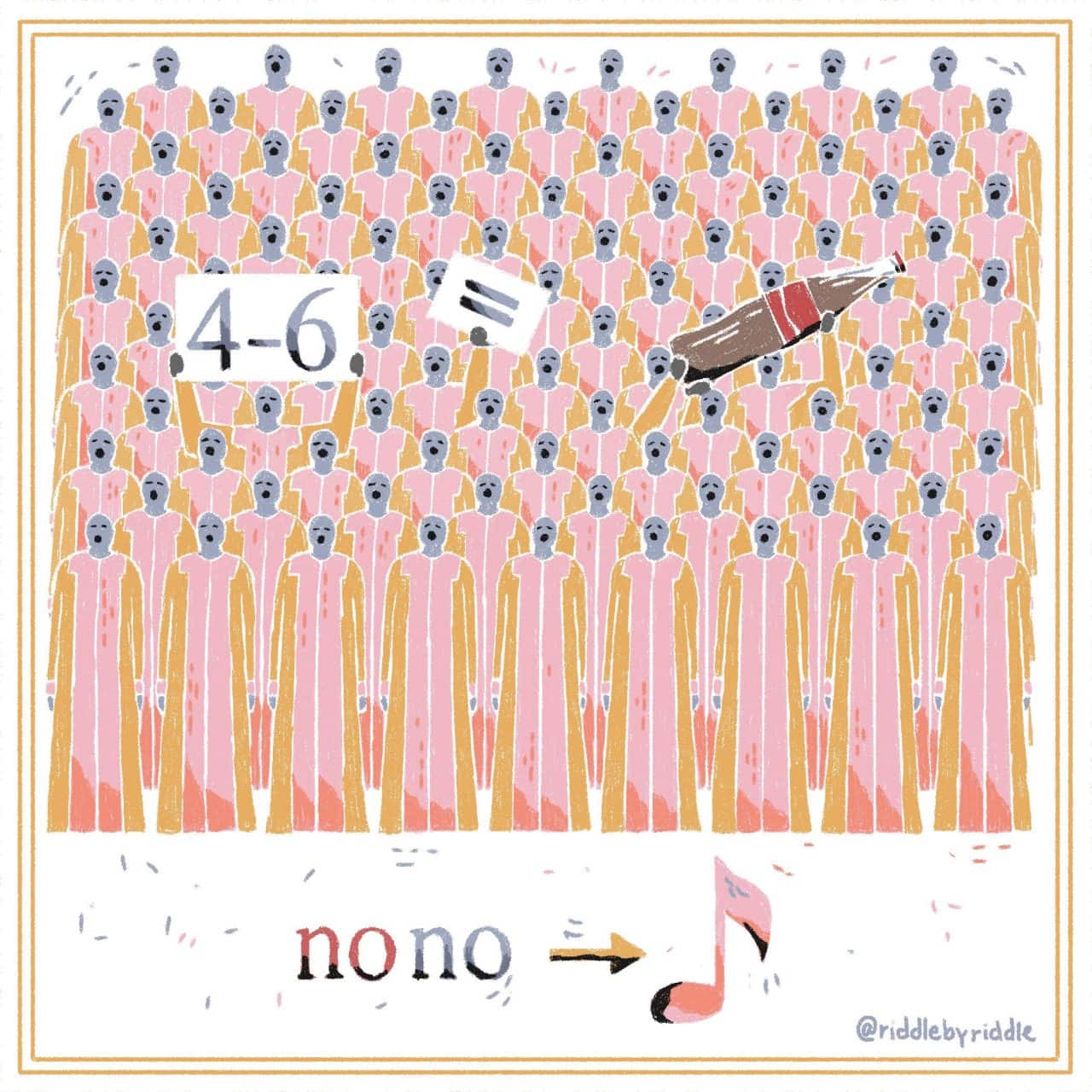
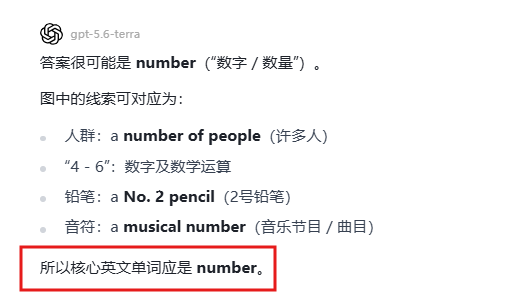
Prompt: Guess which English word the picture describes.
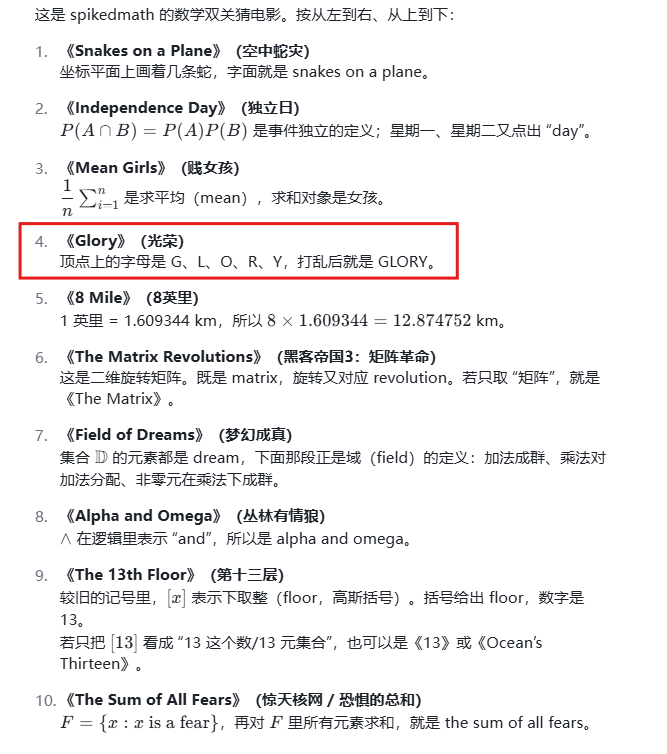
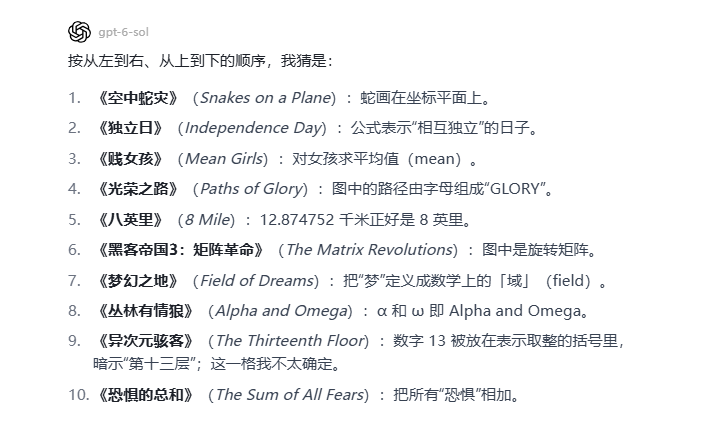
Answer: CHOCOLATE. The singers represent a choir (CHORUS). Replacing letters 4–6 with COLA gives CHOCOLA; then adding NOTE (the musical note) minus NO gives CHOCOLATE.

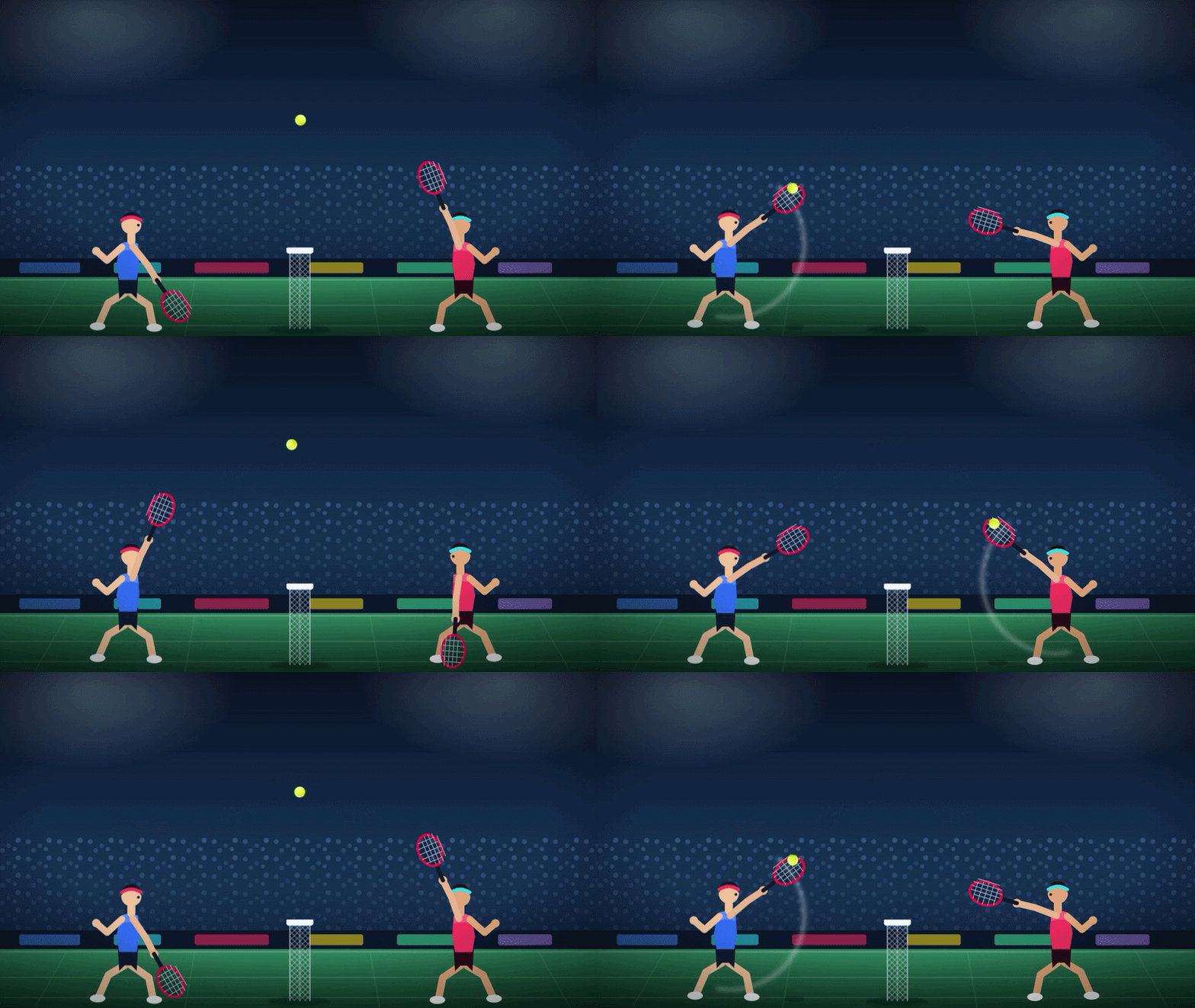
Case 2: procedural SVG generation
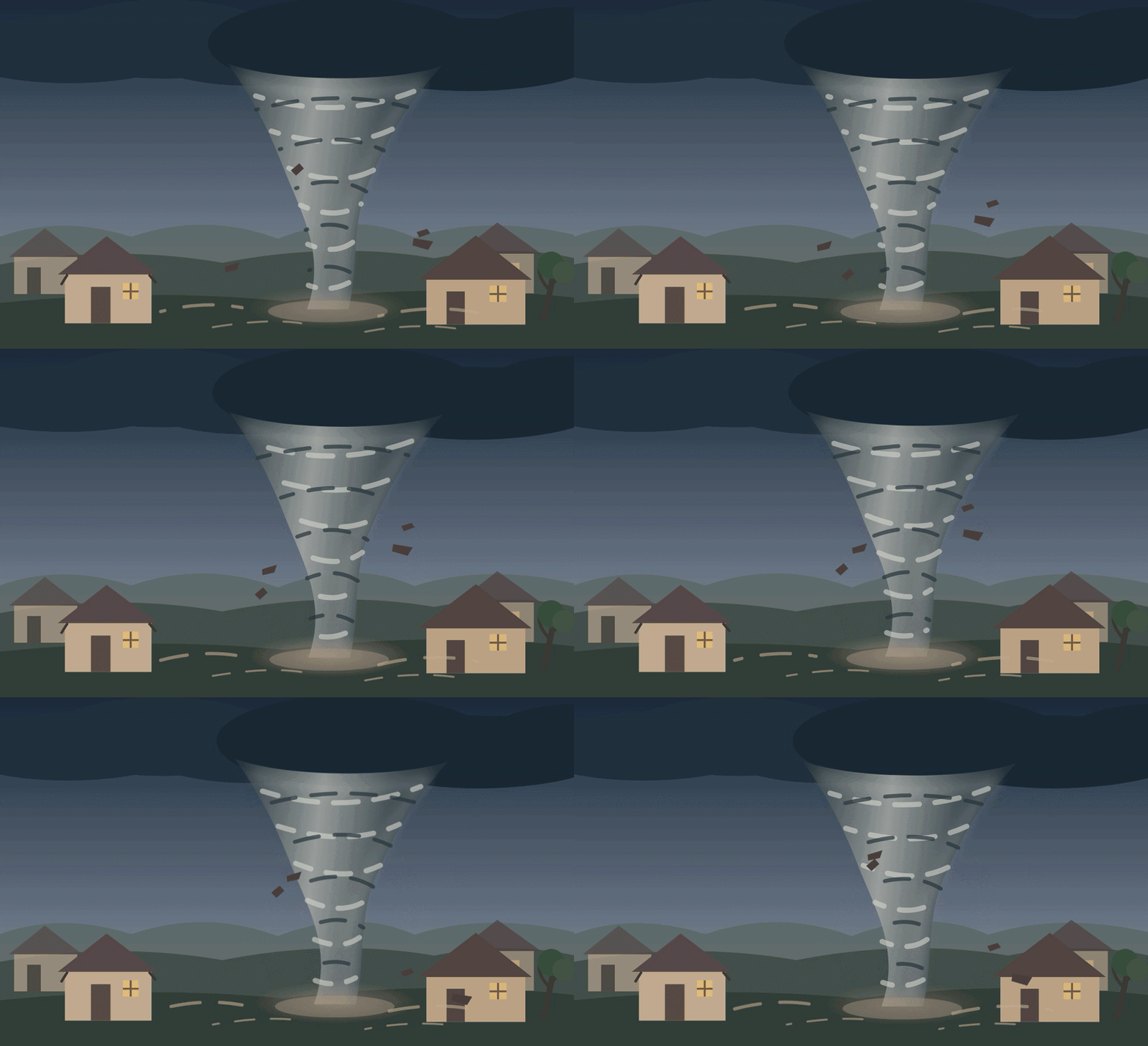
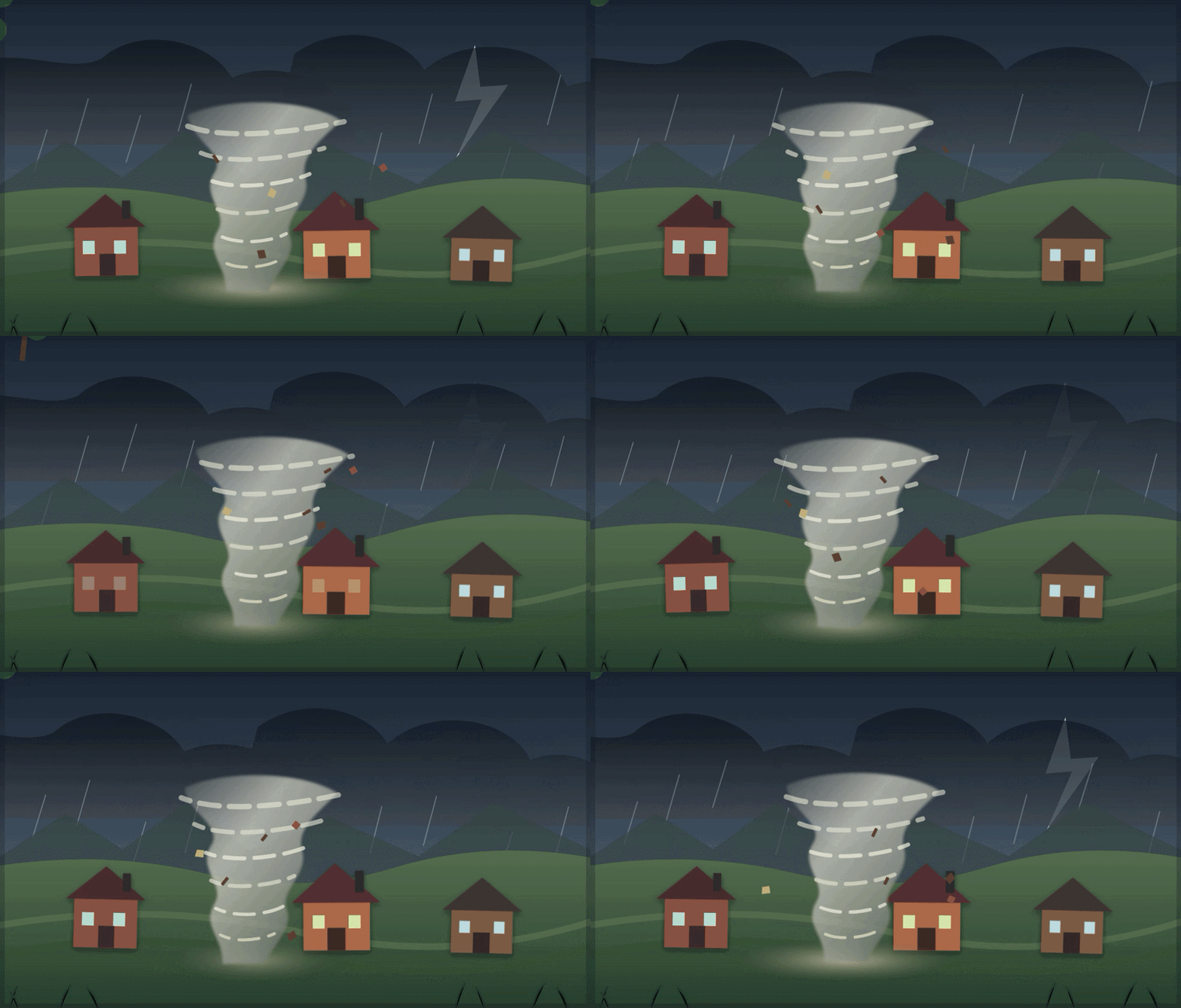
Prompt 1: Draw an animated SVG of a tornado sweeping through a village.
Prompt 2: Draw an animated SVG of a horse galloping to a river to drink.


| Criterion | GPT-6 Sol | GPT-5.6 Terra |
|---|---|---|
| Semantic accuracy | ⭐⭐⭐⭐⭐ | ⭐⭐⭐⭐⭐ |
| Compositional complexity | ⭐⭐⭐ | ⭐⭐ |
| Animation quality | ⭐⭐⭐ | ⭐⭐ |
Case 3: 3D endless runner game
Prompt (original English):
Create a polished 3D endless runner game as a single self-contained HTML file.
The gameplay should be inspired by the familiar mechanics of mobile endless runners: the character automatically runs forward along a multi-lane path, while the player can switch lanes, jump, slide, and dodge obstacles. Add collectible items, increasing speed, score tracking, and game-over/restart states.
Create a completely original setting, characters, environment, and visual identity. Do not copy the visual style, characters, locations, props, UI, or assets of any existing game. Use a stylized 3D aesthetic with a strong sense of depth and motion.
Include:
Smooth third-person camera following the character
Three-lane movement with responsive controls
Jumping, sliding, and obstacle avoidance
Procedurally generated sections so the run can continue
Moving obstacles and varied environmental hazards
Collectibles and score progression
Increasing difficulty and speed
Polished animations, lighting, particles, and camera effects
Keyboard and mouse controls
A clear start screen, HUD, game-over screen, and restart button
The final result should feel like a complete, polished 3D mini-game rather than a technical demo.
GPT-6 Sol
Strengths:
- Uses a genuine 3D camera system with follow, shake, flash and speed-line effects, a more technically demanding approach.
- Geometry is built from 3D polygons with correct depth sorting, natural occlusion and convincing scene depth.
- Sound effects are synthesized on the fly with WebAudio, and the audio feedback improves the experience.
Weaknesses:
- Despite the 3D polygons, the visual style looks rather blocky.
- High scores are not saved locally, so there is no "BEST" record after a restart, which weakens the incentive to replay.
GPT-5.6 Terra
Strengths:
- A neon theme with heavy use of glow effects gives it stronger visual appeal.
- More complete UI/UX, with a BEST record, a CRUISE multiplier, start and game-over panels, and hint text.
Weaknesses:
- Not a true 3D camera: it only zooms, with no rotation or pitch, so it is essentially pseudo-3D through perspective.
- Obvious logic flaws that can easily freeze the browser.
- Crude collision detection that may miss or misfire at high speed.
| Criterion | GPT-6 Sol | GPT-5.6 Terra |
|---|---|---|
| Gameplay creativity | ⭐⭐⭐⭐ | ⭐⭐⭐⭐ |
| Visual execution | ⭐⭐⭐ | ⭐⭐ |
| Technical implementation | ⭐⭐⭐⭐ | ⭐ |
Case 4: immersive digital museum
Prompt (original English):
Create a premium immersive 3D web experience about the history and making of traditional Chinese mooncakes, delivered as a single self-contained HTML file.
Design it as a cinematic digital museum rather than a conventional webpage. The visitor should move through a virtual exhibition space and experience the story through carefully choreographed camera movements, lighting, animations, spatial transitions, and interactive 3D objects.
The experience should include:
Origin & History — a cinematic introduction explaining the origins and cultural evolution of mooncakes through an immersive historical gallery.
Ingredients — interactively explore flour, lotus seeds, egg yolks, nuts, and other ingredients as detailed 3D objects.
Making Process — show the complete process: preparing the filling, making the dough, wrapping, shaping with a wooden mold, baking, and the final mooncake emerging from the oven.
Mooncake Showcase — create several original regional and traditional mooncake variations with different shapes, patterns, fillings, and textures.
Cultural Story — connect mooncakes with the Mid-Autumn Festival, family reunion, the full moon, lanterns, and traditional Chinese symbolism.
Build all visual elements yourself with Three.js and procedural geometry/materials. Do not rely on external images, downloaded 3D models, stock assets, or image textures. Model the mooncakes, ingredients, utensils, exhibition architecture, lanterns, moon, clouds, tables, shelves, and other major visual elements from scratch.
Use a sophisticated visual language: dark museum architecture, warm golden illumination, subtle volumetric atmosphere, realistic materials, soft shadows, reflections, floating particles, and restrained Chinese-inspired visual details.
The transitions should feel like a digital film or high-end interactive museum installation rather than a website slideshow. Use cinematic camera choreography, depth of field, slow reveals, object close-ups, environmental animation, and smooth transitions between exhibition spaces.
Make the experience highly polished and interactive. Users should be able to explore objects, trigger animations, zoom into the mooncake-making process, and move naturally between different exhibition areas.
The final result should feel like an award-winning interactive digital exhibition, with strong storytelling, atmosphere, spatial depth, and visual craftsmanship — not a collection of simple 3D objects placed on a webpage.
GPT-6 Sol
Strengths:
- A complete narrative structure: five separate circular galleries organized by chapter, with a progress bar at the bottom and a cinematic feel to the space.
- A more mature camera-follow system that lets users adjust the view freely by dragging.
- Deeper content: exhibits rendered in 3D and a detailed walkthrough of the mooncake-making steps, with complete scenes and high information density.
- A consistent visual language and high-quality code engineering.
Weaknesses:
- Loading depends on CDN modules, so it does not work offline.
- Some objects have limited geometric detail and look less refined up close.
- Weak interaction cues: some features show no highlight or outline feedback on hover.
GPT-5.6 Terra
It uses a corridor-style spatial narrative that visitors drag through, a good idea. But poor handling of light and shadow, along with rough animation and modeling, makes it visually unappealing and monotonous overall.
| Criterion | GPT-6 Sol | GPT-5.6 Terra |
|---|---|---|
| Visual execution | ⭐⭐⭐⭐ | ⭐⭐ |
| Narrative and information completeness | ⭐⭐⭐⭐ | ⭐⭐⭐ |
| Interaction and user experience | ⭐⭐⭐⭐ | ⭐⭐ |
Conclusion
The bottom line: among flagship-class models, GPT-6 Sol's overall performance is solid but unremarkable.
Compared with the previous mid-tier workhorse, GPT-5.6 Terra, it does improve across the board. But placed within the full GPT-6 lineup, Sol looks somewhat underwhelming.
Consistent all-round ability, no standout strength
In these tests, Sol's multimodal reasoning was mediocre, and it slipped up on some logical inference tasks. By contrast, it handled complex tasks better than its predecessor in the same tier, with greater consistency. Put differently, Sol is better at getting a complex project built than at cracking a single hard reasoning puzzle, where its edge is less clear.
As the GPT-6 family's workhorse, Sol can genuinely do it all, covering code, web pages, visual understanding and complex task orchestration. But among flagship models it leans toward stability and caution, without the kind of leap that leaves peers far behind.
Capable at coding, but not firmly top tier
In these cases, Sol did well at complex code generation and 3D web development. The projects it produced already had fairly complete engineering structures and could handle layered requirements such as camera systems, animation, sound and interaction logic. Compared with GPT-5.6 Terra, the improvement in technical implementation is plain to see.
In practice, though, if you want the strongest coding ability above all, Sol does not yet deliver flagship-level dominance. Set against Claude Opus 5.5, released in the same period, Sol still falls behind on some complex coding tasks, and Astra remains the higher-tier first choice. Sol is better suited to development work that involves heavy generation and repeated revisions while keeping costs under control.
In short, its coding advantage comes mostly from the balance it strikes between capability, speed and cost.
The real edge: price
Price is also what drew the most attention after GPT-6 Sol launched.
Sol's API price is now $2 input and $10 output per million tokens, matching GPT-5.6 Terra on input and undercutting it on output. On top of that, GPT-6's new caching mechanism further reduces the cost of repeated context.
So even if it does not dazzle on every capability metric, for users who work with agents, code and long-context tasks every day, good-enough capability, consistent performance and lower costs are its biggest advantage. In scenarios like long-running coding agents, complex web page generation and batch jobs, a single run may cost only a few dollars, but run dozens of times a day, the cost gap between models widens quickly.
Seen this way, Sol's positioning is very clear: a highly capable workhorse model you can call at scale without worry.
Price is GPT-6 Sol's biggest selling point in this release. Whether it is worth using depends on the task and the trade-offs, but for Sol, the advantage of costing half as much far outweighs how much more capable it has become.
Source: 302.AI