GPT-Image-2.5 tested: image quality plateaus as speed becomes the breakthrough
OpenAI's GPT-Image-2.5 splits into Flare for speed and Sunburst for precision, cutting latency by up to 50% with unchanged API pricing. Eight head-to-head tests against GPT-Image-2 show modest quality gains; speed and multi-turn editing consistency are the real upgrades.
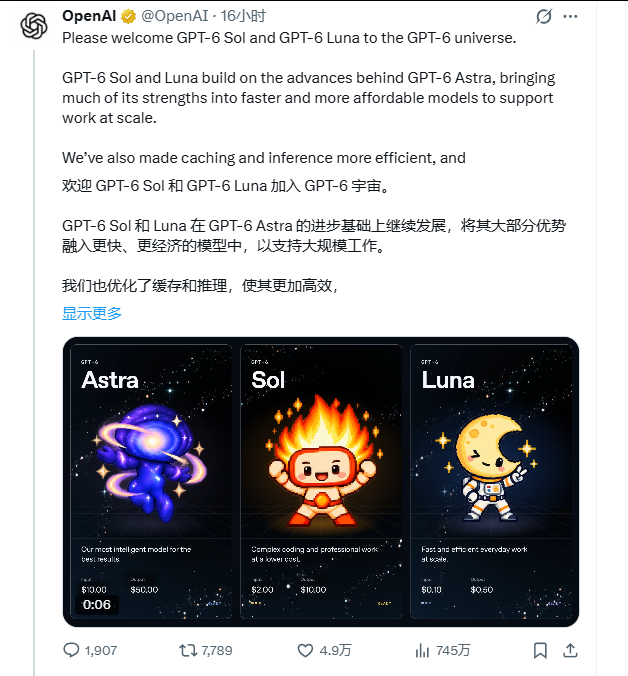
On September 9, 2026, just five days after releasing GPT-6 Astra, OpenAI launched two image models under ChatGPT Images 2.5.
OpenAI opened its announcement with a single figure: every week, people generate more than 3 billion images in ChatGPT and the GPT-Image API. That works out to roughly 5,000 images per second.
If AI image generation were still a niche toy, the focus of each iteration would naturally be the quality ceiling, and another 10% jump in quality would keep the AI crowd buzzing for days. But when 3 billion images a week is routine, the tool has become a productivity staple for many people. It is infrastructure, and one of the biggest pain points of infrastructure is throughput.
That is why the most important line in this update is this one: generation latency is down by up to 50%, and API pricing is unchanged.
From 2.0 to 2.5: one model becomes two
This upgrade includes a structural change, so it is worth sorting out the versions first.
Previously, GPT-Image-2 was a single model that handled everything, whatever the complexity of the task. Now Images 2.5 is one model in ChatGPT but is split into two in the API:
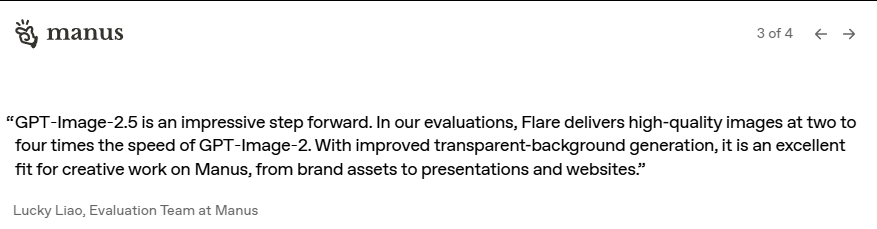
- GPT-Image-2.5 Flare (default): built for efficiency, with higher image quality than GPT-Image-2 and half the latency. According to the Manus evaluation team, it is two to four times as fast as GPT-Image-2 at the same high quality. It suits high-throughput work such as batch generation, social media assets, rapid prototyping and visual search.
- GPT-Image-2.5 Sunburst (precision): built for accuracy, trading longer generation times for tighter control. It targets production pipelines where the final output cannot go wrong, such as ad-grade materials and polished product shots.
Both models carry exactly the same token price ($30 per million image output tokens). Third-party estimates put the actual per-image cost of 2.5 at about a quarter of the previous generation's at the same high-quality setting: with better efficiency, each image burns fewer tokens.
In one sentence: instead of forcing users to choose between "fast" and "good," OpenAI has put each answer behind its own endpoint.
Four upgrades, and the underrated one is multi-turn consistency
OpenAI's update covers four areas: reference-image fidelity, precise editing, multi-turn consistency, and intelligence and style. The first two are the easiest to be impressed by, but the real turning point is the third.
Reference-image fidelity. Give it a photo of a real person, and the generated image still shows the same person: facial features, expression and recognizability survive a change of style. One widely shared third-party test turned a rough cat doodle drawn with a mouse into a realistic photo, then used a single follow-up instruction to change only the eye color while everything else stayed exactly the same.
Precise editing. "Change only what you specify" has gone from a gamble to a promise. Swap one product in a poster or change one outfit in a party photo, and the composition, lighting and surrounding details stay intact. For e-commerce and marketing teams, editing an image no longer means starting over.
Multi-turn editing consistency. Anyone who has used AI image tools knows the drill: round one, you are happy with the result; round two, you change the background and the face goes slightly off; round three, you try to fix the face and the outfit's style disappears. Every edit is a fresh roll of the dice, and after ten rounds the image is unrecognizable.
Images 2.5 remembers earlier changes across a multi-turn conversation, so each edit builds on what is already there instead of tearing it down and starting again.
This is the turning point because real creative work is never one-and-done. It is a loop of "generate, dislike, revise, revise again." Multi-turn editing that holds together means AI image generation can support a workflow for the first time, not just inspiration. Inspiration is a one-off; workflow is productivity.
Leaderboard rankings
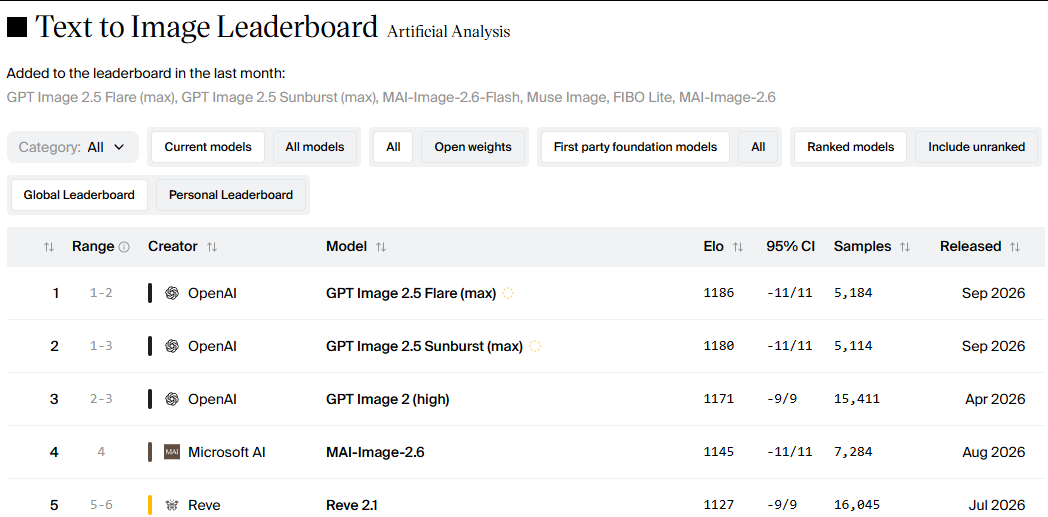
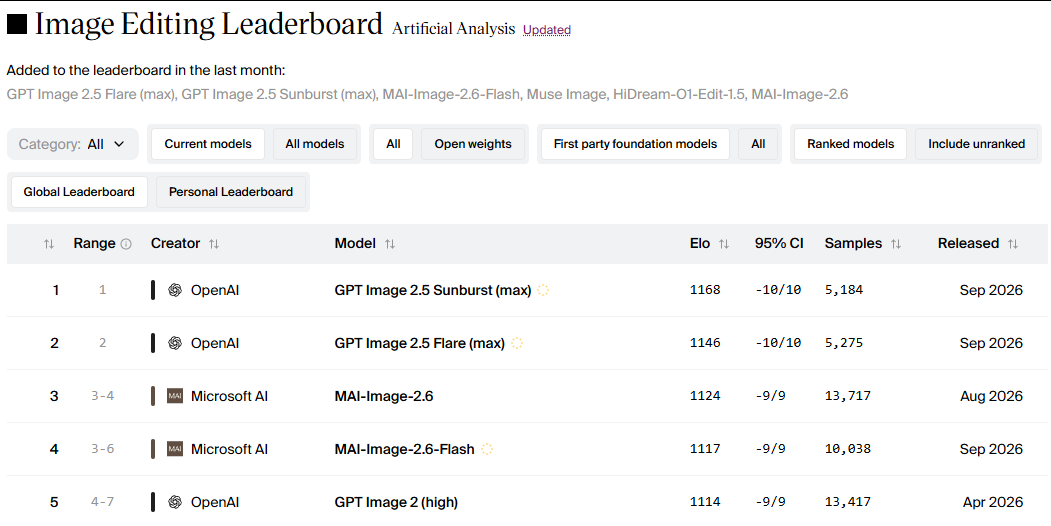
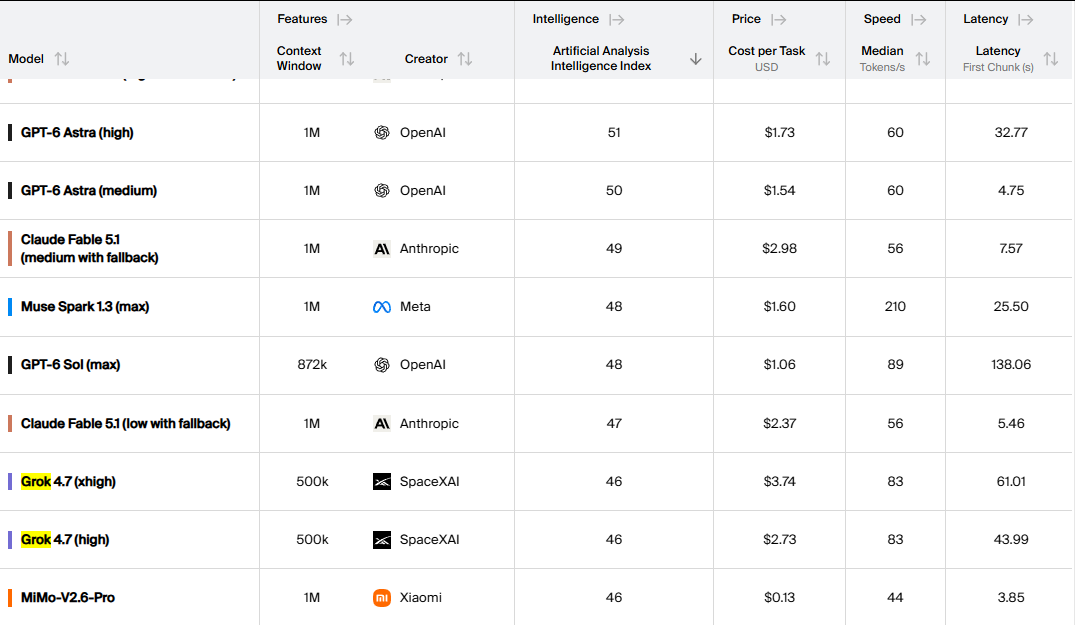
On both the Artificial Analysis text-to-image and image editing leaderboards, the two GPT-Image-2.5 models take the top two spots.
Test methodology
The tests pit GPT-Image-2.5 Sunburst against its predecessor, GPT-Image-2, which had long held the state-of-the-art (SOTA) position, to see whether the improvements are obvious at a glance.
- Goals: first, generation quality and aesthetics, assessing the visual results, including prompt adherence, detail and any artifacts or distortion; second, instruction understanding and execution accuracy, testing how well the model understands text or image instructions and whether the output accurately reflects the user's intent.
- Tools: all images were generated through an online API debugging console.
- Method: each case used the same Chinese or English prompts and images for both models, and the first generated result was taken. The results are for reference only.
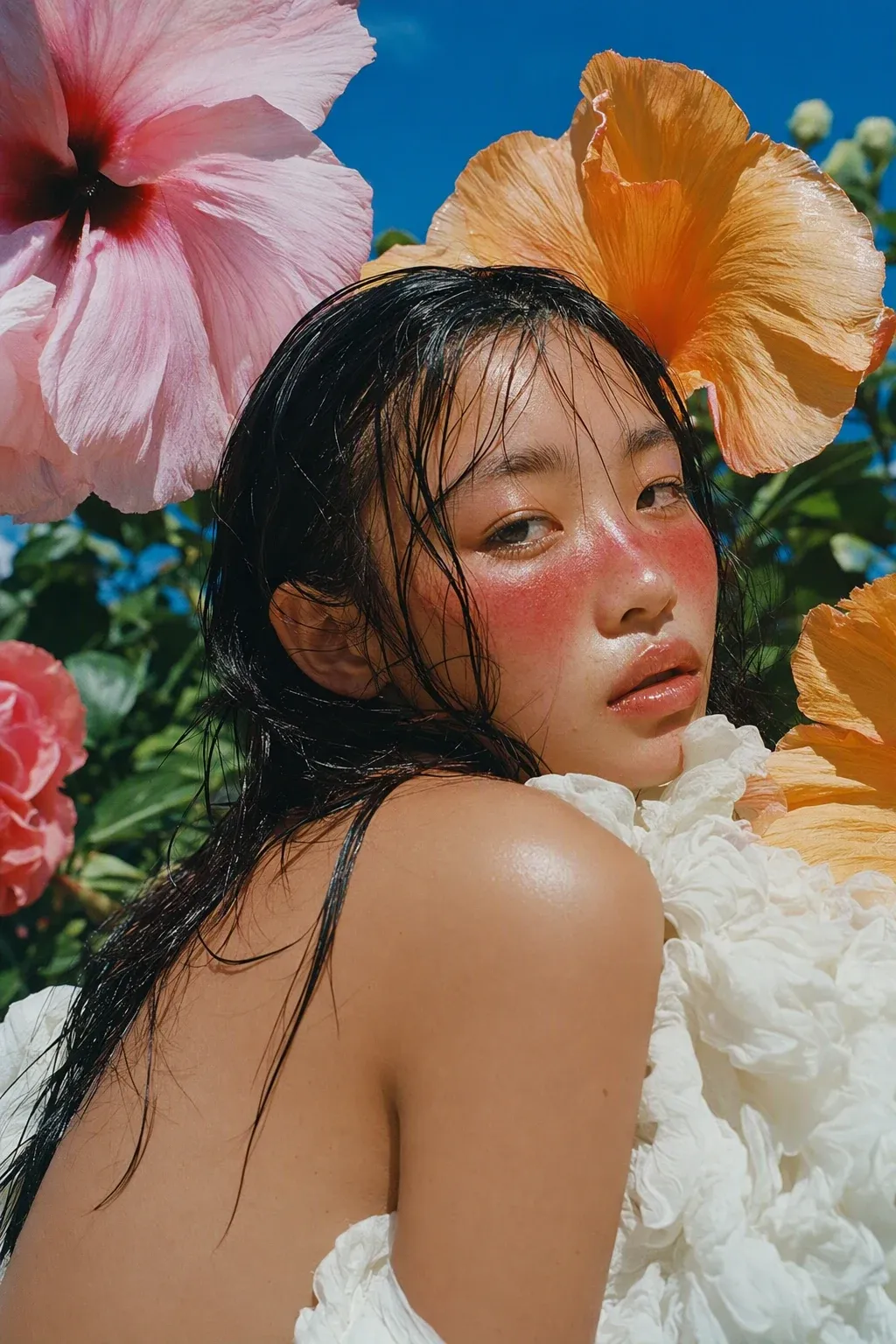
Case 1: text-to-image, realistic portrait
Prompt:
Fashion close-up editorial:
An Asian woman in her early 20s, wet-look styling with messy long black hair clinging to her face, sunburn makeup (heavy red blush across the bridge of the nose and the cheeks), glossy lips, realistic skin texture with freckles and pores.
Body turned sideways, looking back directly at the camera, calm and slightly hazy gaze, lips slightly parted. Bare shoulders, tightly hugging a huge cloud-like mass of white ruffled fabric, chin resting lightly on it.
Surrounded by giant surreal flowers, with the foreground and background framing her head together. Blue sky and dark green foliage in the background.
Hard midday light, strong highlights on skin and petals, sharp shadows, a midsummer-afternoon mood.
Highly saturated fashion surrealism, strong pink, orange, blue and green contrast, 35mm film grain, realistic skin detail with no smoothing.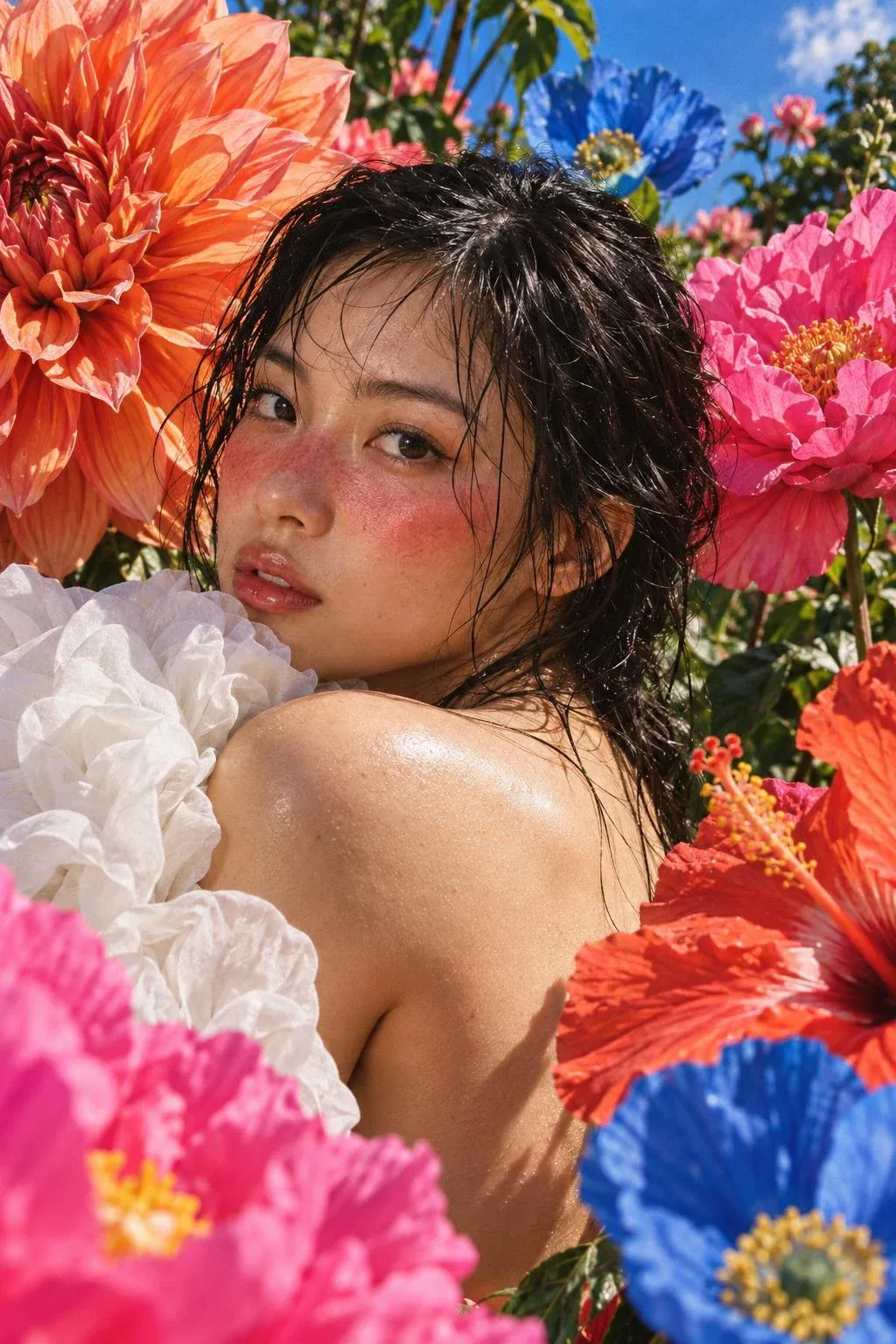
| Model | GPT-Image-2.5 Sunburst | GPT-Image-2 |
|---|---|---|
| Score | 5/5 | 4.5/5 |
Verdict: both follow the prompt accurately, with realistic, attractive images; which one you prefer comes down to taste. From a photographic point of view, 2.5 renders the flowers in richer detail, including stamens and foreground elements, giving fuller depth; the light falling on the model's back also adds a stronger sense of dimension.
Case 2: text-to-image, stylized photography
Prompt:
A colorful, abstract floral photograph with a strong motion-blur effect. The frame is filled with patches of pink, yellow, blue and green formed by flowers, stems and leaves blending and bleeding into one another. In the center of the frame, the lowercase text "more art merch coming soon" is written in a white serif font. The overall mood is light and whimsical. There is a small round white logo in the lower-right corner.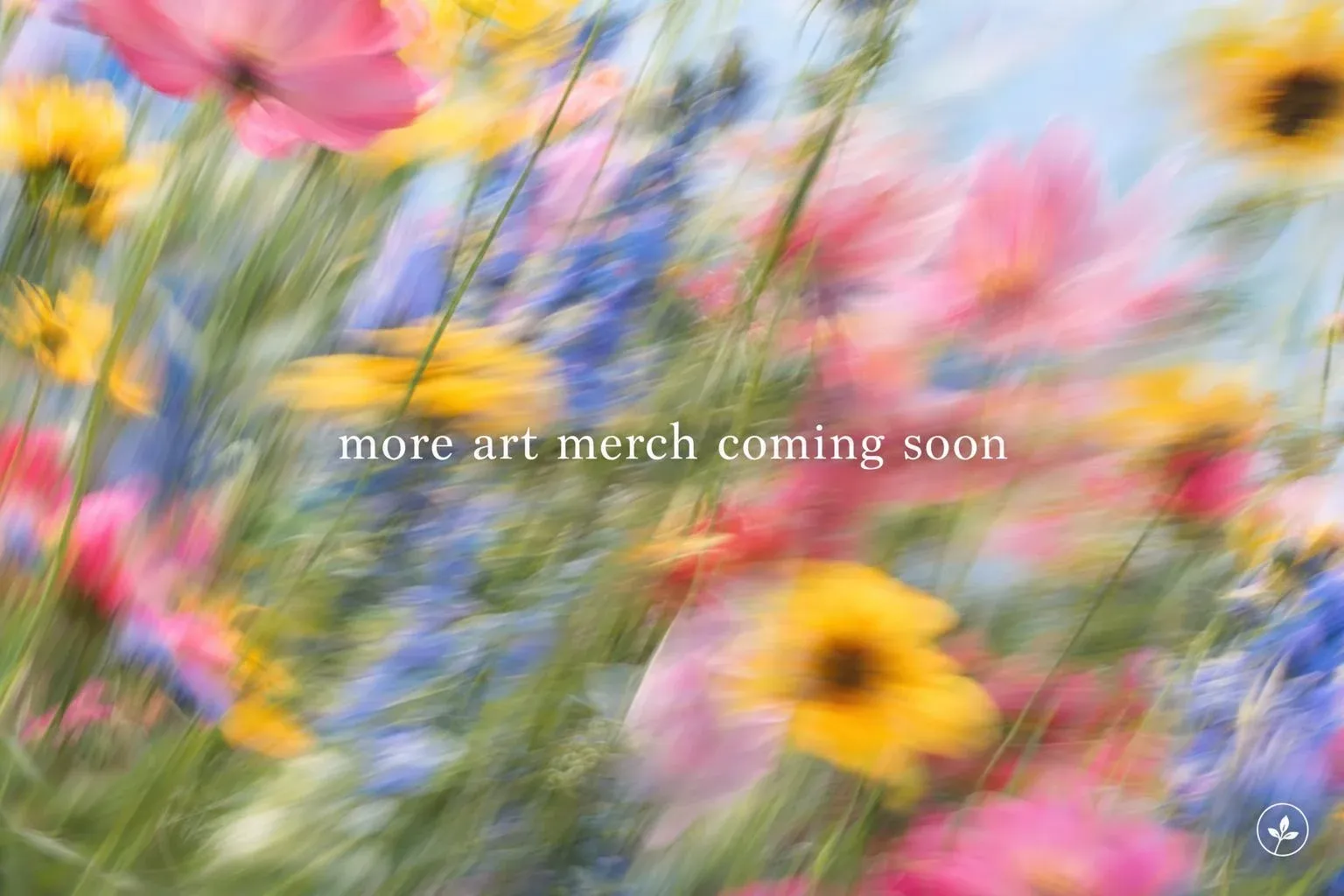
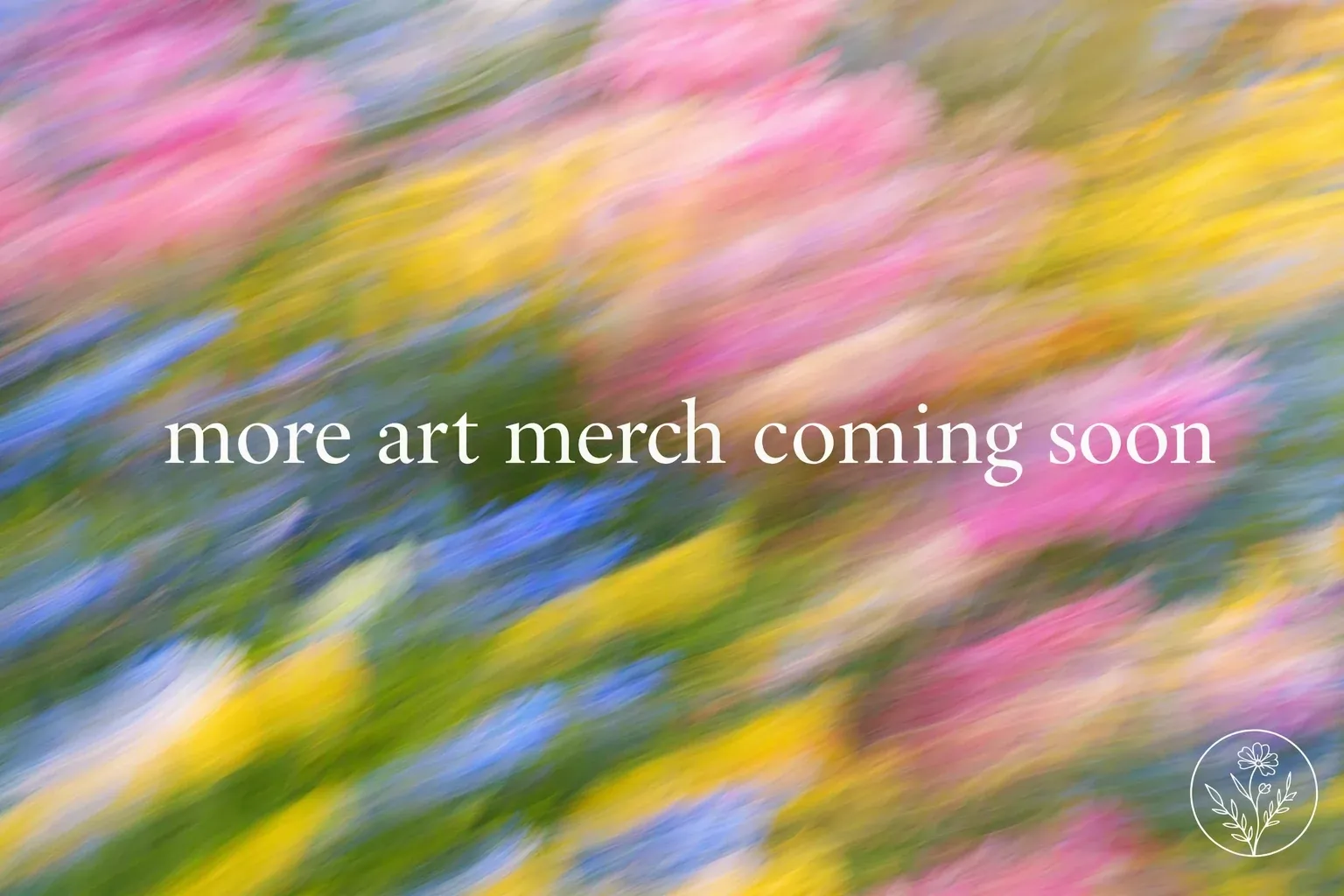
| Model | GPT-Image-2.5 Sunburst | GPT-Image-2 |
|---|---|---|
| Score | 5/5 | 3/5 |
Verdict: 2.5 wins on two counts. First, the defocus and slow-shutter effect stay within a reasonable range, so it is easy to tell the subject is flowers (GPT-Image-2's image is clearly too abstract). Second, the text and logo are restrained in size and do not steal the show, and the layout is sensible.
Case 3: text-to-image, sci-fi scene
Prompt:
A surreal photograph of a man in a modern office, shot in an inverted composition, as if gravity has disappeared.
He wears a dark blue formal suit. His head is close to the floor and his legs extend upward toward the ceiling. His hands are raised near his torso, palms up, his body showing a natural tension, as if hovering in midair.
The office environment is completely normal and realistic: nothing in the room has been altered, and it looks like a typical everyday office. There is a wooden desk, and the walls are painted a very light, pale green. Only the man and the objects around him float in midair, creating a strong sense of weightlessness and controlled chaos.
A white desk phone with a coiled cord is caught in a dynamic moment of splitting apart: the handset drifts in one direction while the base floats on its own. A coffee cup hovers nearby. Other office supplies are floating too: a bulky old-fashioned computer monitor, a matching vintage keyboard, a mouse and an office chair, drifting in different poses, slightly rotating and tilting. A potted red geranium also hangs in the air, adding a vivid touch of color contrast.
The window is open, and bright midday sunlight pours into the room. Outside, the view of Azadi Square in Tehran is clearly visible. A pigeon flies into the room and also hovers in midair, wings slightly spread, as if frozen mid-motion. The lighting is bright, high-key and clean, with a minimalist aesthetic. The color palette is soft, slightly desaturated and cinematic. The overall mood emphasizes surrealism, weightlessness and a frozen moment.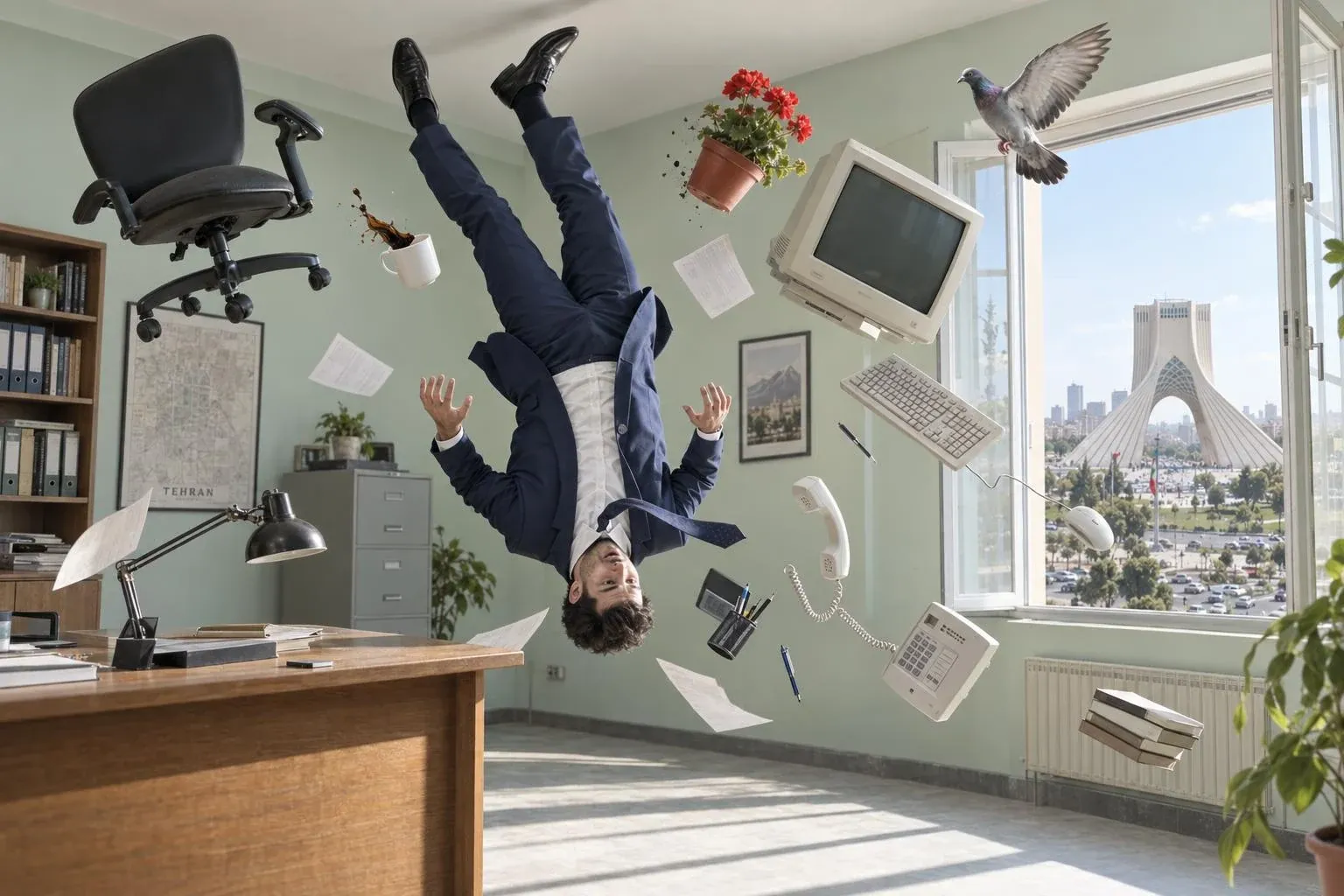
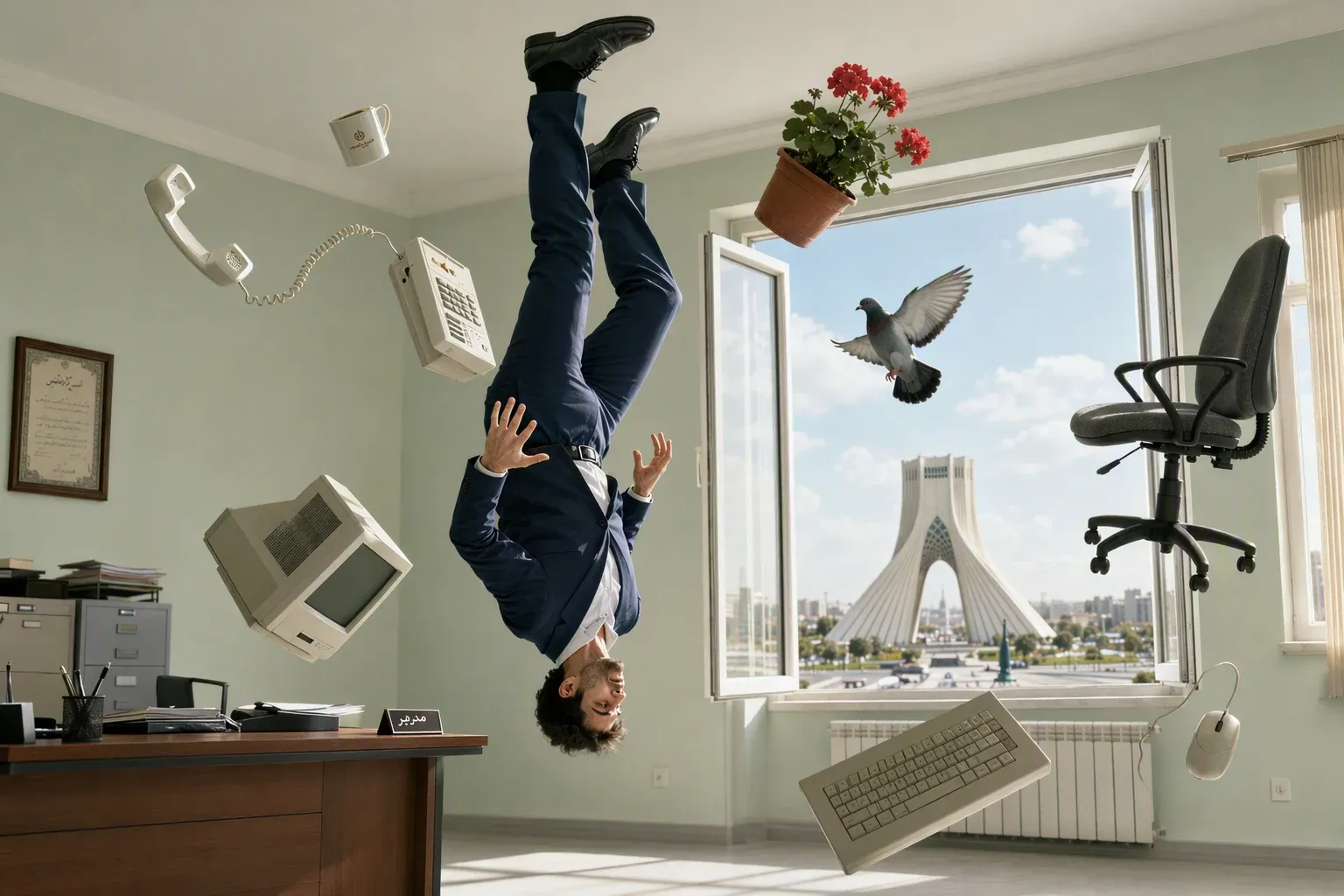
| Model | GPT-Image-2.5 Sunburst | GPT-Image-2 |
|---|---|---|
| Score | 4.5/5 | 4/5 |
Verdict: it is obvious at a glance that the two images come from the same model family, with highly similar color tones, spatial layout and composition. 2.5's flaws: the office chair in the upper left is twisted and distorted, and the phone cord is not continuous, looking disconnected.
Case 4: text-to-image, contemporary painting
Prompt:
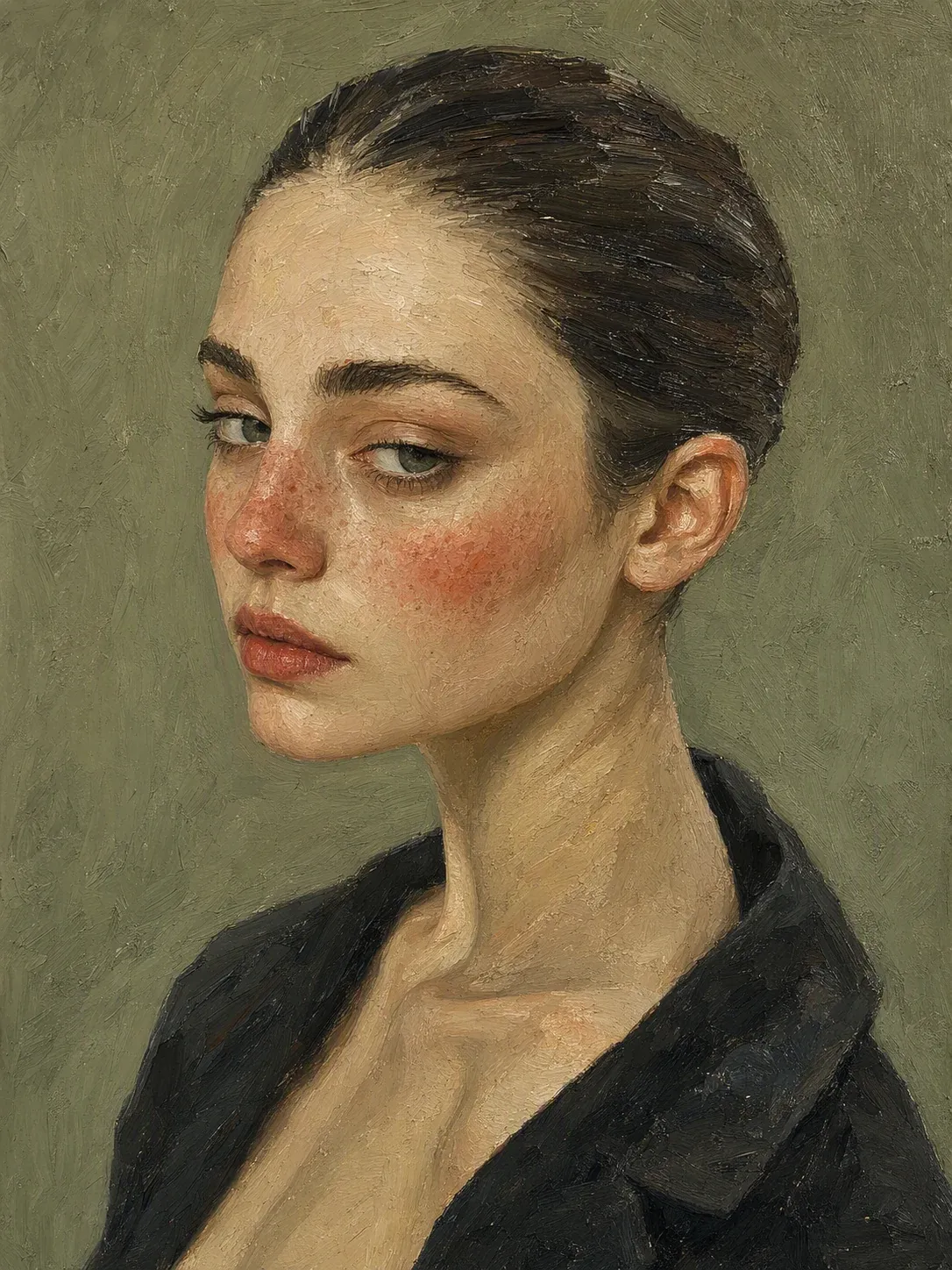
An expressive oil portrait: a young woman looking directly at the viewer over her bare shoulder, in a close-up composition. Fair skin with distinct texture, visible freckles, a natural flush on the cheeks and the tip of the nose, gray-green eyes, thick natural eyebrows. Her expression: eyes lowered, dignified and reserved, lashes casting soft shadows. Her hair is slicked back, glossy and smooth, revealing her whole face. She wears a charcoal-gray blazer, with her collarbones exposed.
Background: a sage/olive green backdrop with visible painterly brushstroke texture and no scenery. Soft, diffused natural light comes in from the front left, creating gentle modeling transitions on the face with no harsh shadows.
Style: contemporary expressionist oil painting, clearly visible impasto brushstrokes, bold directional strokes in the hair and fabric, hand-painted canvas texture, a soft Morandi-style earth palette (white, black, sage green, warm skin tones with red-orange accents), museum-grade portrait, masterpiece.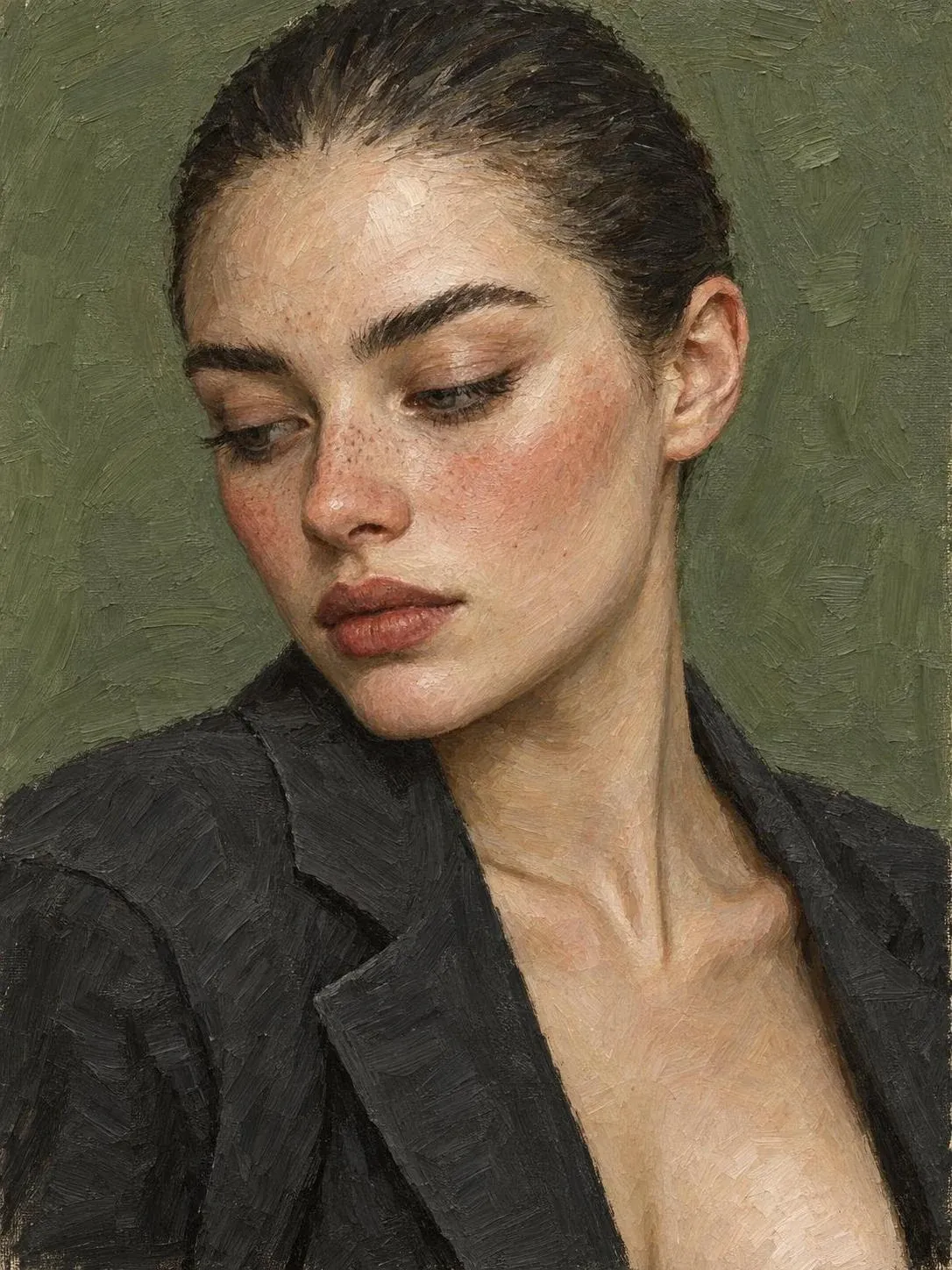
| Model | GPT-Image-2.5 Sunburst | GPT-Image-2 |
|---|---|---|
| Score | 4/5 | 5/5 |
Verdict: the most obvious difference between the two paintings is the direction of the woman's gaze. The prompt says "a young woman looking directly at the viewer over her bare shoulder," and GPT-Image-2 clearly renders this more accurately. Otherwise, neither model has any obvious problems with the woman's appearance, expression, or the overall brushwork and color palette.
Case 5: text-to-image, text rendering
Prompt (original text):
A photorealistic overhead shot of an open premium design magazine lying flat on a minimalist light-oak desk, soft natural window light from the left, a matte ceramic coffee cup and a brass pen resting nearby, shallow depth of field, editorial photography.
The magazine’s two-page spread displays a full article, typeset in a clean modern editorial layout (large display title, pull-quote, body columns, page numbers “38 · 39”). ALL TEXT MUST BE RENDERED EXACTLY AS WRITTEN BELOW, correctly spelled, no gibberish, no missing or fused strokes:
LEFT PAGE — header label in small caps gray: “封面专题 · COVER STORY /
深度拆解 · DEEP DIVE” Title block, bold serif Chinese, two lines: 「GPT-Image-2.5 深度拆解: 30亿张图/周的生意,OpenAI 为什么突然把「速度」当主角?」
Directly beneath, English title in lighter italic sans-serif:
“GPT-Image-2.5 Deep Dive: The 3-Billion-Images-a-Week Business — Why Did OpenAI Suddenly Make Speed the Star?”
A red pull-quote strip: 「从『谁画得更惊艳』转向『谁能让创作跟得上思维』」
BODY TEXT in three bilingual column pairs (Chinese paragraph followed by its English translation in smaller gray type):
Paragraph 1: “2026年9月8日,发布GPT-6 Astra仅仅5天后,OpenAI又甩出 ChatGPT Images 2.5:生成延迟比上代砍掉最多50%,但API单价一分不涨。”
Translation 1: “On September 8, 2026 — just five days after GPT-6 Astra — OpenAI unveiled ChatGPT Images 2.5: up to 50% lower generation latency, with API pricing completely unchanged.”
Paragraph 2: “表面看这是一次常规的版本号迭代,实际上藏着一个信号—— 图像模型的军备竞赛,正在从『谁画得更惊艳』转向『谁能让创作跟得上思维』。”
Translation 2: “On the surface, a routine version bump. In fact, a signal: the image-model arms race is shifting from ‘who draws better’ to ‘who keeps up with your thinking’.”
Paragraph 3: “本文将拆解Images 2.5的三大真实升级、Flare与Sunburst的 双子星布局,以及为什么这次『快』比『美』更值得聊。”
Translation 3: “This article breaks down its three real upgrades, the Flare & Sunburst twin-star lineup, and why ‘fast’ beats ‘beautiful’ this time.”
RIGHT PAGE — a large editorial illustration occupies the top half:
a stylized speedometer whose needle points past the red zone, rendered in flat magazine illustration style with the same red accent color as the pull-quote; caption beneath it in tiny type: “图1:速度计 · Fig.1 The Speedometer”. The bottom half continues the body columns. Footer:
“302.AI 基准实验室 · Benchmark Lab · 2026年9月”.
Typography: Chinese in a Song-style serif (思源宋体 feel), English in Inter; crisp, print-quality glyph rendering at legible small sizes; Paper has a subtle matte sheen where the window light crosses it.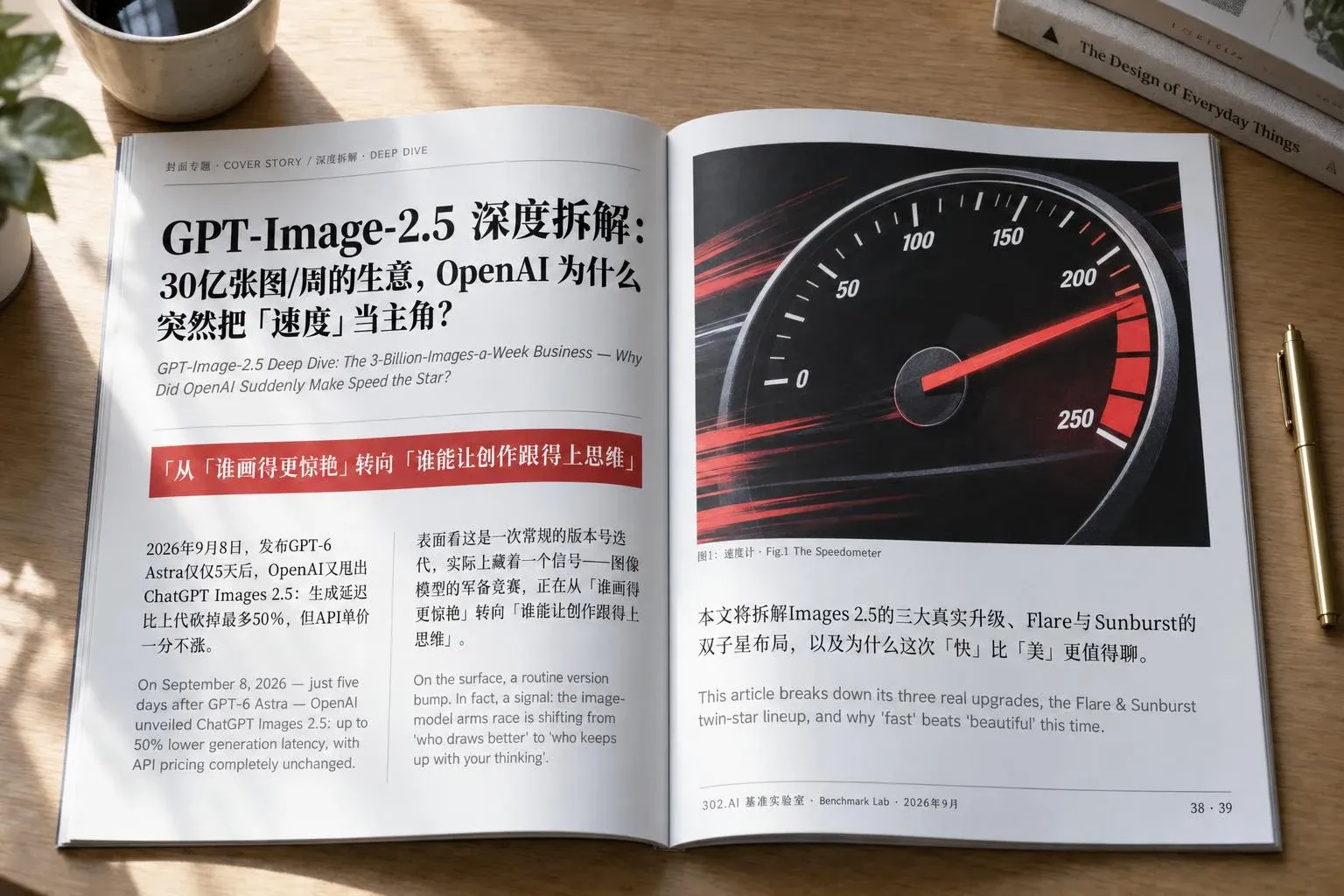
| Model | GPT-Image-2.5 Sunburst | GPT-Image-2 |
|---|---|---|
| Score | 5/5 | 3.5/5 |
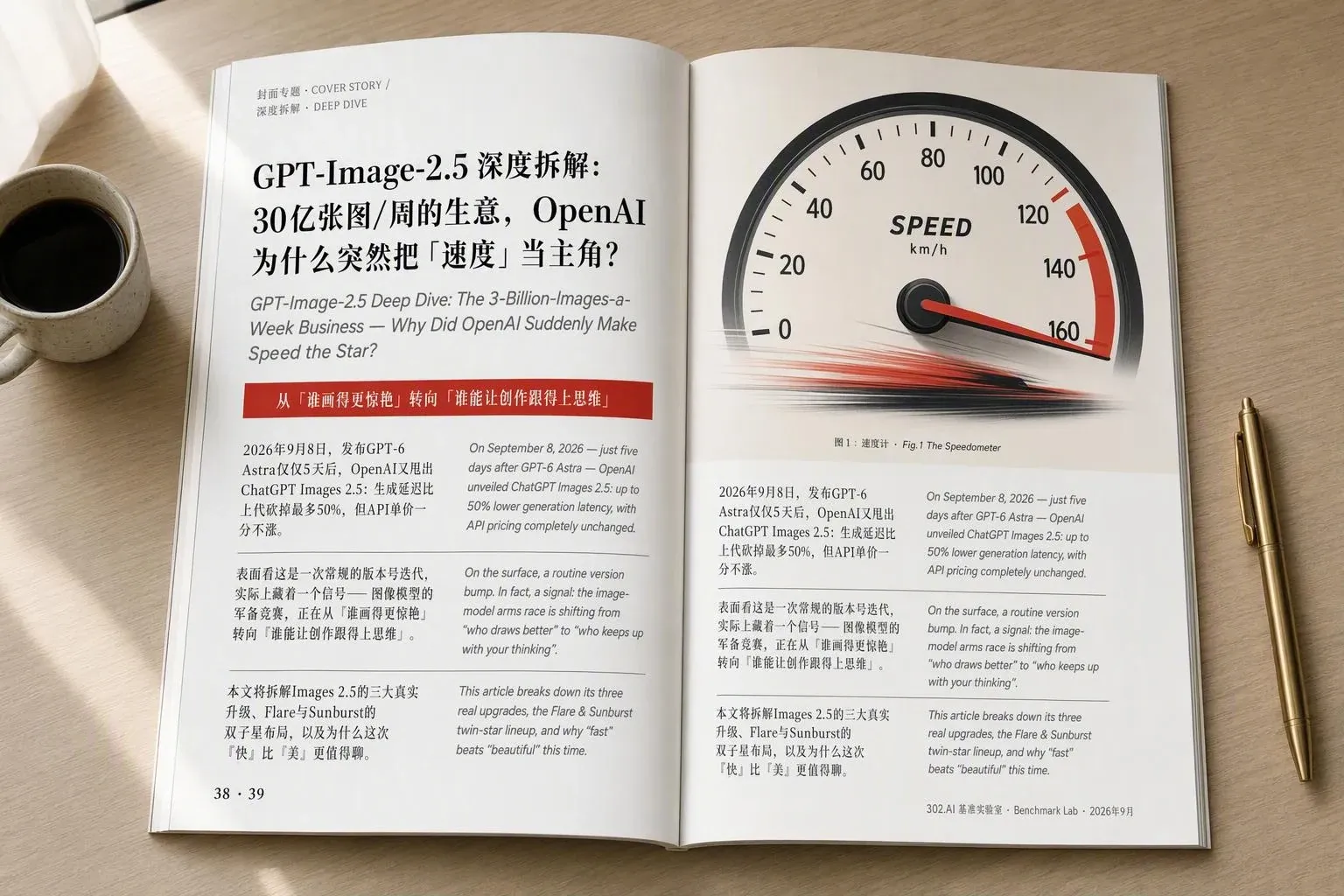
Verdict: 2.5 wins. On the text itself, neither set of results shows garbled or blurry characters. 2.5 wins on overall realism, with lighting and texture closer to a real photo; the magazine's text and image layout is sensible, and the headers and footers are well placed. GPT-Image-2's magazine repeats the same text on the left and right pages, and parts of the layout do not follow a logical reading order.
Case 6: multi-image editing, e-commerce poster
Prompt:
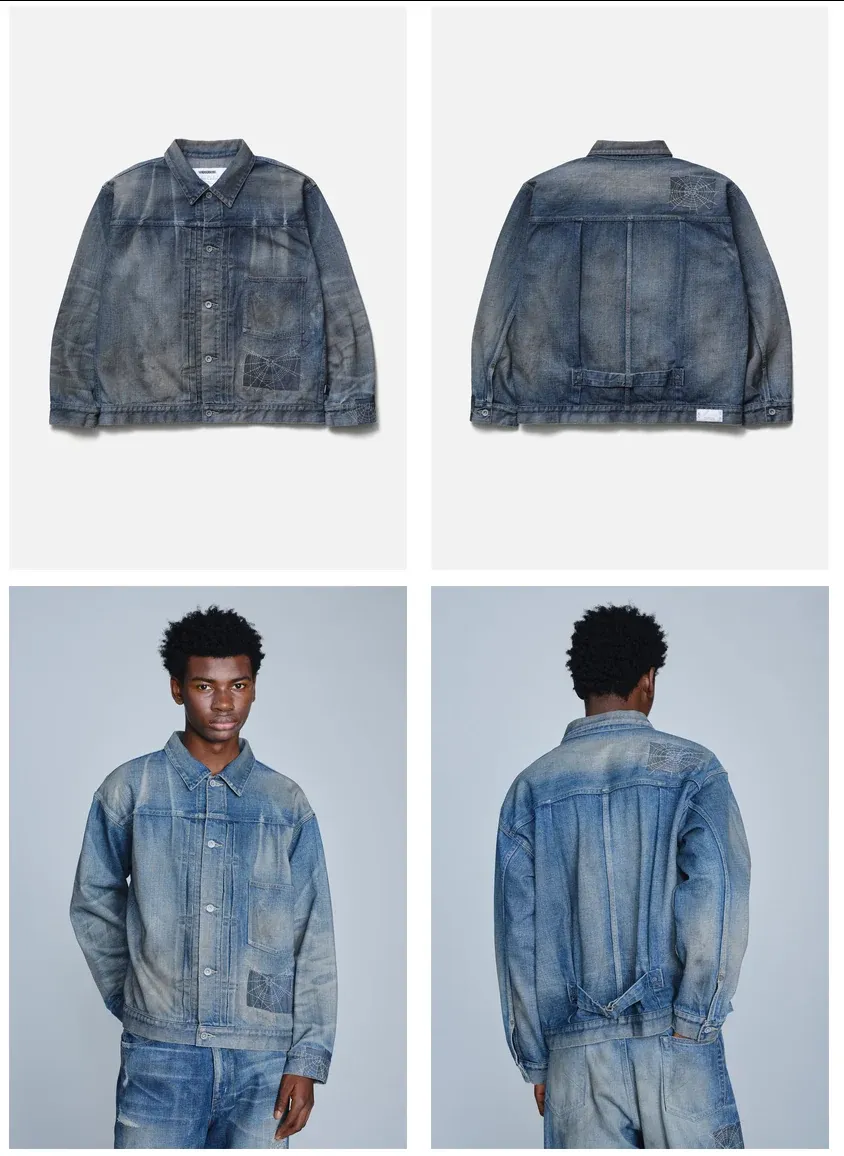
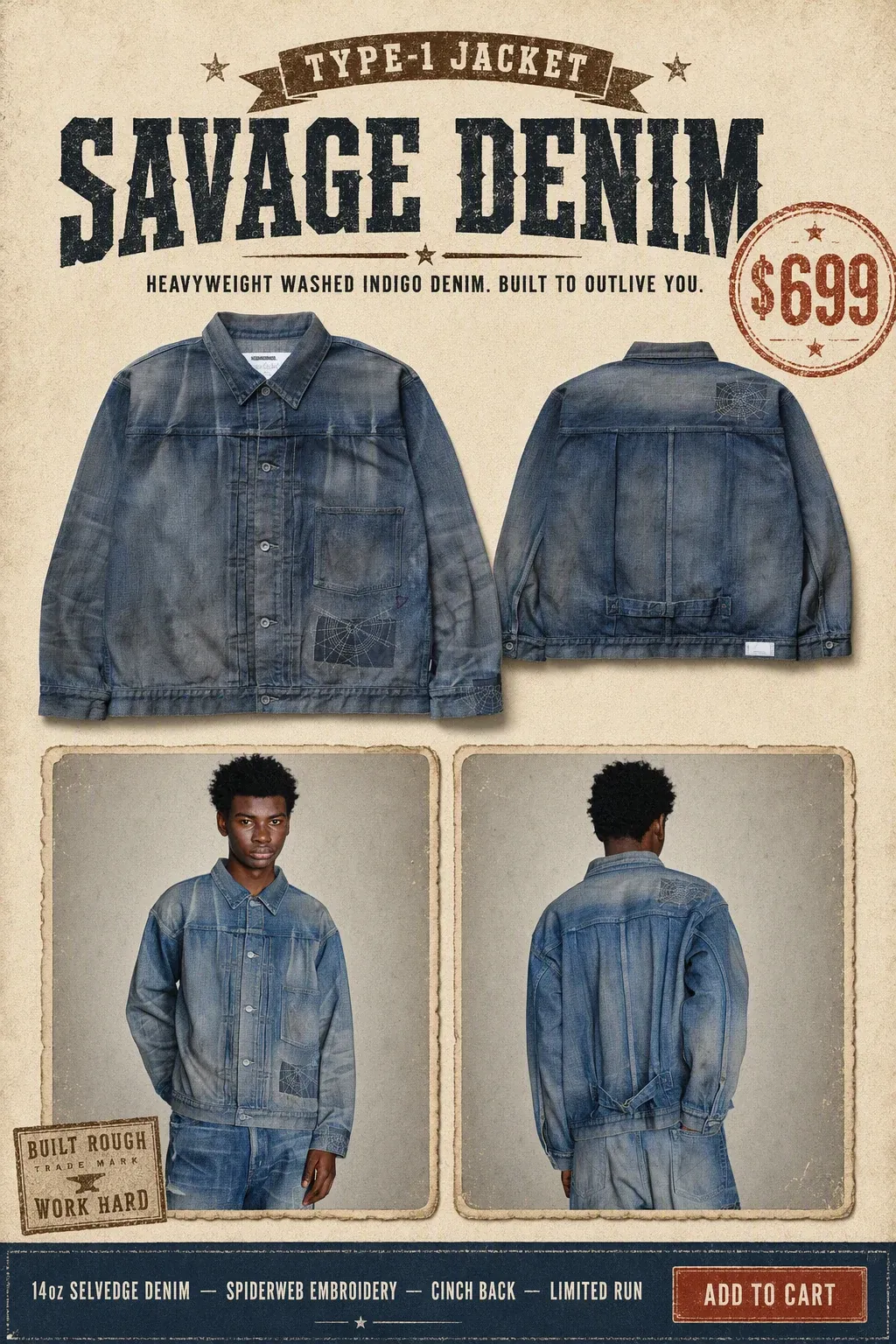
Single-page e-commerce product detail page design in an American vintage workwear heritage aesthetic, based on 4 reference images. The denim jacket's design must match the reference photos 100%: the same washed indigo denim, the same spiderweb embroidered patches, the same cinch-back hem, the same silver buttons, and the same model from the reference images. Do not alter the jacket's design or the model's identity.
Layout (vertical e-commerce page, 3:4 aspect ratio):
Top hero section: cream/off-white paper texture background. A large vintage headline in a bold Western slab serif: "SAVAGE DENIM", with a smaller arched banner above it reading "TYPE-1 JACKET", plus a distressed rubber-stamp badge: "$699" inside a brick-red circle. Tagline in a condensed sans-serif: "Heavyweight washed indigo denim. Built to outlive you."
Middle: show the front and back of the jacket, with the front view larger on the left and the back view slightly smaller on the right, both as cutouts with soft drop shadows on the cream background.
Lower half: two model photos side by side in vintage frames with slightly torn paper edges (a front pose and a back pose), with a subtle warm film-grain treatment.
Bottom bar: a deep indigo strip with white type: "14oz Selvedge Denim — Spiderweb Embroidery — Cinch Back — Limited Run", and a small brick-red button: "ADD TO CART".
Color palette: cream #F2EBDC, denim indigo #2E4A66, brick red #B3402A, ink black #1A1A1A, with faded tobacco brown as an accent.
Typography: American vintage signage style: bold slab serif/Western display type for headlines, condensed sans-serif for body text, tracked small caps for labels, all with slight ink bleed and a letterpress texture. Distressed stamps and union-label-style badges as decorative elements.
Quality requirements: professional e-commerce layout, clean grid alignment, print-poster quality, vintage American workwear atmosphere (the feel of 1950s–70s posters), no watermark, no extra products, all English text correctly spelled and legible.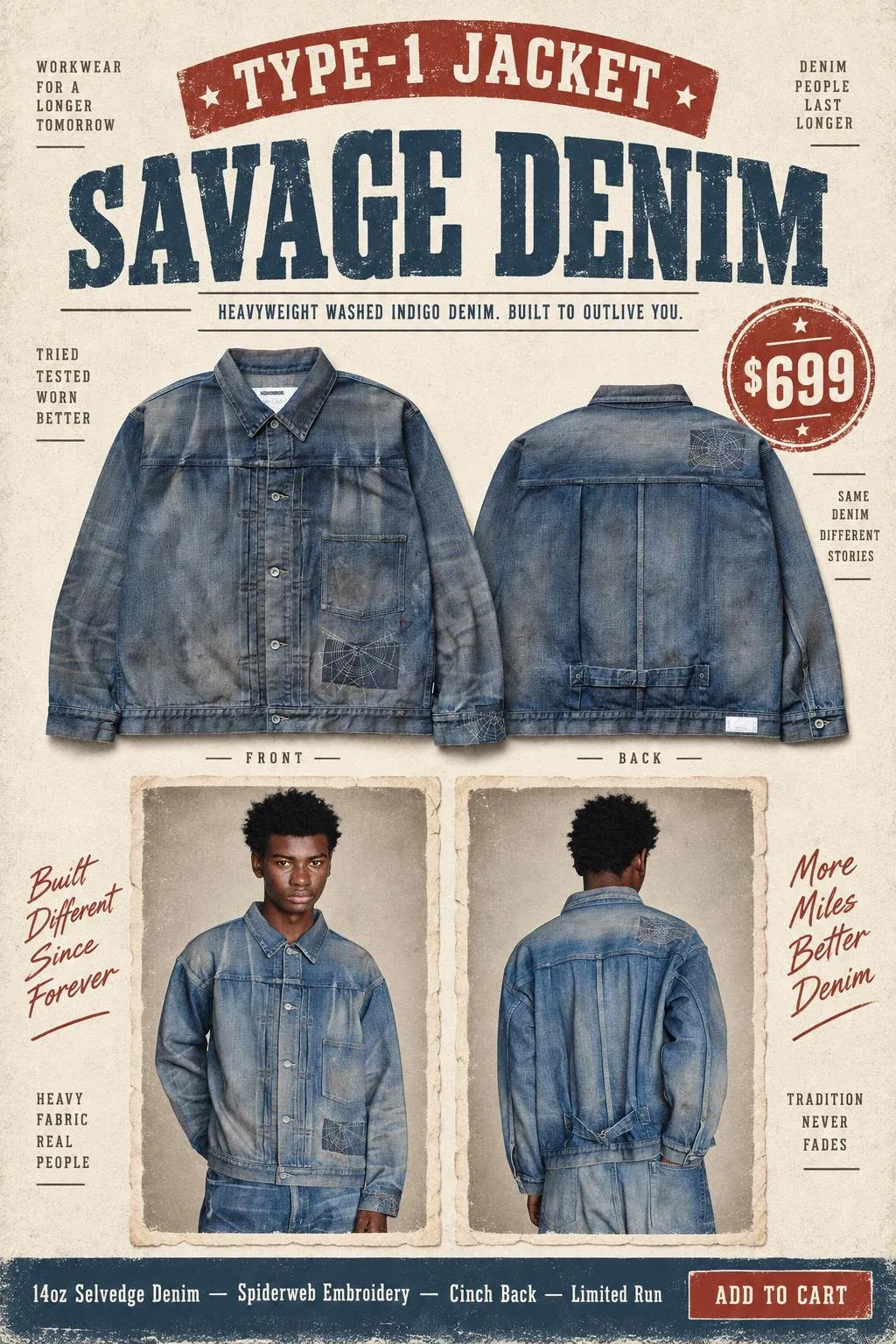
| Model | GPT-Image-2.5 Sunburst | GPT-Image-2 |
|---|---|---|
| Score | 5/5 | 4/5 |
Verdict: both produce accurate, clean cutouts with similar layouts. GPT-Image-2's layout is clearly unbalanced: the SAVAGE DENIM headline is not centered, the left and right margins are uneven, and the front and back views of the jacket differ too much in size. 2.5's poster, with its color scheme, distressed details and rich decorative text, is good enough to deliver as is.
Case 7: image-to-image, storyboard
Prompt:
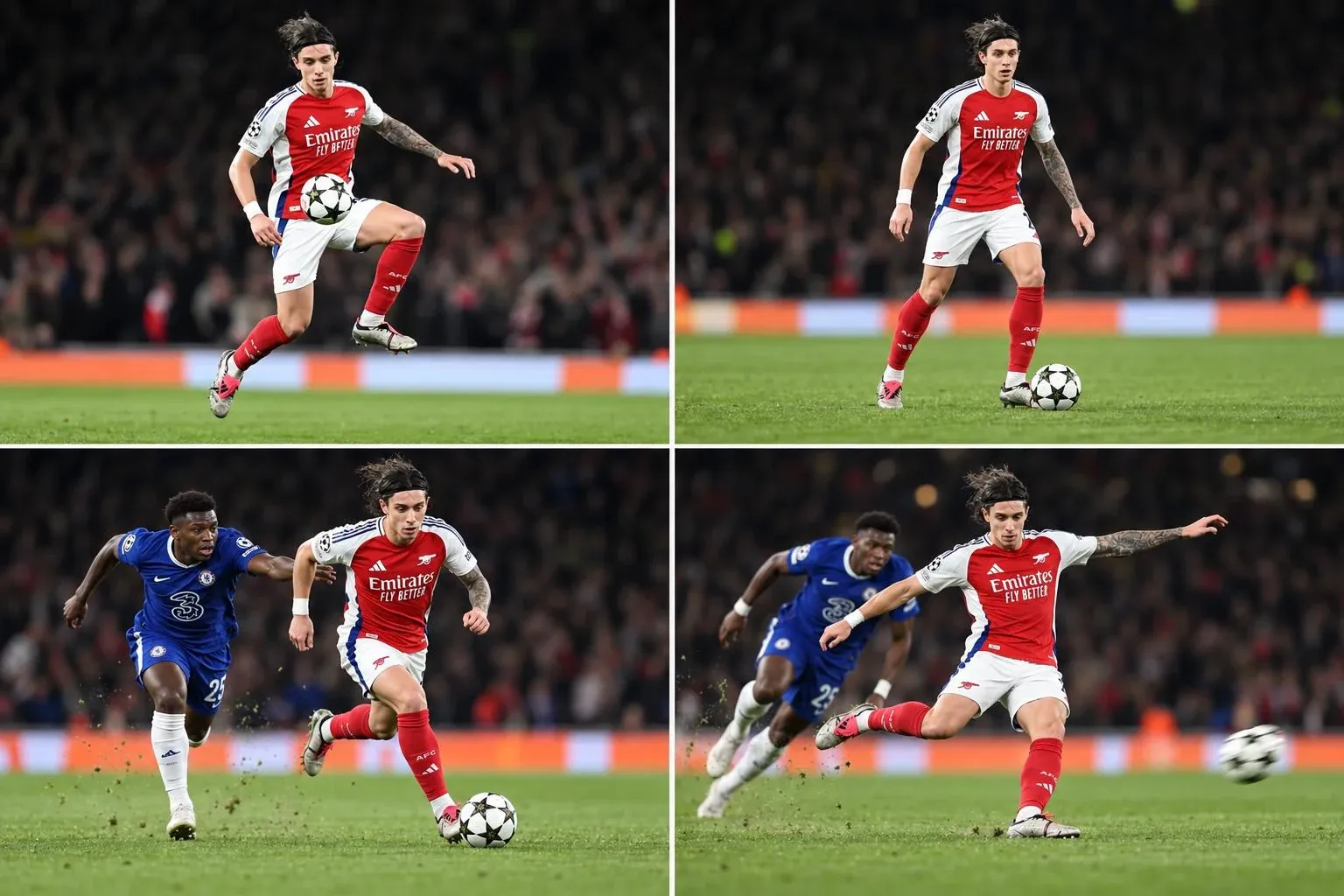
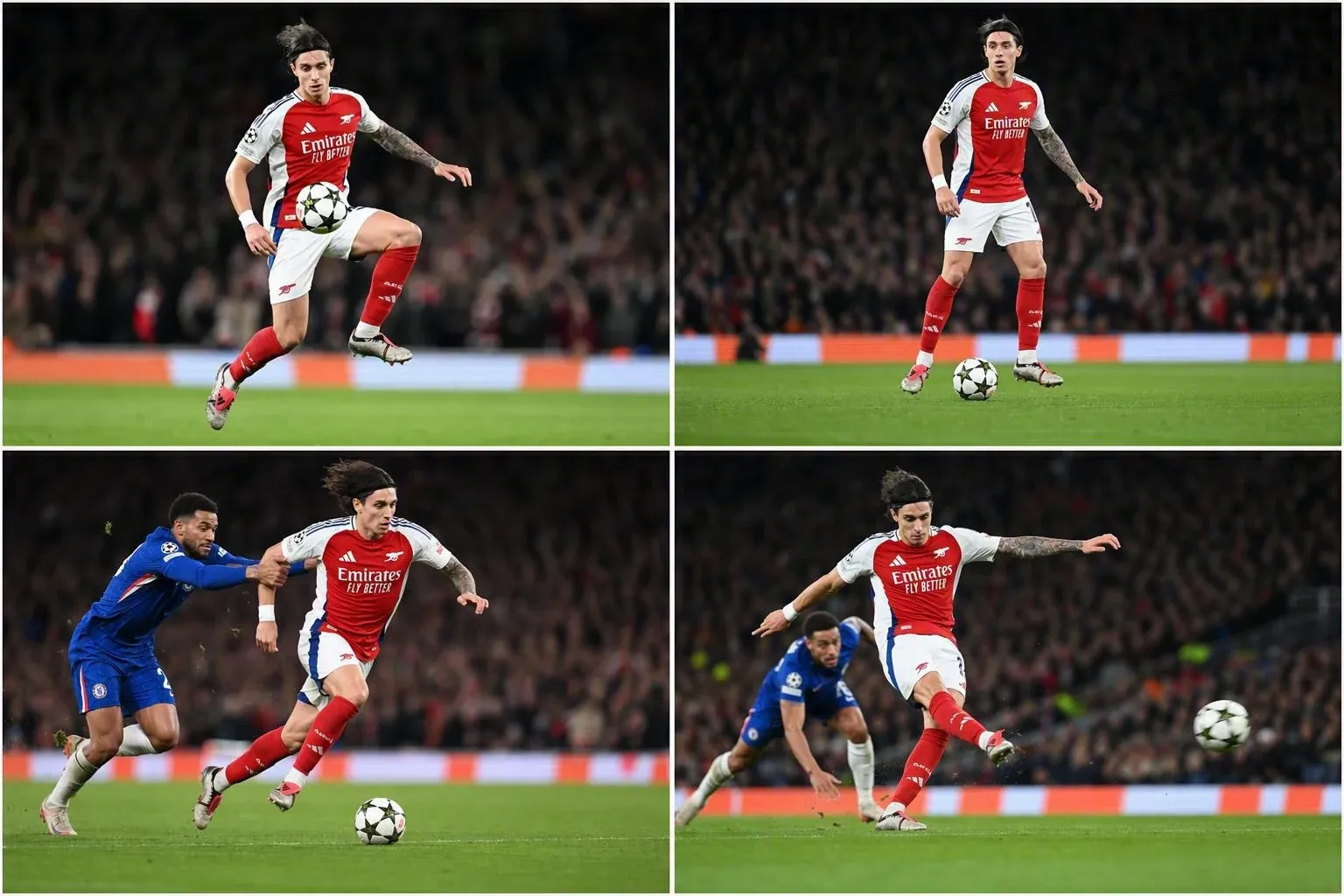
A 2×2 grid on a single canvas, with four equal-sized panels separated by thin white gutters. The subject is identical in all four panels. Character lock: the same Arsenal player, in the red-and-white home kit (red body, white sleeves, "Emirates FLY BETTER" sponsor text, Adidas logo, club crest, Champions League starball badge on the sleeve), white shorts, red socks, long dark hair swept back and flowing slightly, a tattoo on the left arm, an athletic build and fair skin. Scene lock: a night match under floodlights, a lit green pitch, a blurred dark crowd in the stands, orange-and-white LED advertising boards, the official Champions League starball (a white ball with a black star pattern). Photorealistic professional sports photography, a fast shutter freezing the action, shallow depth of field, a slightly low-angle shot, saturated colors.
Use the reference image as Image 1.
Image 2: Based on the reference image: the same Arsenal player has just controlled the ball, which has dropped from his thigh and now rests on the grass directly in front of his standing foot. He stands upright in a balanced athletic stance, both feet on the turf, looking up to read the play ahead, eyes focused into the distance, arms slightly out for balance. Same character, same kit, same floodlit night stadium, same shallow depth of field. Photorealistic sports photography, wide shot, a dynamic yet restrained moment.
Image 3: The same Arsenal player is sprinting forward at full speed, driving forward with the ball, which sits half a step ahead of his right boot; his long dark hair flies back with the speed, his body leaning forward in a driving run. Behind him, a Chelsea defender in a royal-blue kit with white accents stretches out in full pursuit, his arm reaching for the player's shoulder, slightly out of focus. Same floodlit night stadium and blurred crowd, motion blur in the background, focus locked sharply on the Arsenal player. Photorealistic sports photography, a tracking-shot feel, low angle.
Image 4: The same Arsenal player has shaken off the defender and is shooting, in a classic shooting pose: the left standing leg planted beside the ball, the right leg swinging through to strike it, arms out for balance, eyes locked on the target. The Champions League starball has just left his boot, with slight motion blur. The blue-shirted Chelsea defender is a step behind, off balance, his sliding tackle too late, partly blurred. Photorealistic sports photography, a dramatic low-angle shot, a fast shutter freezing the moment, with fine motion blur on the ball and the swinging leg.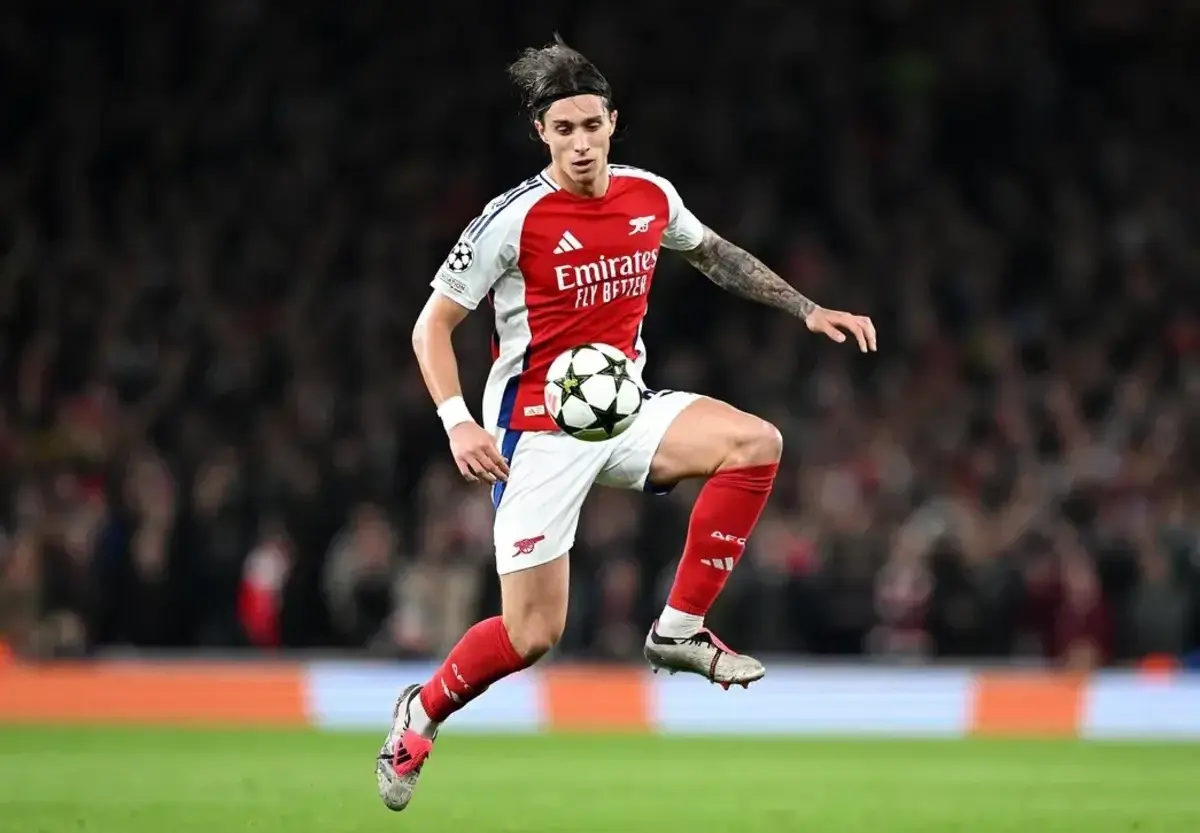
| Model | GPT-Image-2.5 Sunburst | GPT-Image-2 |
|---|---|---|
| Score | 4.5/5 | 4/5 |
Verdict: straight to the flaws in each set. 2.5's problems are in the bottom two images, both of which show turf visibly flying up. That makes no sense whether the player is dribbling past a defender or shooting (only a sliding tackle would kick up turf). The shooting motion in Image 4 is also off: the player should be looking in the direction of the pass or shot, not down at his feet, and the ball shows an implausible afterimage. GPT-Image-2's problem is in the top-right image, where the player has both feet off the ground and seems to hover in the air; its Image 4 has the same gaze-direction problem. Beyond that, both models are close to flawless on character consistency and the logic of the movements.
Case 8: image editing, multi-turn editing
Original image:
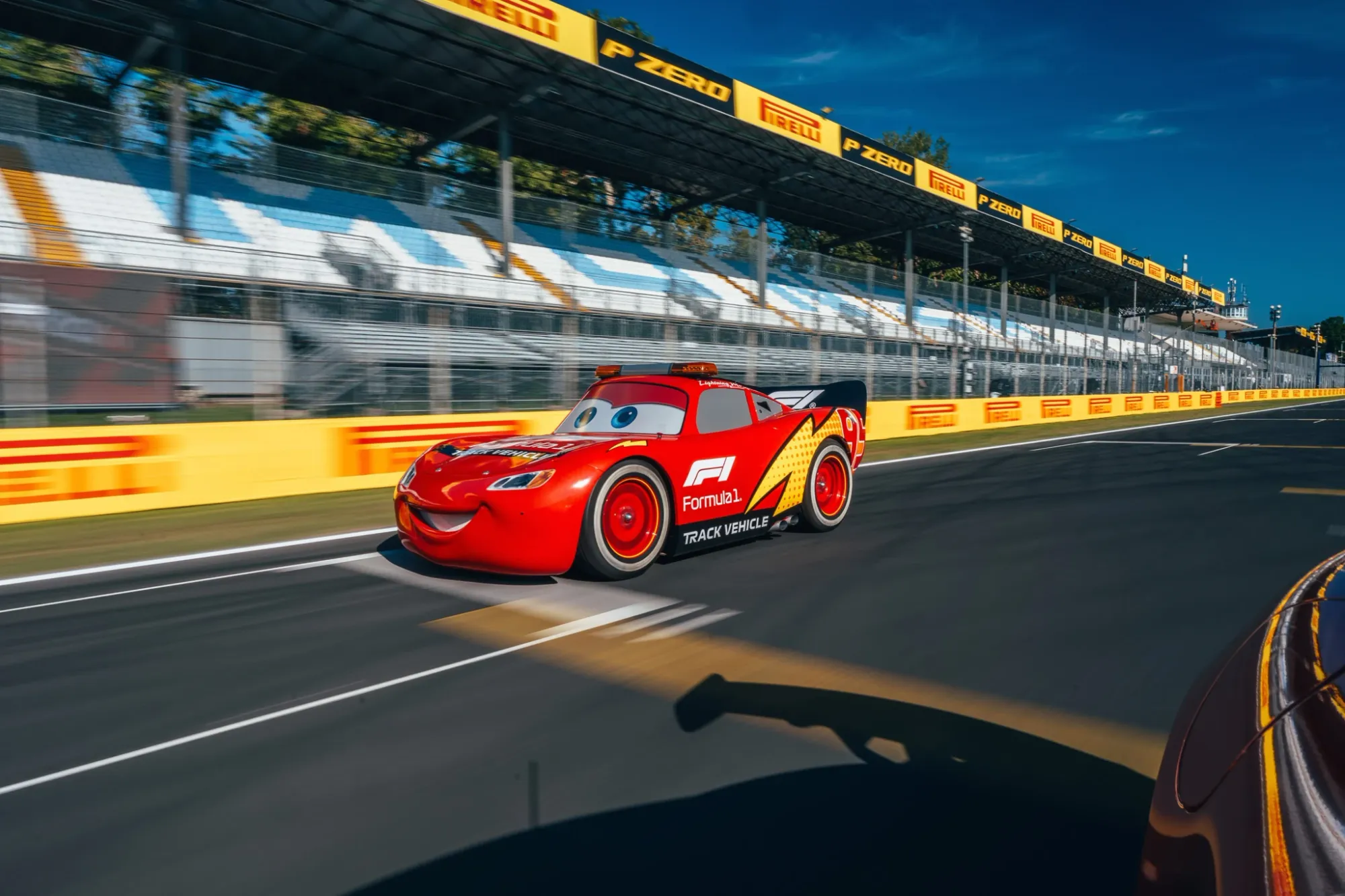
Round 1
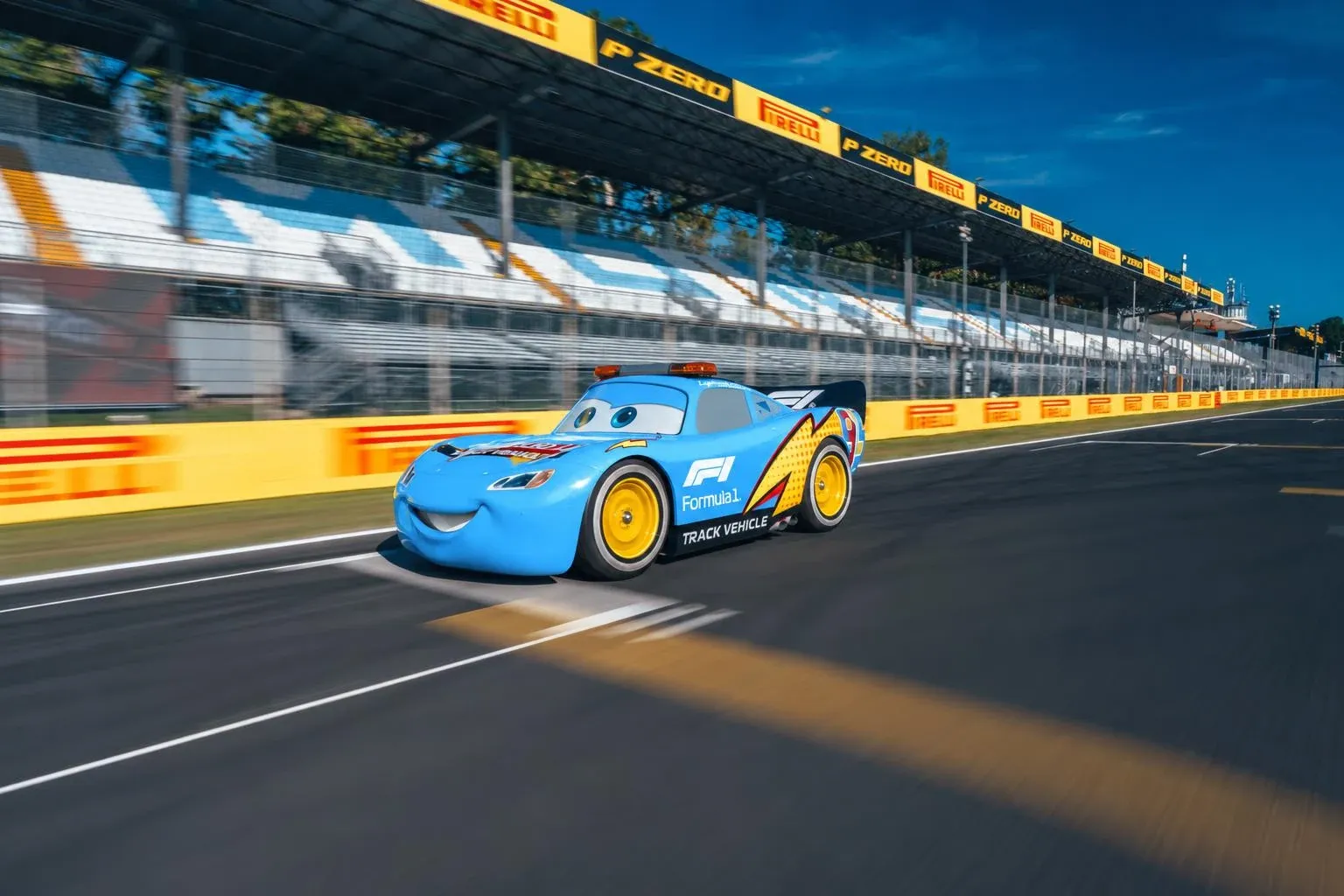
Prompt: Change Lightning McQueen's red body to baby blue, and change the red on the wheel hubs to the same yellow as the lightning bolt on the body; remove the car body in the lower-right corner and its shadow.
| Model | GPT-Image-2.5 Sunburst |
|---|---|
| Score | 4.5/5 |
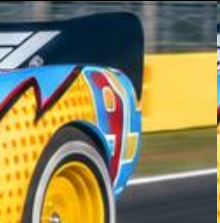
Verdict: the only problem is that the number 95 on the rear of the car was not cleaned up properly, leaving some of the original car's red.
Round 2
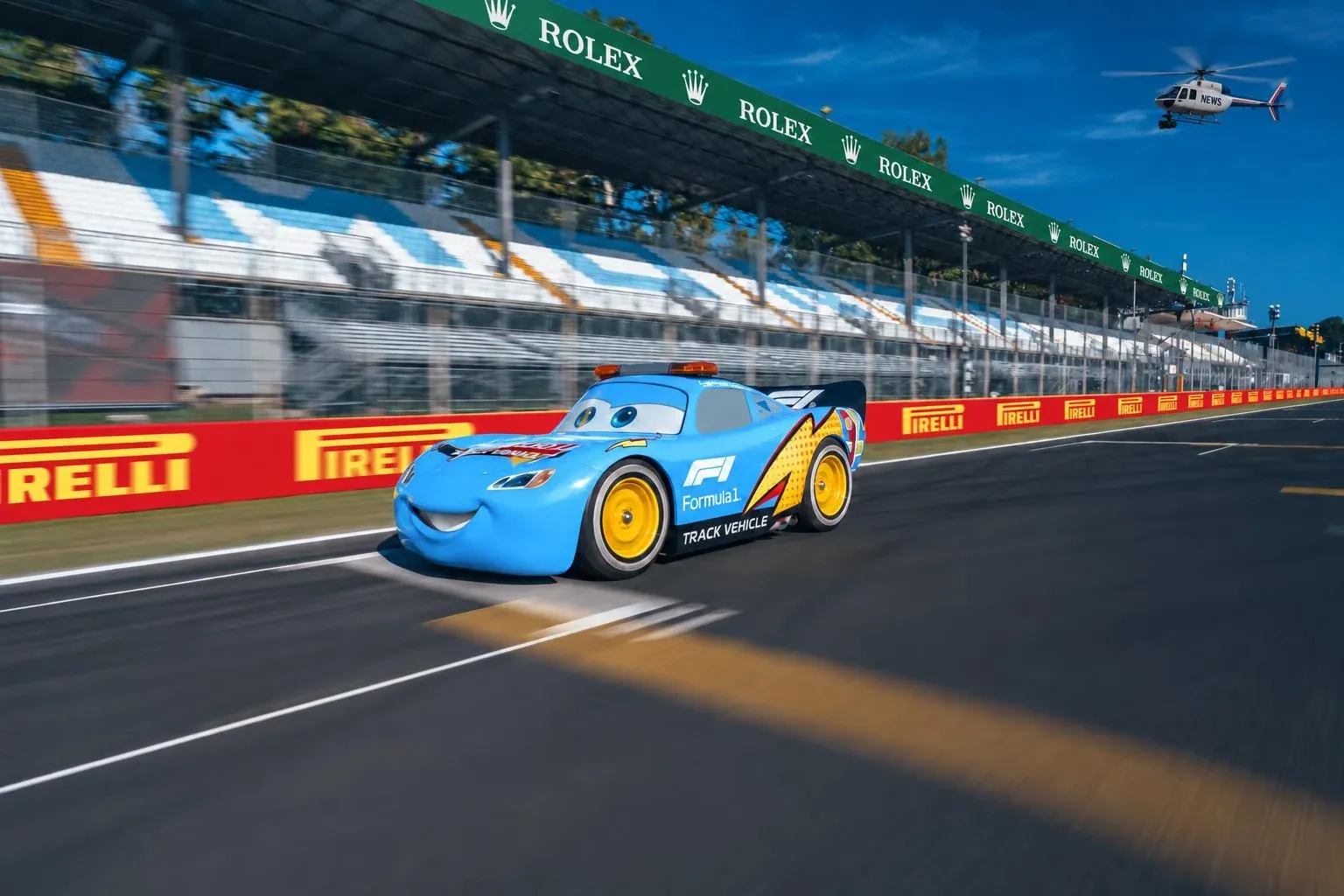
Prompt: Invert the colors of the yellow Pirelli billboards (red background, yellow text); change the black P Zero billboards to green Rolex billboards; add a TV broadcast helicopter to the blue sky in the upper right.
| Model | GPT-Image-2.5 Sunburst |
|---|---|
| Score | 3/5 |
Verdict: all three edits have problems. First, the Pirelli ads on the grandstand roof disappeared and were all replaced with Rolex. Second, the sharpness of the Pirelli ad text at the bottom changed, going from blurry in the original to sharp. Third, the added helicopter is too sharp, so the focus is implausible.
Round 3
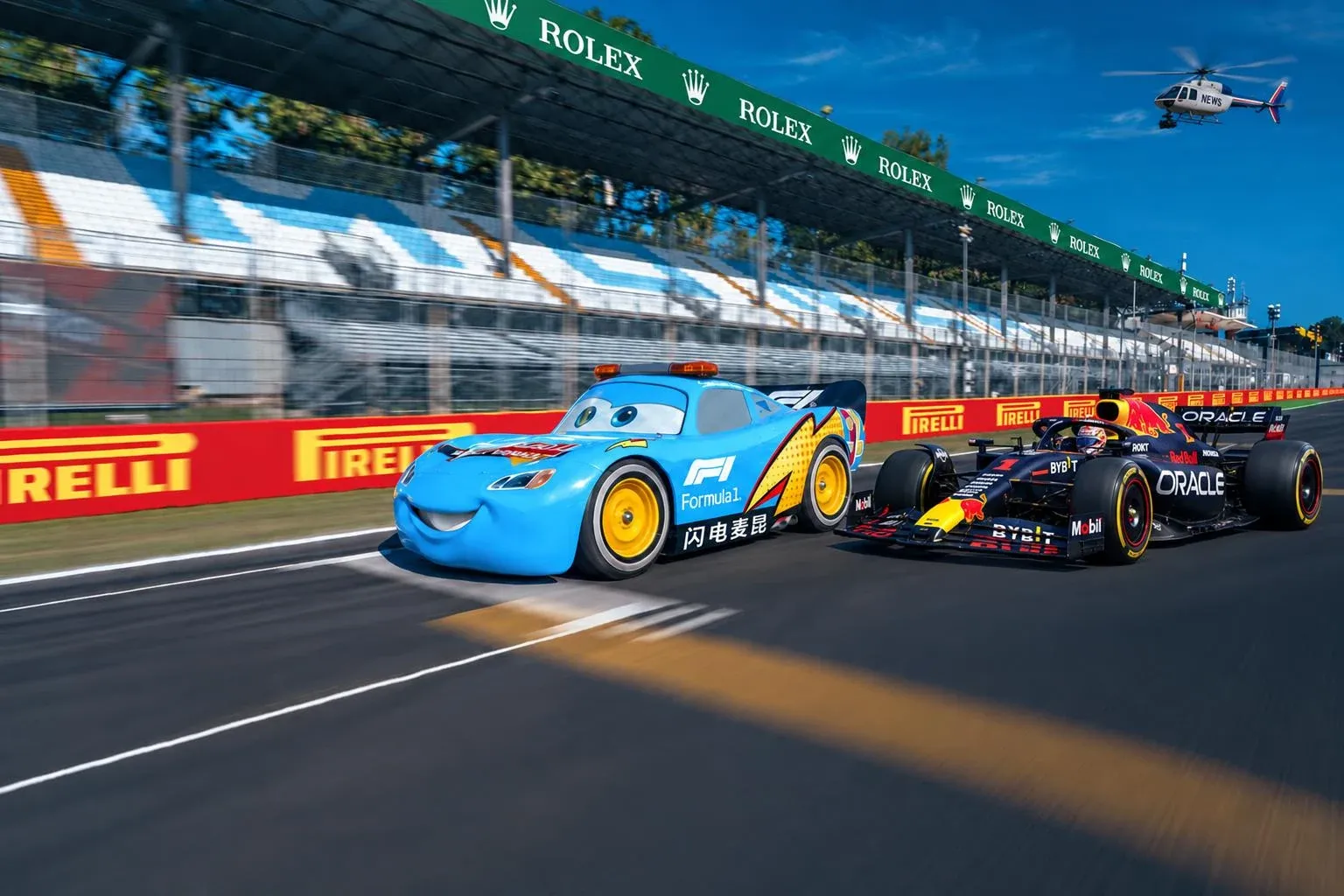
Prompt: Change the text "TRACK VEHICLE" on the black side skirt of the blue car to the Chinese name for Lightning McQueen; add a Red Bull F1 car driven by Verstappen at the spot marked by the green frame.
| Model | GPT-Image-2.5 Sunburst |
|---|---|
| Score | 2.5/5 |
Verdict: this one looks very fake. The F1 car is too close to McQueen and is heading to the right, as if about to crash into him, which is unrealistic. Its tires show no sense of motion and look static, and its body is too sharp, again a focus problem.
Conclusion: image quality has plateaued, and speed is the progress you can feel
Better, but only modestly
After eight sets of tests, the most direct impression is that there is improvement, but it is limited. GPT-Image-2 had already held the SOTA position for a long time, and its capabilities were already top-tier across the board.
OpenAI itself barely mentioned image quality in this launch. The only quality-related line in the announcement was "more natural lighting and richer textures." There were no eye-popping benchmarks and no slogans about breakthroughs.
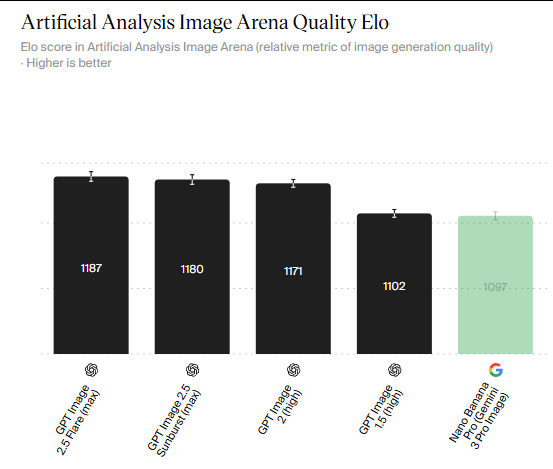
Here are the Elo scores from the Artificial Analysis Image Arena:
| Version | Elo score | Gain |
|---|---|---|
| GPT-Image-1.5 | 1102 | — |
| GPT-Image-2 | 1171 | +69 points (+6.3%) |
| GPT-Image-2.5 Flare | 1187 | +16 points (+1.4%) |
From 1.5 to 2.0, a 6.3% jump was enough to delight every user, because the gains in image quality and other capabilities were plain to see. This time it is 1.4%: progress is still there, but only in small change.
This is not because OpenAI is not trying hard enough. The race for image quality and realism is itself nearing the finish line. Look at what today's models can do: take prompts thousands of words long, render text accurately and clearly, make precise edits exactly where you point, and stay consistent across multiple rounds. Capabilities that were unthinkable a year ago are now standard among the leading models.
When a model's remaining problems are at the level of "every character is right, but the layout doesn't feel magazine-like enough," the floor for image models has been set, and the ceiling now lies in a higher dimension of aesthetics. In that dimension, Midjourney is still a name you cannot get around.
This is the era of diminishing returns for image generation models: every 1% gain in quality brings users less and less surprise, while moving a leaderboard score by another 10 points may cost exponentially more in research and development. The Elo curve is flattening not because vendors are coasting, but because the ceiling is right overhead.
The real upgrade: speed
With image quality hard to push much further, OpenAI's answer is speed.
In the real world, nobody needs a model to produce a single jaw-dropping image that wows the internet. What creators need is the loop of "idea, image, dislike, revise, revise again." Within that loop, going from 90 to 95 points in quality is barely noticeable, but cutting the wait from 100 seconds to 30 seconds is something you feel immediately.
That makes the speed-focused GPT-Image-2.5 Flare the most practical model of this generation:
- Image quality keeps pace (still higher than GPT-Image-2), with half the latency;
- Manus's assessment: at the same quality, it is two to four times as fast as the previous generation.
Faster generation is not just a better experience; it changes the workflow itself. Time costs plunge, more attempts fit into the same amount of time, and creative density doubles.
Recommended uses
- E-commerce and marketing asset pipelines: swapping product backgrounds, rewriting poster copy, and testing multiple versions of one image in ad campaigns. This is Flare's home turf: the same cost per image at twice the speed, so producing 10 variants of a campaign for A/B testing comes down to efficiency.
- Social media and everyday design revisions: as any marketer or designer knows, the client's fifth round of feedback is where the real work starts. Images 2.5's multi-turn editing consistency makes it the strongest option available right now.
- Infographics and image-and-text cards: bilingual Chinese and English layouts, tables and multiple passages of precise text are all within reach, so course slides, social media graphics and data cards can be delivered with confidence.
Not recommended
- Work that pushes artistic limits: 2.5 offers no wow factor beyond what the previous generation could already deliver. For stronger stylization and creative expression, especially in text-to-image mode, a model such as Midjourney may be more likely to produce that "aha" moment.
- Budget-sensitive, high-volume tasks: however affordable GPT-Image-2.5 gets, it is still a SOTA-tier model. A single image does not drain credits as quickly as a top LLM does, but at volume it still adds up. If the requirement is "quality at a 60-point level is fine, but we need 10,000 images" (bulk cleanup of product photos, filling asset libraries, internal test data), open-source models such as Qwen-Image and Flux remain the more pragmatic choice.
Source: 302.AI