
Meta acquires Conductor, leaving cloud users to find a new home
Meta acquires Conductor. The team plans a new interface as Cloud goes read-only and closes in November. The product’s value and users’ reactions reveal two outcomes from one deal.
Meta acquires Conductor, and users start looking for alternatives
A Hacker News user named iamunr said they had committed to Conductor’s cloud offering just the day before. The next day, they needed a refund and had to move their organization to another tool. Another user, adam-eclse, congratulated the team but expressed regret: after trying several AI coding tools, they had thought their search was finally over. Both reactions appeared in the discussion beneath the acquisition announcement.
On November 4, 2026, US time, Conductor founder Charlie Holtz announced that the company was joining Meta. The team will build a new product. For people who rely on the existing one, the most immediate change is the shutdown of its cloud service. The team has found its next home; users still have to move the workflows they have built.
Conductor is a Mac app that lets multiple AI coding agents work in parallel. Users can assign different tasks, inspect code changes and decide how to merge them within one interface. In our earlier article on how Garry Tan works on more than a dozen development tasks at once, we noted his use of this kind of workspace to manage parallel tasks.
In the official announcement, Holtz said the team hoped to have something new early next year. Cloud users cannot wait that long: Conductor Cloud will become read-only on November 13, then shut down and begin deleting cloud data on November 20. As of November 5, 2026, public materials had not disclosed the acquisition price or the specific deal structure.
What the acquired tool made easier
Conductor launched in July 2025. In March 2026, Holtz and co-founder Jackson de Campos announced a $22 million Series A, with investors including Spark and Matrix. Their ambitions were broad: to expand from small AI teams on MacBooks to AI organizations on phones and even in enterprise private clouds.
Its starting problem was much simpler: what happens when one agent is editing code and another wants to change the same files?
Conductor gives different tasks separate workspaces. According to its product documentation, each workspace has its own branch and copy of the files. Agents can run commands there, while people review and merge the results separately. Git worktrees can be understood as multiple working copies of the same repository. Organizing them makes it possible to move several development tasks forward at once.
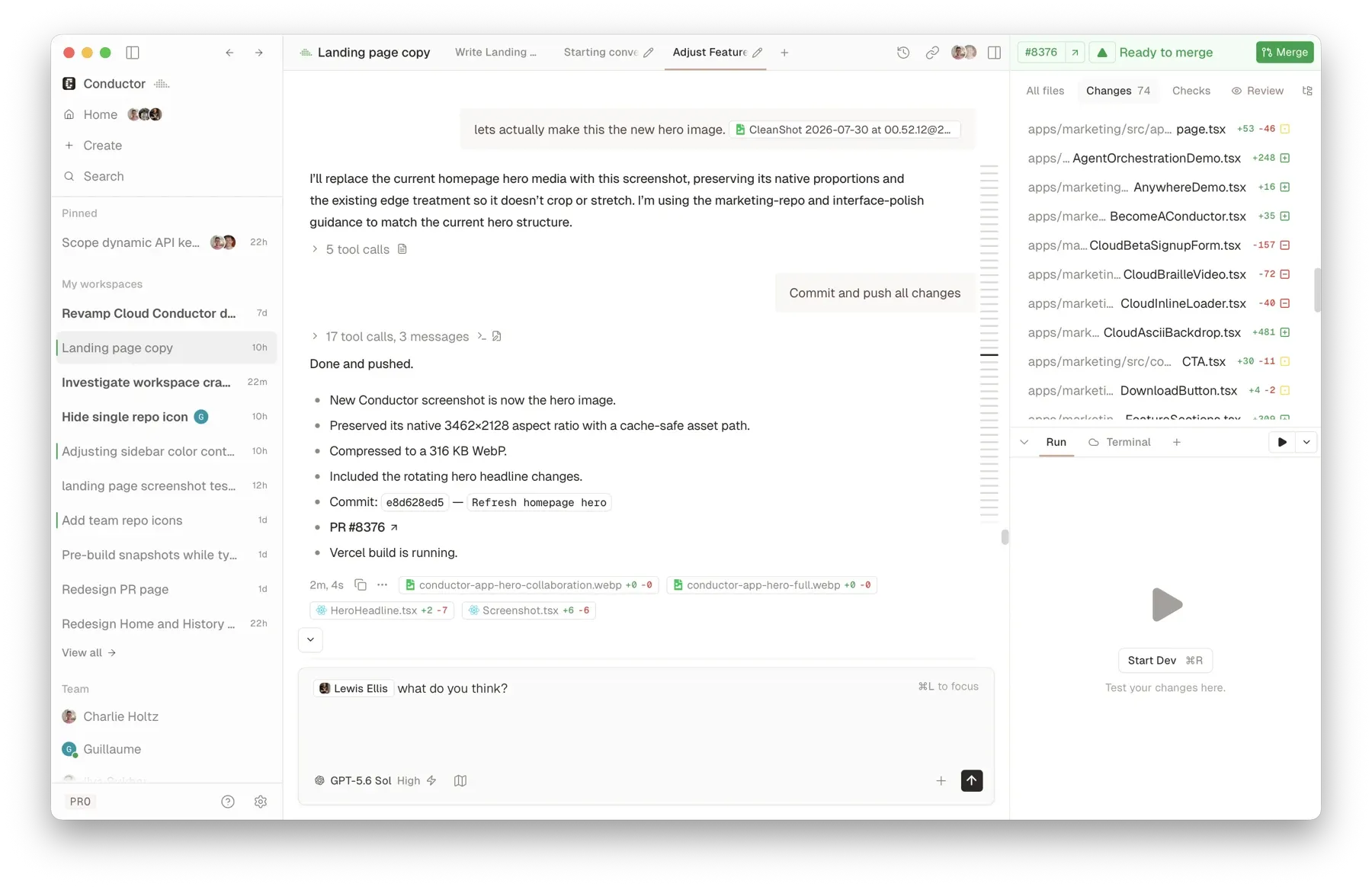
In this actual screenshot from the website, the left side lists tasks such as homepage copy, troubleshooting and sidebar colors. The current conversation sits in the center, with changed files on the right. These areas bring the task list, current conversation and file changes into one window. Users can switch between tasks and inspect the corresponding changes.
Someone comfortable with the command line can open terminals, create branches and switch working copies themselves. But making those operations easy to reach can change how much work people are willing to take on at once. The interface makes visible the state they would otherwise have to keep in their heads, saving time spent switching tasks and recovering context. Our article on Goldman Sachs tightening access to AI coding tools discussed the handoff after a prototype; Conductor puts review and handoff inside the everyday development window.
Cloud users value work that keeps running after the laptop closes
The difference between local Conductor and Conductor Cloud magnifies the impact of this shutdown.
According to Conductor’s Cloud FAQ, local sessions run on the Mac, and closing the app or shutting down the computer stops the running tasks. Chat history stays on the device: stopping execution is different from losing records. Cloud workspaces run in a hosted environment, where agents can keep working after the user closes the app. The cloud also stores conversation records, while the local version keeps session data on the user’s device.
So when commenters began listing alternatives, user stevenou asked a different question: was there a replacement for Conductor Cloud, rather than just the local app? He specifically wanted webhooks, workspace and session APIs, and isolated virtual machines.
Together, those terms describe a way of working that keeps running independently of a laptop. Webhooks let external events trigger work, APIs let users’ own systems schedule sessions, and isolated environments let tasks run separately. Another desktop window with a chat box may not take over that whole setup.
One user may have only a few branches to move. Another may have built automation around the service. Closing the same product imposes very different migration costs on them.
In June, it had already waited on an upstream decision
On June 15, Conductor published a subscription update to tell users they could keep using their Claude plans as usual. In May, Anthropic had announced changes to the Claude Agent SDK subscription rules for third-party tools. Conductor fell within the policy’s scope because it connects through the SDK. By June 15, the changes had been postponed indefinitely, with no action required from users. People bring existing subscriptions to the tool, but how those subscriptions can be accessed still depends on the upstream provider. This policy change affected expectations about using the product; Conductor’s announcement did not explain the reason for the sale.
Meanwhile, others continue to build different entry points. The former Superset project has been renamed Paradev, combining separate worktrees, terminals and code review. Worktrunk approaches the problem from the command line, reducing the friction of managing multiple worktrees. Their product designs and cloud capabilities differ. Users need to recover the work they were already doing: editing several local branches at once, or having external systems schedule cloud tasks. A name on an alternatives list may not meet both needs.
On the same day, Pierre offered a different acquisition promise
Another deal announced on November 4 offers a useful comparison: OpenAI announced plans to acquire Pierre Computer Company. Pierre’s Code Storage helps applications store code and its version history. It also builds file-tree and code-diff components: Trees and Diffs are already used to browse files and view changes in the Codex app.
The two deals involve different parts of programming. Conductor helps people organize parallel work, while Pierre’s tools help them store, browse and review code. The more code models produce, the more people need easy ways to find changes, inspect differences and decide what to merge. Product expertise around code is also entering the acquisition plans of large tech companies.
But the promises to existing users differ sharply:
| Announced terms | Conductor joins Meta | OpenAI plans to acquire Pierre |
|---|---|---|
| Existing services | Cloud will close in November; the local version will be maintained until its wind-down begins early next year | The announcement says users can continue using Code Storage after closing |
| Future products | Hopes for a new product early next year; details have not been disclosed | Plans to bring features into Codex; open-source projects will remain open source |
| Current status | The company has announced it is joining Meta and set a shutdown timeline | Subject to customary closing conditions and regulatory approvals; the companies remain independent until closing |
The Pierre deal has not closed, and how those promises are fulfilled remains to be seen. For people choosing tools now, the distinction is already concrete: an acquisition can mean continued service, or a requirement to move first.
The new product is still out of reach; existing work has a deadline
Conductor’s announcement timeline is explicit: new sign-ups and downloads stopped on November 4. On November 13, Cloud workspaces become read-only: users can still read old chats and export data, but cannot send new messages. On November 20, Cloud shuts down and deletion of cloud user data begins. Users with active subscriptions will receive refunds.
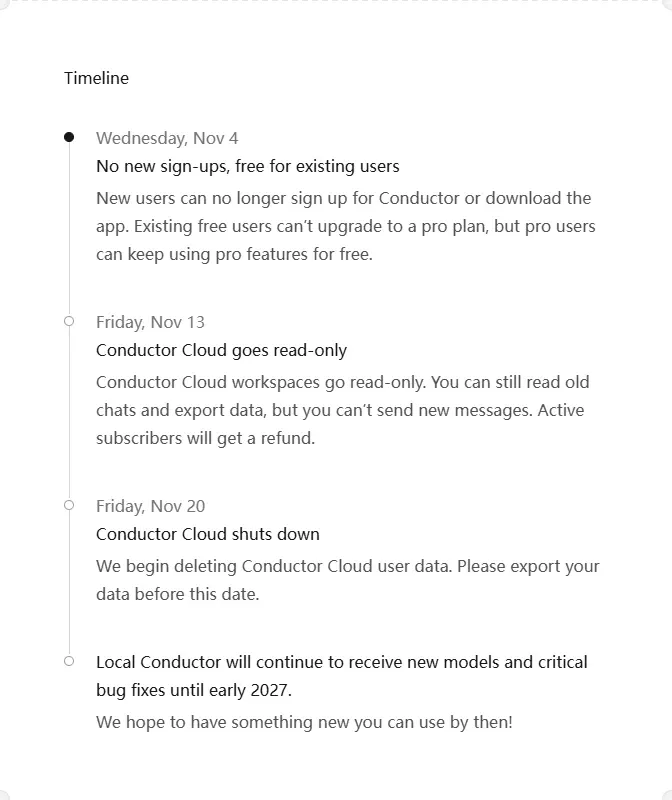
The local app will continue receiving new models and critical bug fixes until its wind-down begins in early 2027. This does not give users a local version they can rely on indefinitely. The new product’s specific form and launch date have not been announced either.
Existing Cloud users can take their data through the two routes in the announcement: right-click a cloud workspace and choose Transfer to local to move the workspace and chats to a Mac, or download a data archive through Settings → Account → Export data.
Another easily confused action also needs attention. In the existing cloud workspace documentation, “sync to a local directory” is a one-way mirror of files from the cloud to the Mac; local changes are not synced back. It addresses a different problem from the workspace transfer and full data export in the announcement. Keeping a copy of the code files does not also move the hosted environment and external calls.
Holtz hopes users will have something new early next year. Users like iamunr first have to arrange tomorrow’s work: where to put their existing branches, chats and cloud tasks, and which window to use to carry on.