
From Claude Code to Pi: control the workspace, own the upkeep
An older farewell to Claude Code is back on the HN front page. Pi offers control over sessions, tools, and workflows, with trade-offs in extension upkeep, interfaces, and model billing.
Change the workspace; keep the model for now
Coding models keep getting stronger, but the software around them does not always feel easier to use. Perhaps you just want to switch between two projects, send selected code to another session, or keep a well-tuned workflow from changing so often. Enough small frustrations can give you a reason to switch.
On November 8, 2026, the Hacker News discussion of “Goodbye Claude, Hello Pi” reached the front page. Created on September 21 and updated on November 7, the older article brought workspace trade-offs back into the discussion.
Caleb’s main frustrations involved editor sessions and the disruption caused by continual tool changes. That personal experience raises a practical question: when a ready-made tool’s defaults keep getting in your way, do you want to take over the workspace yourself?
Pi’s appeal is that it makes that control a product direction. The trade-off is taking on some of the integration and maintenance that a vendor previously handled. For anyone already comfortable with a ready-made tool, that may not be a worthwhile exchange.
This workspace is an agent harness: the software connecting the model, sessions, files, and tool execution. Changing harnesses does not require changing models, and does not automatically produce better code. This article draws on public documentation and discussions; we have not tested performance or costs.
Keep different routes through the same task
Pi’s session documentation offers a concrete example. Halfway through a change, you may want to try another implementation. History can be kept as a branching tree (see the connecting lines on the left of the screenshot): /tree takes another route within the current session, /fork creates a new session from an earlier message, and /clone copies the current branch.
Suppose you are comparing two page layouts and want the alternative to remain part of the same task. Keep it in the tree. When you want to pursue another route as separate work, fork it out. The active branch determines which history enters the next request. Compaction adds a summary and retains recent messages, while the original entries remain.
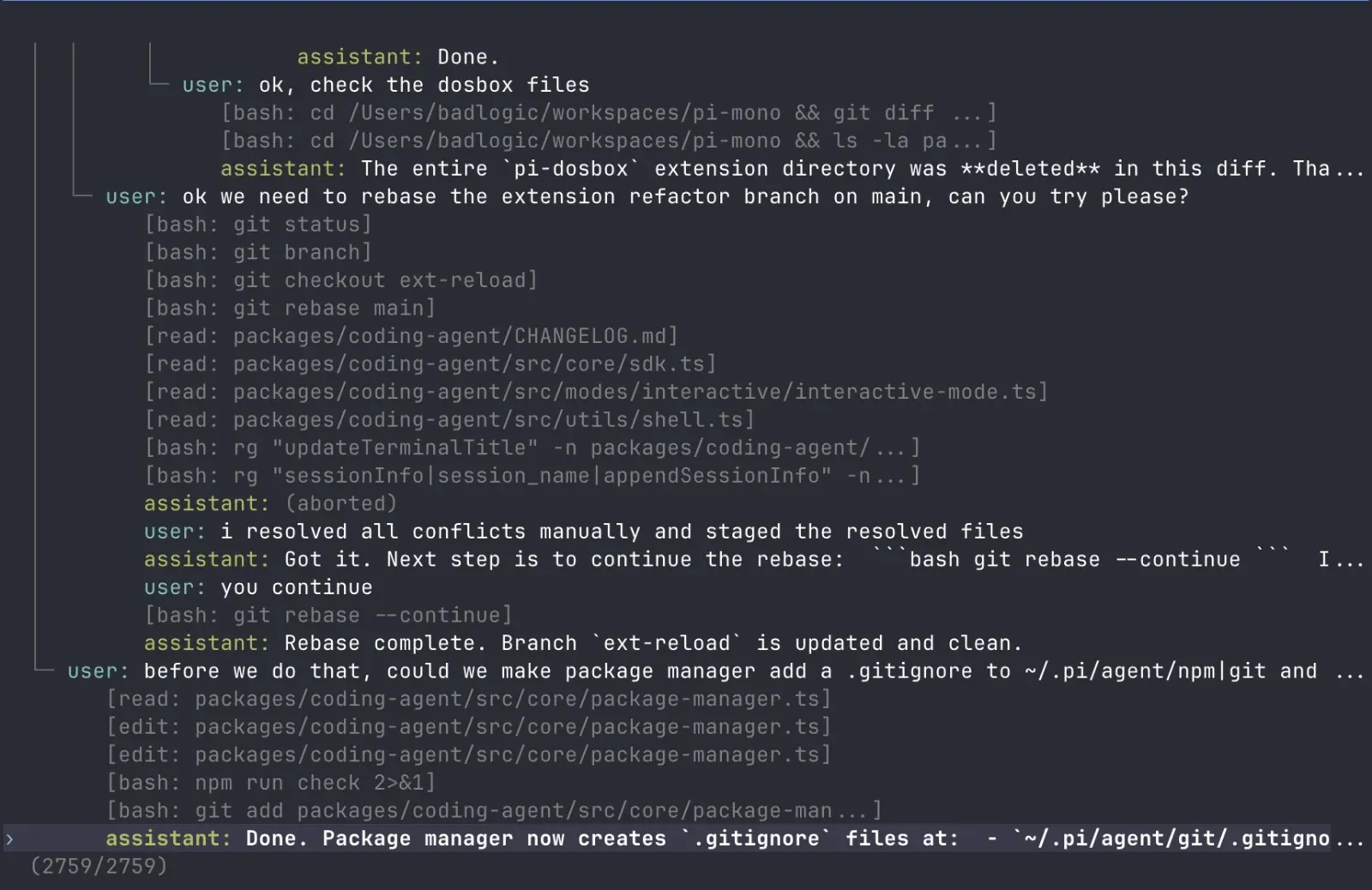
That can save you some manual copying into a new window.
There is no single community preference. In the HN discussion, some users prefer desktop interfaces for managing multiple projects; others value terminals over SSH. Think back to last week’s most annoying switch: was it finding a session, copying context, or an interface getting in the way of code review? Different problems lead to different workspace preferences.
Doing less also means leaving more to the user
Pi’s website describes a minimal, adaptable harness. Some workflows are left out of the defaults and can be added through extensions. Its four customization routes serve different purposes: extensions, skills, prompt templates, and themes. Not every change requires editing the core.
Extensions change program behavior. The extension documentation lets TypeScript modules hook into lifecycle events, register tools and commands, and adjust context and interactions. For example, an in-house checker repeatedly used during code review can become a tool the model can call; a skill can preserve the review sequence and references. Extensions also run with the same operating-system permissions as Pi, so their sources and code deserve close attention.
Skills meet a different need: preserving instructions for how to do a job. The skills documentation explains that names and descriptions are exposed at startup, while full instructions are read when needed. A code-review workflow can live alongside scripts and references in a skill directory. Use /skill:name to invoke one explicitly when necessary. Skill directories follow the Agent Skills specification, making them reusable across tools that support it.
For distribution, Pi Packages bundles those resources for installation through npm, git, or local paths. Personal and project configuration are separate, allowing a repository to carry its own working conventions.
For people who repeat the same tasks, the benefit is tangible: rules and tools become portable assets. But you also need to know what is installed, where something failed, and what to check after an upgrade. Someone who simply wants to open an app and work may not want those responsibilities.
Pi creator Mario Zechner emphasized inspectable context, session formats, and customizable interfaces in his 2025 design article. That explains the historical motivation; current documentation remains the guide to present capabilities.
The easy-to-misread migration cost is in billing
A Reddit question about subscription access captures the confusion: a user already paying for Claude was unsure how to use that allowance after installing Pi. In another experience thread, some users reported smooth operation while others felt they exhausted their allowance quickly. Those impressions do not amount to a controlled cost comparison.
Pi’s provider documentation distinguishes provider-supported sign-in methods from paths such as API keys. Seeing a model in the interface does not establish that requests draw on your existing chat or coding subscription. Installing the harness, calling the model, and determining which allowance pays for it are separate questions.
Earendil’s pi-claude-code extension offers one specific route: requests pass through the official Claude Code CLI’s non-interactive mode, while Pi handles history, approvals, and tool execution. The Claude Code layer only communicates with the model; it does not run tools. The project explicitly warns that billing policy could change. Before relying on it long term, confirm your actual connection method and the current terms. Do not move your entire workflow on the strength of a comment promising savings.
For permission records in your existing tool, see where Claude Code saves commands. For the costs of running multiple tasks, agent costs and parallel workflows examines a different layer of the problem.
Start with one recurring frustration
Pi is worth trying if you can name the step you want to change: retaining alternative branches, connecting your own tools, or carrying the same skills across projects. Knowing the original friction makes it easier to judge whether customization has helped.
Start with a small project and a familiar model, changing only the harness. Compare how you organize sessions, review output, and call tools. Keep your original tool available and expand only once the new workflow is stable.
If a ready-made product’s interface, subscription value, and integrated features already suit you, keeping it is reasonable. Pi leaves choices with the user, which means more decisions: which defaults to retain, which workflows to maintain, and which recurring frustrations that control actually removes.