
Val Town shutdown: AI brought users. Who will keep paying?
Val Town is winding down despite having an AI coding assistant and paying users referred by AI. Its business updates and internal tools show the challenge of finding customers who will keep paying.
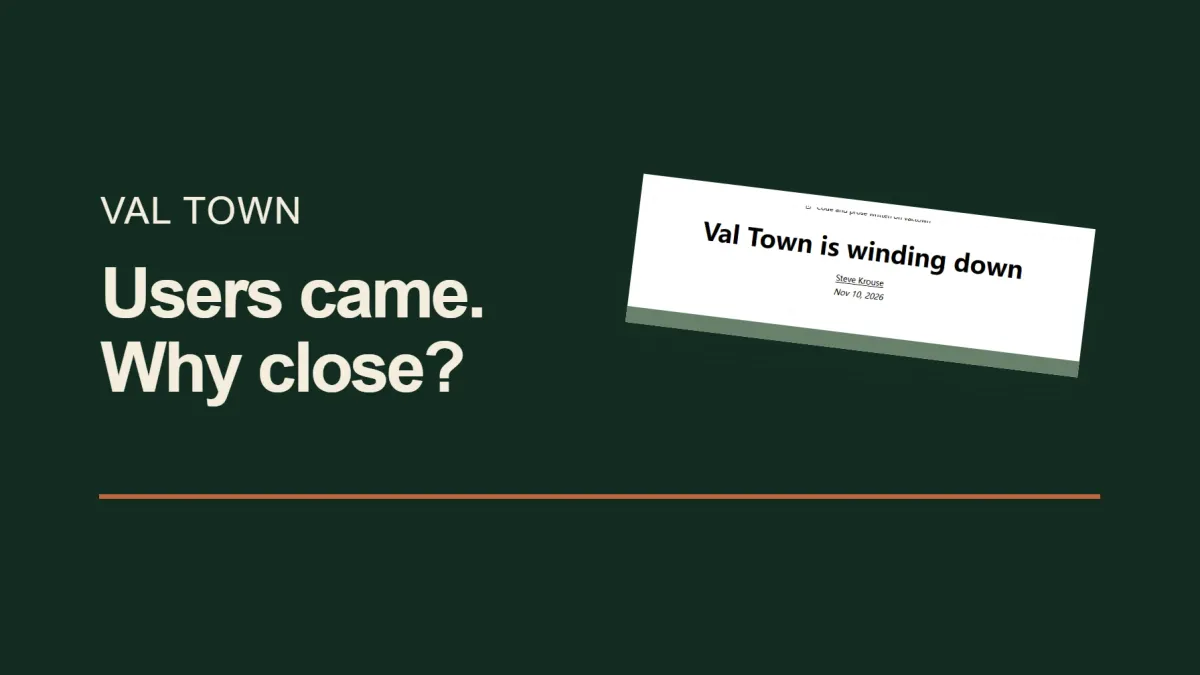
On November 10, 2026, Val Town founder Steve Krouse announced that the platform, which lets users write, run and deploy small apps in a browser, would wind down. New registrations and subscription upgrades stopped that day, and billing was paused. The remaining services will end on January 10, 2027.
Val Town brought an AI coding assistant, app deployment, databases, scheduled tasks and email into one platform, aiming to make useful small tools easy for one person to build. People were using it, developers liked it, and AI assistants were even sending it new customers. Yet that progress did not keep the company in business. The shutdown announcement said Val Town had failed to establish itself in the competitive cloud computing market.
For independent developers, the point to examine is that Val Town had already helped people build small apps with AI, but was still looking for customers willing to pay over the long term. Our view is that identifying work users need to do repeatedly, then expanding the product around it, is a better starting point for a solo builder than a platform that can do everything. The team also narrowed its focus to internal tools for sales work.
What Val Town made easier before the shutdown
Val Town aimed to remove the hassle of getting a small tool up and running. A usable app often needs more than code: it must store data, run on a schedule and send out results. Val Town combined those capabilities so users could write and run programs in a browser, reducing the work of configuring several cloud services for a single small tool.
Townie was the AI coding assistant in that environment. Townie v5, released in January this year, could already work alongside the editor: writing files, reading runtime logs, querying databases and configuring scheduled tasks. At the time, the platform claimed code changes could go live in about 100 milliseconds. After writing code, the AI could inspect the results and revise it, without a person continually carrying error messages back to a chat window.
Its May update also put the MCP entry point for connecting external AI assistants on the homepage. MCP can be understood as a set of interfaces that connects AI assistants to external tools: users no longer had to rely solely on Townie and could let their usual assistant access the platform's capabilities. That gave Val Town a chance to become the app runtime behind different AI tools.
That convenience also raised questions about its positioning. In the Hacker News discussion, user Zambyte asked what distinguished Val Town if AI assistants could already operate conventional cloud platforms through a command line or MCP. When assistants can help with configuration too, an integrated platform needs to explain more specifically what work it still saves users.
Another user, simonw, lamented the loss of its many good ideas while noting how difficult it is to build a sustainable business around a hosted service that requires users to adopt a particular way of working.
Subscriber numbers can rise while revenue falls
In its June business update, Val Town reported that Pro subscriptions had grown 16% during the month while ARR had fallen 1%. ARR, or annual recurring revenue, expresses current subscription revenue as an annual figure to measure the size of a subscription business. The figures moving in opposite directions meant that new individual users had not offset revenue lost elsewhere.
That month, Val Town lost five Business customers. Three of those companies had shut down, one had a payment problem, and one had chosen to leave. Most departures reflected problems at the customers' own companies. While the platform was adding individual users, it was also losing entire business accounts.
Steve was focused on the price gap between plans. A new Pro subscription cost $25 a month, while existing customers kept their $10 monthly rate; Business cost $200 a month. Moving from individual use to the business plan meant a substantial jump in monthly fees. He considered the gap too large and planned to make upgrades more gradual.
In July, total ARR grew 6% from the previous month, missing the team's 20% ARR growth target for that month. Within that total, ARR from the Pro plan grew 26%, and most new Pro customers came from AI referrals. AI assistants had become a source of customers for the platform, and individual subscription revenue was recovering.
The team had also changed how it charged for AI. In his 2025 retrospective, co-founder Tom MacWright wrote that Townie had lost thousands of dollars in its most expensive months early on, before Pro and usage-based billing improved that part of the business. By May this year, both Pro and Business plans included a Townie usage allowance. Inference beyond that allowance was billed at the upstream provider's cost, with no markup.
Tom also noted that Townie had driven growth for a time, but some users became increasingly frustrated when they spent a long time talking to AI and running up model costs without being able to build the app they wanted. In his view, users were willing to pay for results, rather than the process of chatting.
The team began building tools around sales work
By July, Val Town was focusing on GTM engineering. GTM means bringing a product to market; engineering here meant building internal software for work such as finding customers and following up on sales. After a new user signed up, for example, a tool could organize their information, identify people worth contacting and send an alert to Slack.
To do this, the team built its own customer relationship management system, or CRM, along with small tools such as a Slackbot. These addressed sales leads, internal alerts and follow-ups, rather than the abstract task of building an app. With tools built around that work, salespeople could receive leads in Slack and continue contacting customers.
In August, team member Charlie Molthrop put this direction into practice in an internal experiment. A colleague requested a feature in Slack. Charlie wanted to ask Townie to build it directly, but found that the bot was not yet connected to Slack. Starting from an existing template, he connected a Slack bot to Val Town's MCP so requests in the chat could enter the platform's development environment.
The clever part was that the bot ran on Val Town alongside the other tools, so it could read and modify its own code. The team then had it fix an interface issue and merge a duplicate sales lead. Steve set up hourly summaries to see what had changed. Requesting changes, modifying tools and checking the results became a connected internal workflow.
Independent developers can start with one paid task
One developer in the shutdown discussion described a similar experience. Hacker News user plesiv said Val Town had inspired them to build Gitlip, but they had stopped about a year earlier because finding paying customers was difficult.
A more useful starting point for an independent developer is to find a specific job someone needs to do repeatedly and is willing to pay for, then build tools around it. The sales lead processing Val Town later explored was closer to a verifiable need than making small apps easy for everyone to build. Who handles the leads, how often they do it and which workflow the results feed into are all concrete questions.
Serve that first customer's job well before deciding how large a platform to build. Especially when building a product alone, spend time following up with real users and finding out whether they will still need it next month, then add features based on how they use it.
Existing users need to plan their migration
For users who already have tools on Val Town, the most urgent issue is timing. The official plan is to release the source code only after the service shuts down, so migration preparations cannot wait until then.
| Date | Plan |
|---|---|
| November 10, 2026 | New registrations and upgrades stop; billing pauses. Existing subscriptions continue free through the transition, with partial refunds for annual plans. |
| December 10, 2026 | Code becomes read-only. SQLite and Blob storage are excluded from this read-only restriction. |
| January 10, 2027 | Remaining services end. |
| February 1, 2027 | Planned source code release. |
The official migration options include Cloudflare, Vercel, Netlify and Render. Users need to plan around the capabilities their apps use. The runtime, storage and scheduled tasks the platform once brought together will again need to be set up individually.